
 12 Sep 2026
Admin ISO
51 Comment
12 Sep 2026
Admin ISO
51 Comment
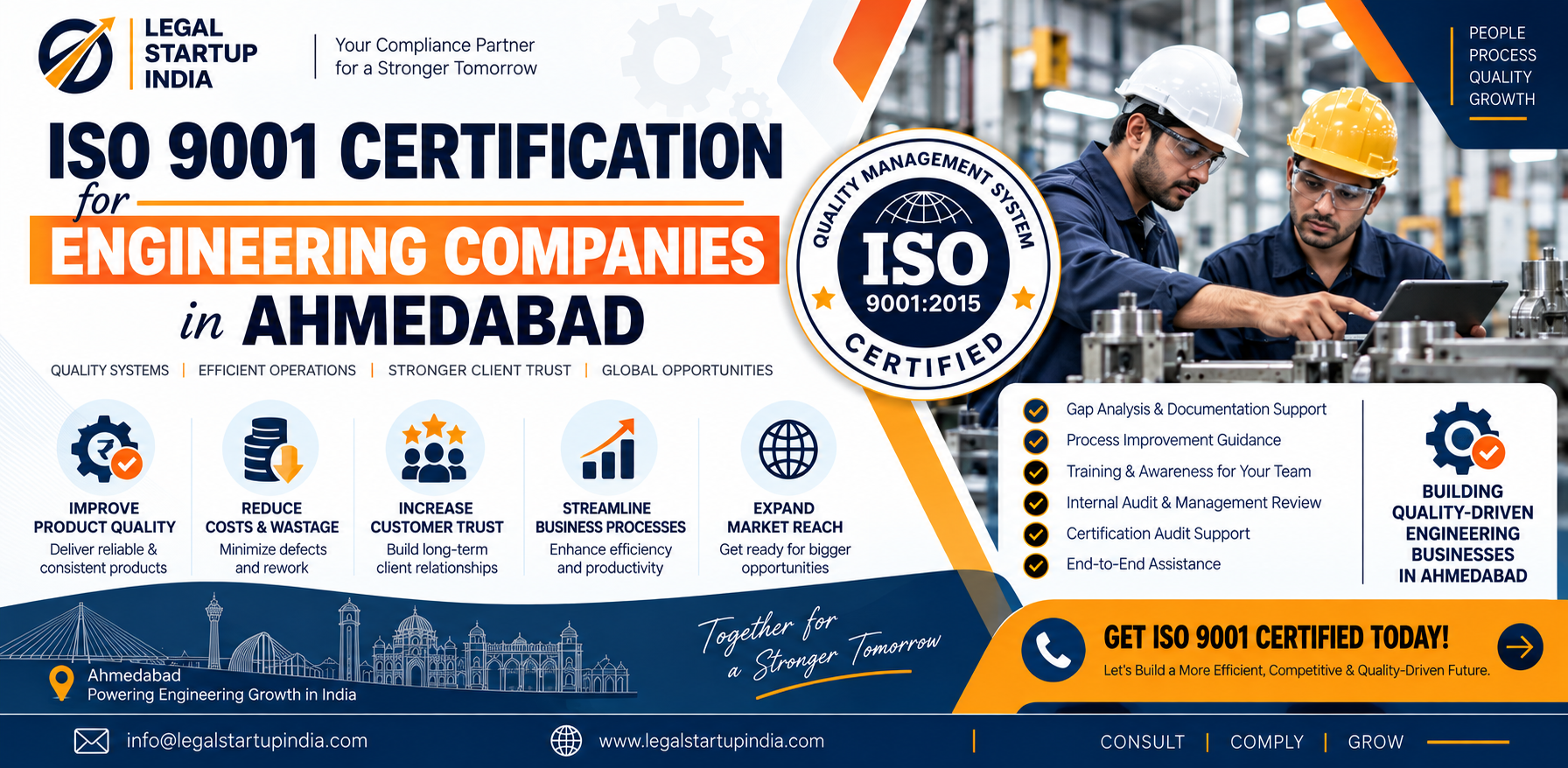
ISO 9001 Certification for Engineering Companies in Ahmedabad
Introduction
Ahmedabad is home to a large and diverse engineering sector, including machinery manufacturers, fabrication units, automotive component suppliers, electrical equipment manufacturers, industrial equipment companies, precision engineering businesses, and many engineering SMEs.
For these companies, quality is closely connected to every stage of the business—from design and procurement to production, inspection, delivery, and customer support.
This is why ISO 9001 Certification for Engineering Companies in Ahmedabad can be an important step toward building a more structured and reliable Quality Management System (QMS).
ISO 9001 is an internationally recognized standard that provides a framework for managing quality-related processes. It focuses on customer requirements, process control, risk-based thinking, performance evaluation, corrective action, and continual improvement.
For example, an engineering manufacturer may receive repeated customer complaints because of dimensional variations in components. Instead of treating every complaint as an isolated problem, an effective QMS helps the company investigate the process behind the issue—such as machine settings, measurement methods, operator competency, raw materials, or inspection controls.
The goal is not simply to obtain an ISO certificate. The real benefit comes from developing controlled, repeatable, measurable, and continually improving processes.
Why Choose Us for ISO 9001 Certification in Ahmedabad?
At Legal Startup India, we understand that every engineering company operates differently.
A precision machining company will have different processes from a heavy fabrication unit or an industrial machinery manufacturer. Therefore, ISO 9001 implementation should reflect the organization's actual products, processes, workforce, customers, suppliers, and operational risks.
Our support can include:
- Understanding your engineering business and processes
- Defining the Quality Management System scope
- Conducting a gap assessment
- QMS documentation support
- Developing practical procedures and process controls
- Implementation guidance
- Employee awareness and training support
- Internal audit preparation
- Management review support
- Corrective-action guidance
- Certification audit preparation
We aim to make ISO requirements easier for engineering business owners and their teams to understand and implement.
Rather than creating unnecessary paperwork, the focus should be on developing a management system that supports your actual engineering operations.
Key Benefits of ISO 9001 Certification for Engineering Companies
1. Improve Product and Component Quality
Engineering products often have precise specifications and customer-defined requirements.
ISO 9001 encourages organizations to establish appropriate controls throughout the production process, helping improve consistency and conformity with specified requirements.
2. Reduce Defects and Rework
Rework can increase production costs and affect delivery schedules.
A systematic QMS helps companies identify process problems, investigate nonconformities, take corrective action, and monitor whether improvements are effective.
This can help reduce:
- Manufacturing defects
- Component rejection
- Rework
- Material wastage
- Customer returns
- Production delays
3. Better Control of Engineering Processes
An engineering company's quality depends on multiple connected processes.
These may include:
- Customer enquiry and order review
- Engineering or design activities
- Procurement
- Incoming material inspection
- Production
- Welding and fabrication
- Machining
- Assembly
- Testing
- Final inspection
- Packaging and dispatch
ISO 9001 helps organizations understand and manage these processes systematically.
4. Stronger Supplier Management
Engineering manufacturers frequently depend on external suppliers for metals, components, electrical parts, consumables, machining services, coatings, and other materials or services.
A QMS provides a structured approach to supplier evaluation, selection, monitoring, and performance review.
5. Improved Customer Satisfaction
Engineering businesses often work with OEMs, infrastructure companies, contractors, distributors, exporters, and industrial buyers.
Consistent quality and reliable delivery can have a direct impact on customer relationships.
ISO 9001 provides a framework for understanding customer requirements, monitoring satisfaction, managing complaints, and improving processes.
6. Better Employee Responsibility
Clear processes help employees understand their responsibilities and the quality requirements associated with their work.
Training and competency controls can also help ensure that employees performing important activities have the appropriate knowledge and skills.
7. Stronger Business Credibility
ISO 9001 certification can demonstrate that an engineering organization has established a formal Quality Management System.
This can be useful during customer evaluations, vendor onboarding, B2B negotiations, and business expansion.
8. Continual Improvement
Engineering companies operate in competitive markets where processes, technologies, customer expectations, and production requirements continue to change.
ISO 9001 encourages organizations to use information such as audit findings, customer feedback, process performance, and nonconformities to identify opportunities for improvement.
Step-by-Step ISO 9001 Certification Process
The ISO 9001 certification process for engineering companies in Ahmedabad generally follows a structured approach.
Step 1: Understand the Organization
The first step is to understand the company's products, services, locations, processes, customers, suppliers, and organizational structure.
This helps determine the appropriate scope of the Quality Management System.
Step 2: Conduct a Gap Assessment
Existing systems and processes are reviewed against the applicable ISO 9001 requirements.
The assessment can identify gaps in areas such as:
- Process controls
- Quality objectives
- Supplier management
- Inspection and testing
- Employee competency
- Documented information
- Customer feedback
- Internal audits
- Corrective actions
Step 3: Prepare QMS Documentation
Relevant documentation is developed based on the organization's actual activities.
Depending on the engineering business, this may include:
- Quality policy
- Quality objectives
- QMS scope
- Process documentation
- Work instructions
- Inspection procedures
- Supplier evaluation processes
- Equipment-related controls
- Nonconformity management
- Corrective-action procedures
- Internal audit process
- Management review process
The documentation should be practical and proportionate to the organization's size and complexity.
Step 4: Implement the QMS
Once the system is prepared, it is implemented across relevant departments.
Employees should understand the processes applicable to their roles and maintain the required records.
For an engineering company, implementation may involve production, quality, purchase, stores, engineering, maintenance, sales, and management teams.
Step 5: Conduct an Internal Audit
An internal audit is performed to determine whether the QMS is properly implemented and working effectively.
It provides an opportunity to identify weaknesses before the certification audit.
Step 6: Correct Nonconformities
If problems are identified during the internal audit, appropriate corrective action is taken.
The company should consider the underlying cause of significant problems rather than simply correcting the immediate issue.
Step 7: Management Review
Top management reviews the performance and suitability of the QMS.
This may include consideration of:
- Customer feedback
- Quality objectives
- Audit results
- Process performance
- Nonconformities
- Corrective actions
- Risks and opportunities
- Improvement opportunities
Step 8: Certification Audit
A competent certification body conducts the certification assessment against the applicable ISO 9001 requirements.
When the organization's QMS successfully meets the certification body's requirements, certification can be issued according to its certification process.
Documents Required for ISO 9001 Certification
The exact documentation depends on the engineering company's size, activities, products, processes, risks, and QMS scope.
Common documents and records may include:
- Quality Management System scope
- Quality policy
- Quality objectives
- Process information
- Organizational responsibilities
- Customer requirement records
- Production records
- Inspection and testing records
- Supplier evaluation records
- Purchase-related records
- Equipment maintenance records
- Calibration records, where applicable
- Employee training and competency records
- Customer complaint records
- Nonconformity records
- Corrective-action records
- Internal audit records
- Management review records
- Monitoring and measurement records
Not every engineering company needs identical documentation. A good QMS should be designed around the organization's real operating environment.
Who Can Benefit from ISO 9001 Certification?
ISO 9001 can be relevant to a wide range of engineering businesses in Ahmedabad, including:
- Precision engineering companies
- Machinery manufacturers
- Industrial equipment manufacturers
- Automobile component manufacturers
- Fabrication companies
- CNC machining companies
- Electrical equipment manufacturers
- Mechanical engineering companies
- Heavy engineering businesses
- Industrial component manufacturers
- Engineering exporters
- Small and medium-sized engineering enterprises
The certification scope should accurately represent the activities covered by the organization's Quality Management System.
Frequently Asked Questions
1. What is ISO 9001 Certification for Engineering Companies in Ahmedabad?
ISO 9001 Certification for Engineering Companies in Ahmedabad confirms that an engineering organization's Quality Management System meets the applicable requirements of ISO 9001. It provides a framework for process control, customer focus, performance evaluation, corrective action, and continual improvement.
2. What are the benefits of ISO 9001 certification for engineering companies?
ISO 9001 can help engineering companies improve product consistency, reduce defects and rework, strengthen supplier controls, improve customer satisfaction, establish measurable quality objectives, and create a systematic approach to continual improvement.
3. What documents are required for ISO 9001 certification for engineering companies?
Requirements vary according to the organization's activities and QMS scope. Common documents and records may include quality objectives, process information, production and inspection records, supplier evaluations, calibration records where applicable, training records, customer complaints, corrective actions, internal audits, and management reviews.
4. Is ISO 9001 useful for small engineering companies in Ahmedabad?
Yes. Small and medium-sized engineering businesses can use ISO 9001 to establish clearer processes, responsibilities, quality controls, supplier management, customer feedback systems, and improvement practices. The QMS should be appropriate to the organization's size and operational complexity.
5. How can an engineering company get ISO 9001 certification in Ahmedabad?
An engineering company can begin by defining its QMS scope, reviewing existing processes, conducting a gap assessment, developing and implementing the Quality Management System, conducting internal audits and management review, addressing identified issues, and completing an assessment by a competent certification body.
Conclusion
For engineering companies, quality is built into the process—not simply checked after manufacturing is complete.
ISO 9001 Certification for Engineering Companies in Ahmedabad provides a structured framework for managing customer requirements, production processes, suppliers, inspections, employee competency, nonconformities, and continual improvement.
For an engineering business dealing with demanding industrial customers, OEMs, exporters, or large procurement teams, a well-implemented QMS can strengthen process discipline and demonstrate a commitment to consistent quality.
If your engineering company is planning ISO 9001 certification, Legal Startup India can help you understand the requirements, prepare the necessary QMS framework, implement relevant processes, and get ready for the certification assessment.
Start Your ISO 9001 Certification Journey
📧 Email: info@legalstartupindia.com
🌐 Website: www.legalstartupindia.com
Improve your engineering processes, strengthen quality controls, and build greater customer confidence. Contact Legal Startup India today to discuss your ISO 9001 certification requirements.
 ISO 9001 Certification for Automobile Industry in Sanand
  ISO 9001 Certification for Chemical Industry in Ahmedabad
  ISO 9001 Certification for Engineering Companies in Ahmedabad
  ISO 9001 Certification for Pharmaceutical Companies in Ahmedabad
  ISO 9001 Certification for Textile Industry in Ahmedabad
  ISO 9001 Certification for Manufacturing Industry in Ahmedabad
  ISO Certification for Pharmaceutical Companies in Ahmedabad
  ISO Certification for Textile Industries in Surat
  ISO Certification for Engineering Companies in Rajkot
  ISO Certification in Gandhinagar