
 06 Sep 2026
Admin ISO
51 Comment
06 Sep 2026
Admin ISO
51 Comment
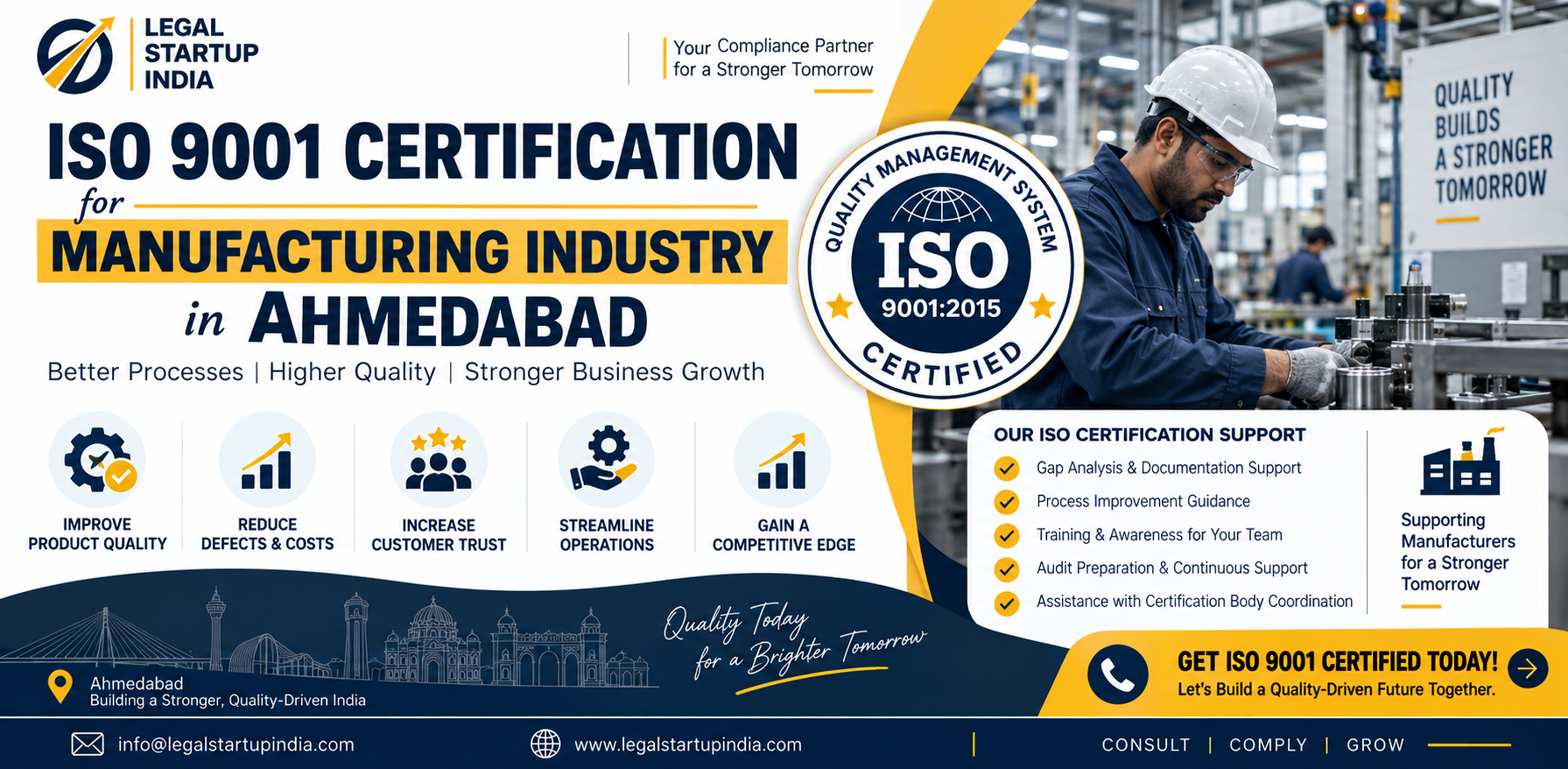
ISO 9001 Certification for Manufacturing Industry in Ahmedabad
Introduction
Ahmedabad is one of India's important manufacturing and industrial centres, with businesses operating across engineering, textiles, chemicals, pharmaceuticals, machinery, plastics, automotive components, food processing, and other sectors. As competition increases, manufacturers need more than good products—they need consistent quality, reliable processes, and customer confidence.
This is where ISO 9001 Certification for Manufacturing Industry in Ahmedabad becomes valuable.
ISO 9001 is an internationally recognized standard for a Quality Management System (QMS). It helps a manufacturing company establish structured processes for production, quality control, purchasing, documentation, customer requirements, corrective actions, and continual improvement.
For example, an Ahmedabad-based engineering component manufacturer may face recurring issues such as inconsistent raw materials, production errors, delayed inspections, or customer complaints. ISO 9001 helps the organization identify where these problems originate and establish a systematic method to control and improve them.
Certification is not simply about obtaining a certificate. Done properly, it helps create a quality-focused system that supports day-to-day business operations.
Why Choose Us for ISO 9001 Certification in Ahmedabad?
Choosing the right certification support provider can make the process much easier for a manufacturing business.
At Legal Startup India, our approach is focused on making ISO implementation practical and understandable for business owners and their teams.
Our approach includes:
- Understanding your manufacturing processes and business requirements
- Identifying applicable ISO 9001 requirements
- Supporting Quality Management System documentation
- Helping define appropriate procedures and records
- Assisting with implementation
- Preparing the organization for the certification audit
- Supporting corrective action where required
- Providing guidance throughout the certification process
We understand that a manufacturing company cannot stop its production activities simply to prepare for certification. Therefore, the process should be aligned with your existing operations as much as possible.
Important: ISO certification should be obtained through a competent and appropriately accredited certification body. The exact certification process, audit arrangements, and applicable requirements may vary depending on the organization and certification body.
Key Benefits of ISO 9001 Certification for Manufacturing Companies
1. Better Product Quality
ISO 9001 encourages manufacturers to establish controlled and repeatable processes. This can help reduce variation and improve consistency in products and services.
2. Reduction in Defects and Rework
A structured quality management system helps identify problems at different stages of production. Early identification can reduce unnecessary rejection, rework, scrap, and associated costs.
3. Improved Customer Satisfaction
Manufacturers supplying OEMs, distributors, exporters, or large corporate buyers often need to demonstrate reliable quality management. ISO 9001 certification can strengthen customer confidence.
4. Stronger Process Control
From procurement and incoming inspection to manufacturing, testing, final inspection, and dispatch, ISO 9001 encourages businesses to clearly define and control important processes.
5. Better Supplier Management
Manufacturing quality depends heavily on suppliers. A QMS can help organizations establish criteria for supplier selection, evaluation, monitoring, and performance review.
6. Improved Employee Accountability
Clearly defined responsibilities and procedures help employees understand who does what, when it needs to be done, and what records need to be maintained.
7. Support for Business Growth
A structured management system can make it easier for a growing manufacturing company to maintain consistent operations as production volumes, employees, customers, and suppliers increase.
8. Competitive Business Advantage
When buyers compare manufacturers, evidence of a systematic quality approach can help differentiate a company from competitors, particularly in B2B and industrial markets.
Step-by-Step ISO 9001 Certification Process
The ISO 9001 certification process for manufacturing companies in Ahmedabad generally involves several stages.
Step 1: Understand Your Requirements
First, the organization's activities, products, processes, locations, and customer requirements are reviewed.
This helps determine the appropriate scope of the Quality Management System.
Step 2: Gap Assessment
Existing manufacturing and quality processes are reviewed against ISO 9001 requirements.
The objective is to identify areas that need improvement before the certification audit.
Step 3: QMS Documentation
Relevant documentation is prepared based on the organization's actual operations.
Depending on the business, this may cover areas such as:
- Quality objectives
- Production controls
- Inspection and testing
- Supplier evaluation
- Document control
- Non-conforming product control
- Corrective action
- Risk and opportunity management
- Internal audit
- Management review
The documentation should reflect what the company actually does rather than being created merely to satisfy paperwork requirements.
Step 4: Implementation
The QMS is put into practice across relevant departments.
Employees may need awareness or training so they understand their responsibilities and the required procedures and records.
Step 5: Internal Audit
An internal audit is conducted to check whether the system is working as intended.
This provides an opportunity to identify weaknesses before the external certification audit.
Step 6: Corrective Actions
If internal audits identify nonconformities or process gaps, corrective actions are taken.
The focus should be on addressing the underlying cause rather than simply fixing an individual incident.
Step 7: Management Review
Top management reviews the effectiveness of the QMS, including relevant performance information, customer feedback, audit findings, objectives, risks, opportunities, and improvement requirements.
Step 8: Certification Audit
The certification body conducts its audit to determine whether the organization's Quality Management System meets the applicable ISO 9001 requirements.
If the audit requirements are successfully met, certification can be issued according to the certification body's process.
Documents Required for ISO 9001 Certification
The exact documentation required depends on the organization's size, processes, products, risks, and QMS scope.
Common records and documents may include:
- Organization and process information
- Quality policy
- Quality objectives
- Scope of the Quality Management System
- Process-related procedures and work instructions
- Production and inspection records
- Supplier evaluation records
- Purchase-related records
- Calibration records, where applicable
- Customer complaint records
- Non-conformity records
- Corrective action records
- Training and competency records
- Internal audit records
- Management review records
- Relevant monitoring and measurement records
A manufacturing company should avoid creating unnecessary documentation. The goal is to maintain useful, controlled information that supports effective operations and demonstrates conformity.
Who Can Benefit from ISO 9001 Certification in Ahmedabad?
ISO 9001 can be relevant to a wide range of manufacturing organizations, including:
- Engineering manufacturers
- Textile manufacturers
- Pharmaceutical manufacturers
- Automobile component manufacturers
- Chemical manufacturers
- Machinery manufacturers
- Plastic and rubber manufacturers
- Electrical and electronic manufacturers
- Food processing companies
- Packaging manufacturers
- Metal fabrication businesses
- Industrial equipment manufacturers
Whether the organization is an established factory or a growing SME, the value of ISO 9001 depends on how effectively the QMS is implemented and maintained.
Frequently Asked Questions
1. What is ISO 9001 Certification for Manufacturing Industry in Ahmedabad?
ISO 9001 certification confirms that a manufacturing organization has established a Quality Management System that meets the applicable requirements of ISO 9001. It focuses on consistent processes, customer requirements, quality control, risk-based thinking, and continual improvement.
2. Is ISO 9001 useful for small manufacturing companies in Ahmedabad?
Yes. ISO 9001 can be useful for SMEs because it helps establish structured processes for quality control, purchasing, production, customer feedback, documentation, and continual improvement.
3. What documents are required for ISO 9001 certification?
Documentation varies according to the organization. Common examples include quality objectives, process information, production and inspection records, supplier records, training records, internal audit records, corrective action records, and management review records.
4. How does ISO 9001 help manufacturing companies?
ISO 9001 can help manufacturers improve process consistency, reduce defects and rework, strengthen supplier controls, improve customer satisfaction, establish measurable quality objectives, and create a framework for continual improvement.
5. How can I start ISO 9001 Certification in Ahmedabad?
You can begin by reviewing your organization's processes, determining the QMS scope, conducting a gap assessment, developing or improving the required system, implementing it, and preparing for the certification audit. Professional guidance can help make the process more structured and efficient.
Conclusion
For manufacturing businesses, quality is not limited to final product inspection. It starts with well-controlled processes, capable employees, reliable suppliers, clear responsibilities, effective monitoring, and continuous improvement.
ISO 9001 Certification for Manufacturing Industry in Ahmedabad provides a structured framework for bringing these elements together. Whether you manufacture engineering components, machinery, textiles, pharmaceuticals, packaging products, or other industrial goods, a properly implemented QMS can strengthen operational control and customer confidence.
If you are planning ISO 9001 certification for your manufacturing company, Legal Startup India can help you understand the requirements and prepare your organization for the certification journey.
Get started today.
📧 Email: info@legalstartupindia.com
🌐 Website: www.legalstartupindia.com
For best results, choose a competent certification body and ensure that the certification scope accurately represents your manufacturing activities.
 ISO 9001 Certification for Automobile Industry in Sanand
  ISO 9001 Certification for Chemical Industry in Ahmedabad
  ISO 9001 Certification for Engineering Companies in Ahmedabad
 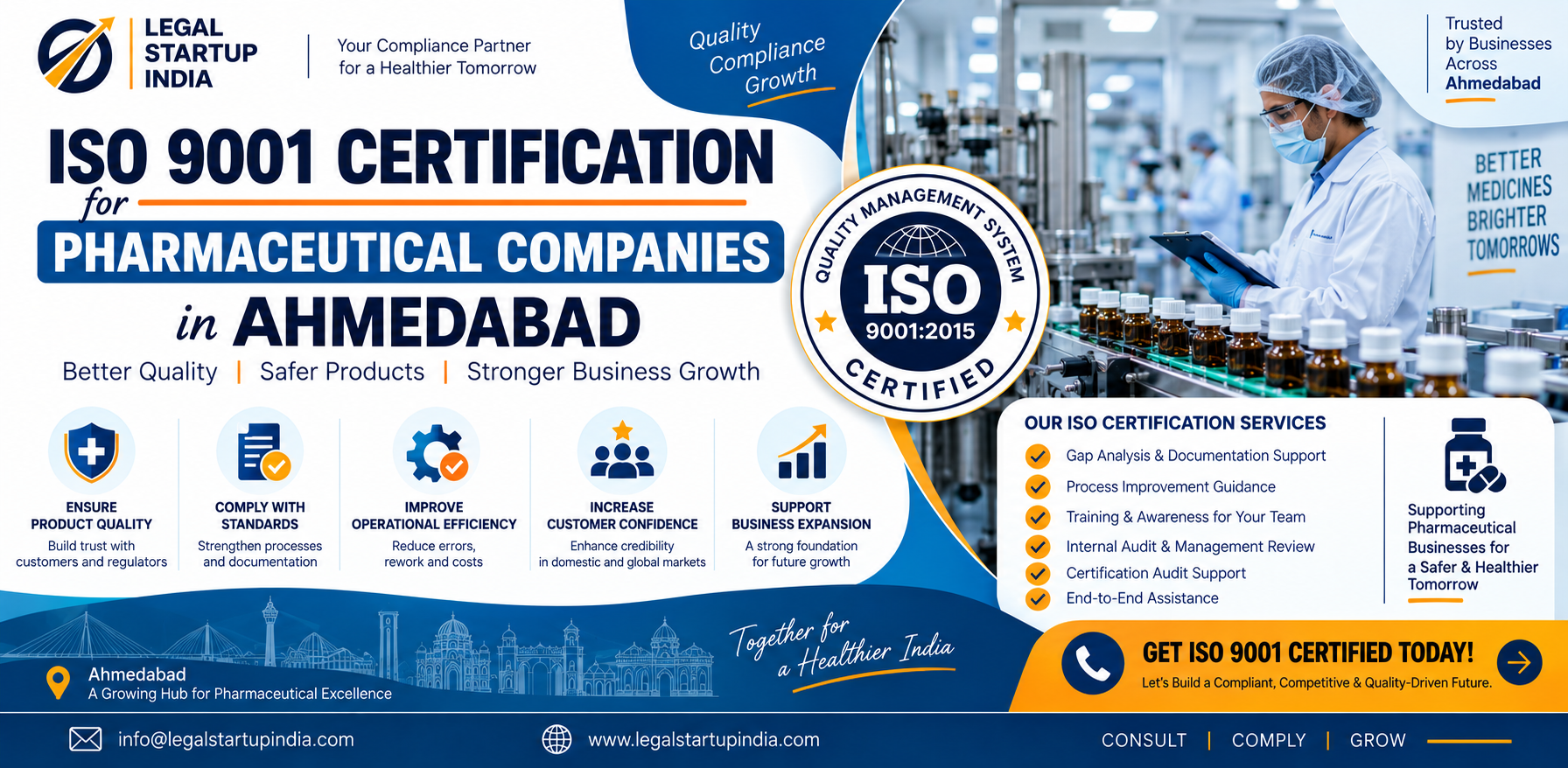 ISO 9001 Certification for Pharmaceutical Companies in Ahmedabad
 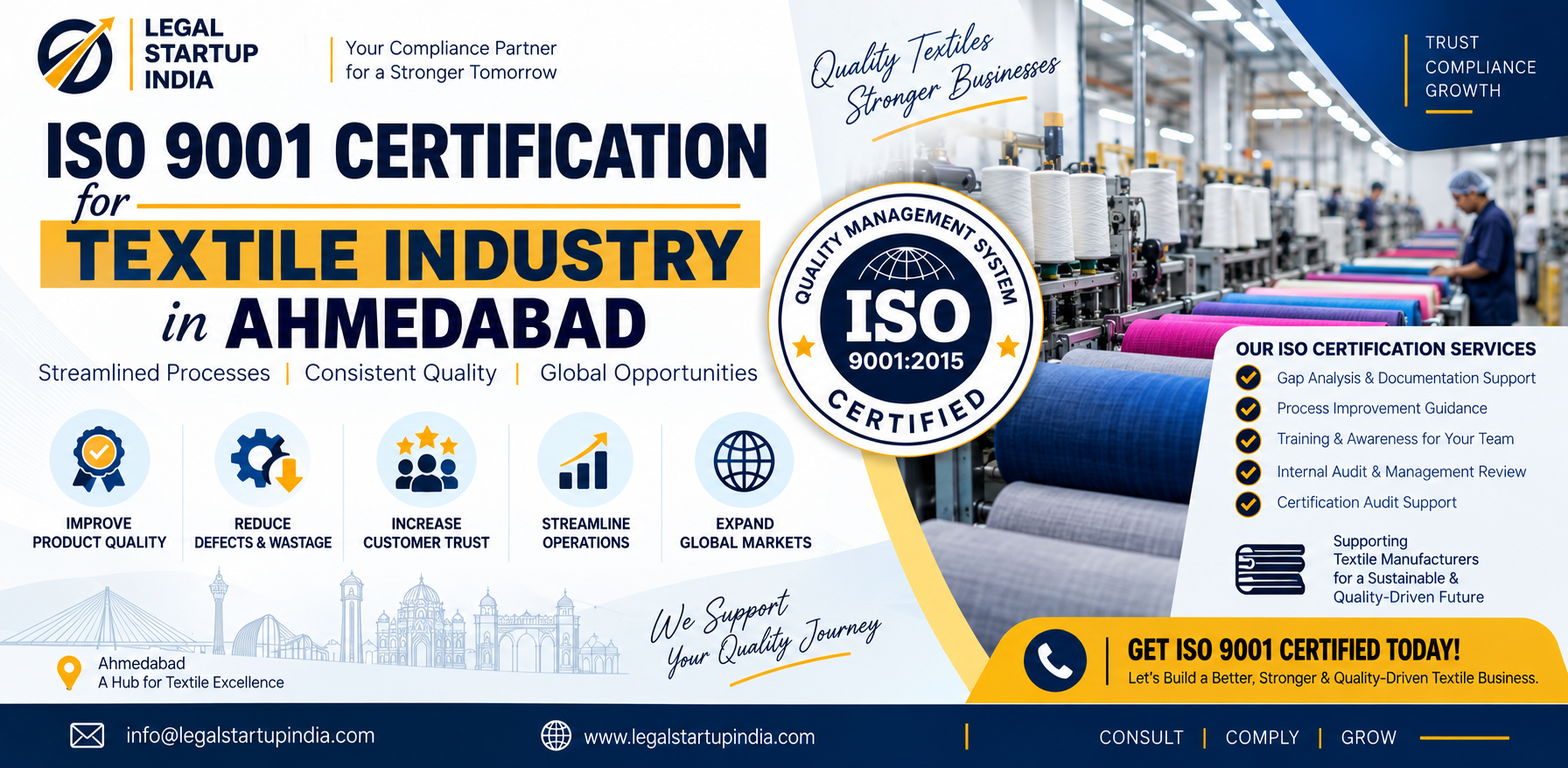 ISO 9001 Certification for Textile Industry in Ahmedabad
 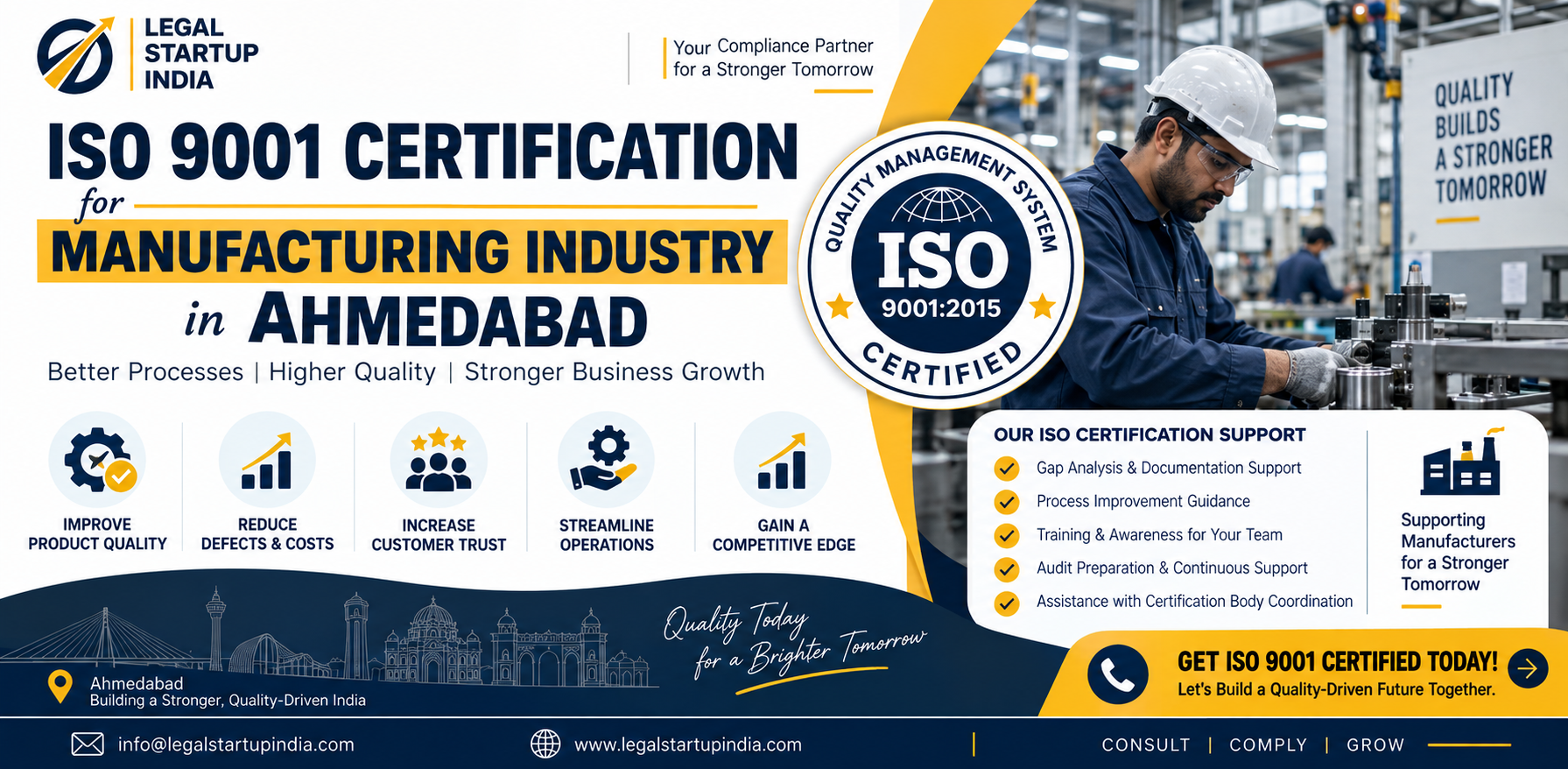 ISO 9001 Certification for Manufacturing Industry in Ahmedabad
 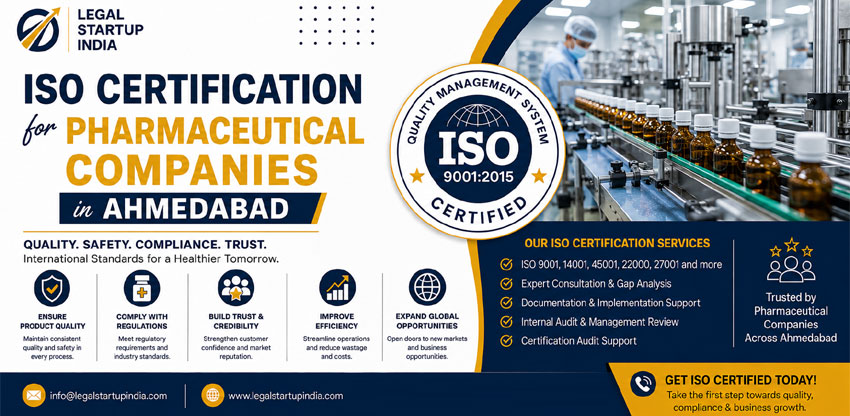 ISO Certification for Pharmaceutical Companies in Ahmedabad
  ISO Certification for Textile Industries in Surat
  ISO Certification for Engineering Companies in Rajkot
  ISO Certification in Gandhinagar