
 08 Sep 2026
Admin ISO
51 Comment
08 Sep 2026
Admin ISO
51 Comment
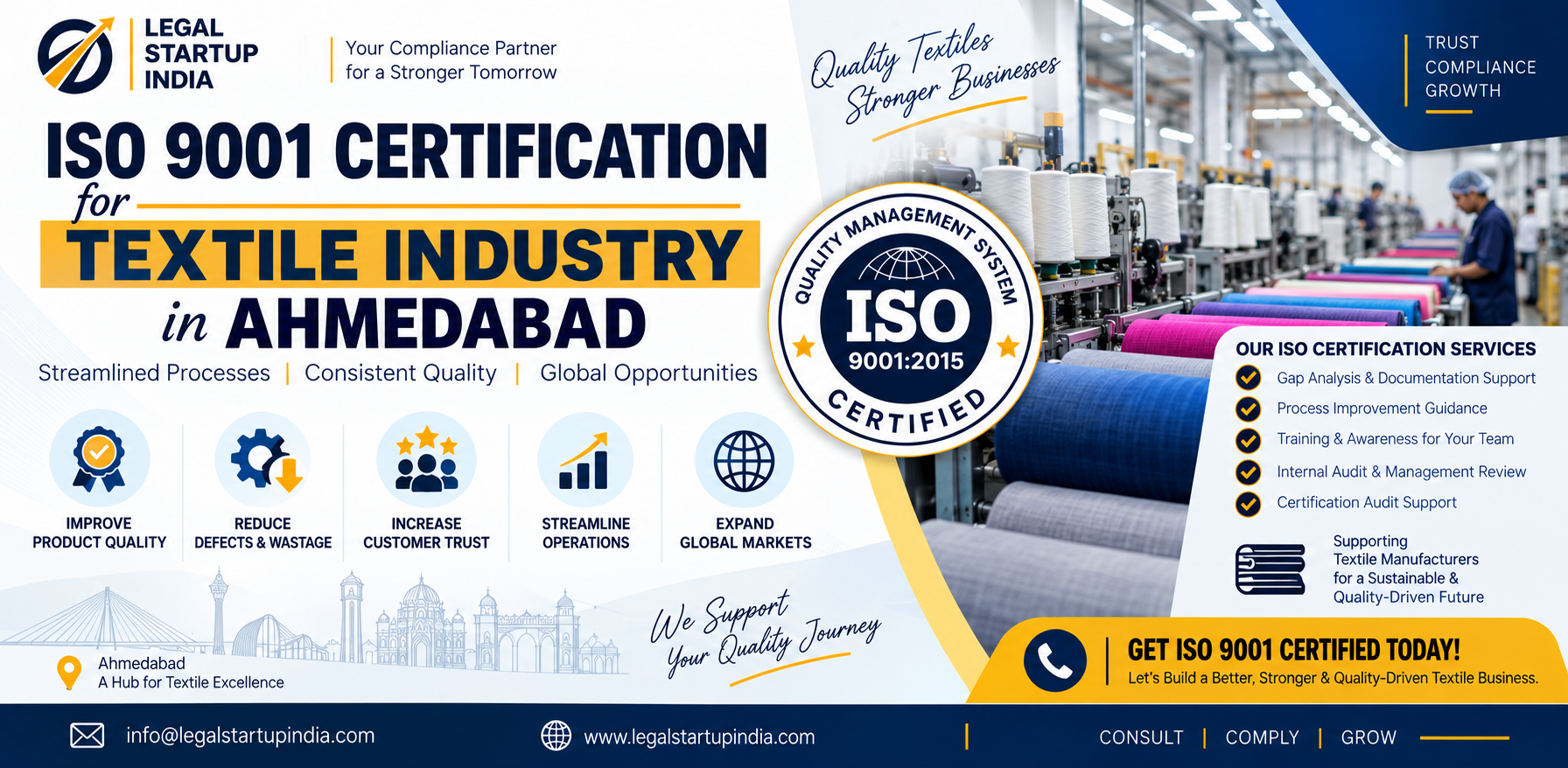
ISO 9001 Certification for Textile Industry in Ahmedabad
Introduction
Ahmedabad has a long-standing textile manufacturing ecosystem, with businesses involved in spinning, weaving, dyeing, printing, processing, garment production, and textile trading. For these businesses, maintaining consistent quality across raw materials, production batches, finishing, and delivery is essential.
This is where ISO 9001 Certification for Textile Industry in Ahmedabad can make a practical difference.
ISO 9001 is an internationally recognized Quality Management System (QMS) standard. It provides a structured approach for managing processes, understanding customer requirements, controlling quality, addressing problems, and continually improving business operations.
Consider a textile processing unit that receives regular complaints about shade variation between batches. Simply inspecting finished fabric may not solve the problem. A properly implemented QMS encourages the business to examine the complete process—from raw-material specifications and machine settings to production controls, inspection methods, employee competency, and corrective action.
That process-focused approach is one of the key reasons textile manufacturers choose ISO 9001 certification.
Certification is not merely about displaying an ISO certificate. The real value comes from building a management system that supports consistent textile quality, controlled production, customer satisfaction, and continual improvement.
Why Choose Us for ISO 9001 Certification in Ahmedabad?
At Legal Startup India, we understand that textile businesses need certification support that fits their actual operations.
A spinning mill, dyeing unit, textile processor, and garment manufacturer will not have identical processes. Therefore, ISO 9001 implementation should be based on the organization's products, processes, risks, workforce, customers, and operational structure.
Our support can include:
- Understanding your textile manufacturing activities
- Defining the appropriate QMS scope
- Identifying gaps in existing processes
- Supporting QMS documentation
- Developing practical procedures and records
- Implementation guidance
- Employee awareness and training support
- Internal audit preparation
- Management review guidance
- Corrective-action support
- Certification audit preparation
Our objective is to make the certification journey easier to understand and implement without creating unnecessary paperwork.
For businesses in Ahmedabad, this practical approach can be particularly useful when the organization is already managing production deadlines, customer orders, supplier coordination, and quality inspections.
Key Benefits of ISO 9001 Certification for Textile Industry
1. Consistent Textile Product Quality
Textile customers expect consistency in areas such as fabric construction, dimensions, colour, finish, strength, and other product specifications.
ISO 9001 helps establish controlled processes so that quality requirements are understood and monitored throughout production.
2. Reduced Defects, Rejection and Rework
Quality problems can become expensive when they are discovered only after production is completed.
A systematic QMS encourages manufacturers to identify potential problems earlier, monitor processes, and take corrective action when deviations occur.
This can help reduce unnecessary:
- Fabric rejection
- Reprocessing
- Customer returns
- Production delays
- Material wastage
- Rework costs
3. Better Control of Suppliers
Textile quality often begins with incoming materials such as yarn, dyes, chemicals, fibres, packaging materials, and accessories.
ISO 9001 encourages businesses to establish appropriate criteria for supplier selection, evaluation, monitoring, and performance.
4. Improved Customer Satisfaction
Whether a textile company supplies domestic customers, exporters, retailers, garment manufacturers, or large corporate buyers, meeting agreed specifications consistently is critical.
A well-maintained QMS provides a systematic way to monitor customer feedback and address complaints.
5. Improved Production Processes
ISO 9001 encourages organizations to identify, monitor, and improve their important processes.
For a textile company, this may involve:
- Raw-material inspection
- Production planning
- Spinning
- Weaving
- Dyeing
- Printing
- Finishing
- Testing
- Final inspection
- Packing and dispatch
The exact processes depend on the organization's activities.
6. Stronger Business Credibility
ISO 9001 certification can demonstrate that a company has established a formal quality management framework.
This can be valuable when approaching new B2B customers, participating in vendor evaluations, or expanding into new markets.
7. A Culture of Continual Improvement
The standard encourages organizations to use information from audits, customer feedback, process performance, nonconformities, and other relevant data to identify opportunities for improvement.
Step-by-Step ISO 9001 Certification Process for Textile Companies
The certification journey generally follows a structured sequence.
Step 1: Understand the Organization
The first step is to understand the textile company's products, operations, locations, employees, customers, suppliers, and quality requirements.
This information helps establish the appropriate scope of the QMS.
Step 2: Conduct a Gap Assessment
Existing systems are compared with applicable ISO 9001 requirements.
The assessment can identify areas requiring attention, such as document control, quality objectives, supplier management, inspection procedures, training, customer complaints, or internal audits.
Step 3: Develop QMS Documentation
Documentation is prepared according to the company's actual processes.
Depending on the textile business, this may include information relating to:
- Quality policy and objectives
- Production processes
- Inspection and testing
- Supplier evaluation
- Customer requirements
- Non-conforming outputs
- Corrective actions
- Risk and opportunity management
- Documented information
- Internal audits
- Management reviews
Documentation should be useful rather than unnecessarily complicated.
Step 4: Implement the System
The documented processes are introduced into daily operations.
Employees need to understand their roles and follow the agreed procedures and controls.
Step 5: Conduct an Internal Audit
An internal audit checks whether the QMS has been properly implemented and whether processes are working effectively.
It also gives the organization an opportunity to identify and correct weaknesses before the external certification audit.
Step 6: Take Corrective Action
If problems or nonconformities are identified, appropriate corrective actions are taken.
The objective is not just to correct the immediate issue but, where appropriate, understand and address its underlying cause.
Step 7: Management Review
Top management reviews the QMS and relevant performance information.
This helps leadership evaluate whether the system remains suitable, effective, and aligned with business objectives.
Step 8: Certification Audit
A competent certification body evaluates the organization's QMS against the applicable ISO 9001 requirements.
If the requirements are successfully met and the certification body's process is completed, the organization can receive ISO 9001 certification.
Documents Required for ISO 9001 Certification
There is no single identical document list for every textile company. Documentation depends on the organization's size, operations, products, risks, and QMS scope.
Common documents and records may include:
- QMS scope
- Quality policy
- Quality objectives
- Process information
- Production records
- Inspection and testing records
- Supplier evaluation records
- Purchase-related information
- Equipment maintenance records
- Calibration records, where applicable
- Employee competency and training records
- Customer complaint records
- Non-conformity records
- Corrective-action records
- Internal audit records
- Management review records
- Relevant monitoring and measurement records
The important point is that documents and records should support the company's real processes and provide evidence that the QMS is being effectively implemented.
Who Should Consider ISO 9001 Certification?
ISO 9001 can be relevant to many textile businesses in Ahmedabad, including:
- Textile manufacturing units
- Spinning mills
- Weaving units
- Dyeing and processing companies
- Textile printing businesses
- Garment manufacturers
- Fabric manufacturers
- Home-textile manufacturers
- Textile exporters
- Textile product suppliers
The certification scope should accurately reflect the activities covered by the organization's Quality Management System.
Frequently Asked Questions
1. What is ISO 9001 Certification for Textile Industry in Ahmedabad?
ISO 9001 Certification for Textile Industry in Ahmedabad is certification of a textile organization's Quality Management System against the applicable requirements of ISO 9001. It focuses on consistent processes, customer requirements, quality control, performance evaluation, and continual improvement.
2. What are the benefits of ISO 9001 certification for textile companies?
ISO 9001 can help textile companies improve process consistency, reduce defects and rework, strengthen supplier controls, improve customer satisfaction, establish measurable quality objectives, and create a systematic framework for continual improvement.
3. What documents are required for ISO 9001 certification in a textile company?
Requirements vary according to the organization's QMS scope and operations. Common records include production and inspection information, supplier evaluation, training, equipment-related records, customer complaints, corrective actions, internal audits, and management reviews.
4. Is ISO 9001 certification useful for small textile businesses in Ahmedabad?
Yes. Small and medium-sized textile businesses can use ISO 9001 to establish clearer processes, responsibilities, quality controls, supplier management, customer-feedback mechanisms, and improvement practices.
5. How can a textile company get ISO 9001 certification in Ahmedabad?
The company can start by defining its QMS scope, assessing existing processes, identifying gaps, implementing the required quality management system, conducting internal audits and management review, and then undergoing certification assessment by a competent certification body.
Conclusion
For textile manufacturers, quality has to be managed throughout the production chain—not checked only at the end.
ISO 9001 Certification for Textile Industry in Ahmedabad provides a structured framework for controlling processes, improving consistency, responding to customer requirements, reducing quality-related problems, and supporting continual improvement.
Whether you operate a spinning unit, weaving facility, dyeing and processing plant, garment factory, or another textile manufacturing business, a properly implemented QMS can help bring greater discipline and visibility to your operations.
If you are planning ISO 9001 certification for your textile business, Legal Startup India can help you understand the requirements, prepare your QMS, and get your organization ready for the certification journey.
Get Started with ISO 9001 Certification
📧 Email: info@legalstartupindia.com
🌐 Website: www.legalstartupindia.com
Build better processes. Deliver consistent quality. Strengthen customer confidence. Start your ISO 9001 journey today.
 ISO 9001 Certification for Automobile Industry in Sanand
  ISO 9001 Certification for Chemical Industry in Ahmedabad
  ISO 9001 Certification for Engineering Companies in Ahmedabad
  ISO 9001 Certification for Pharmaceutical Companies in Ahmedabad
 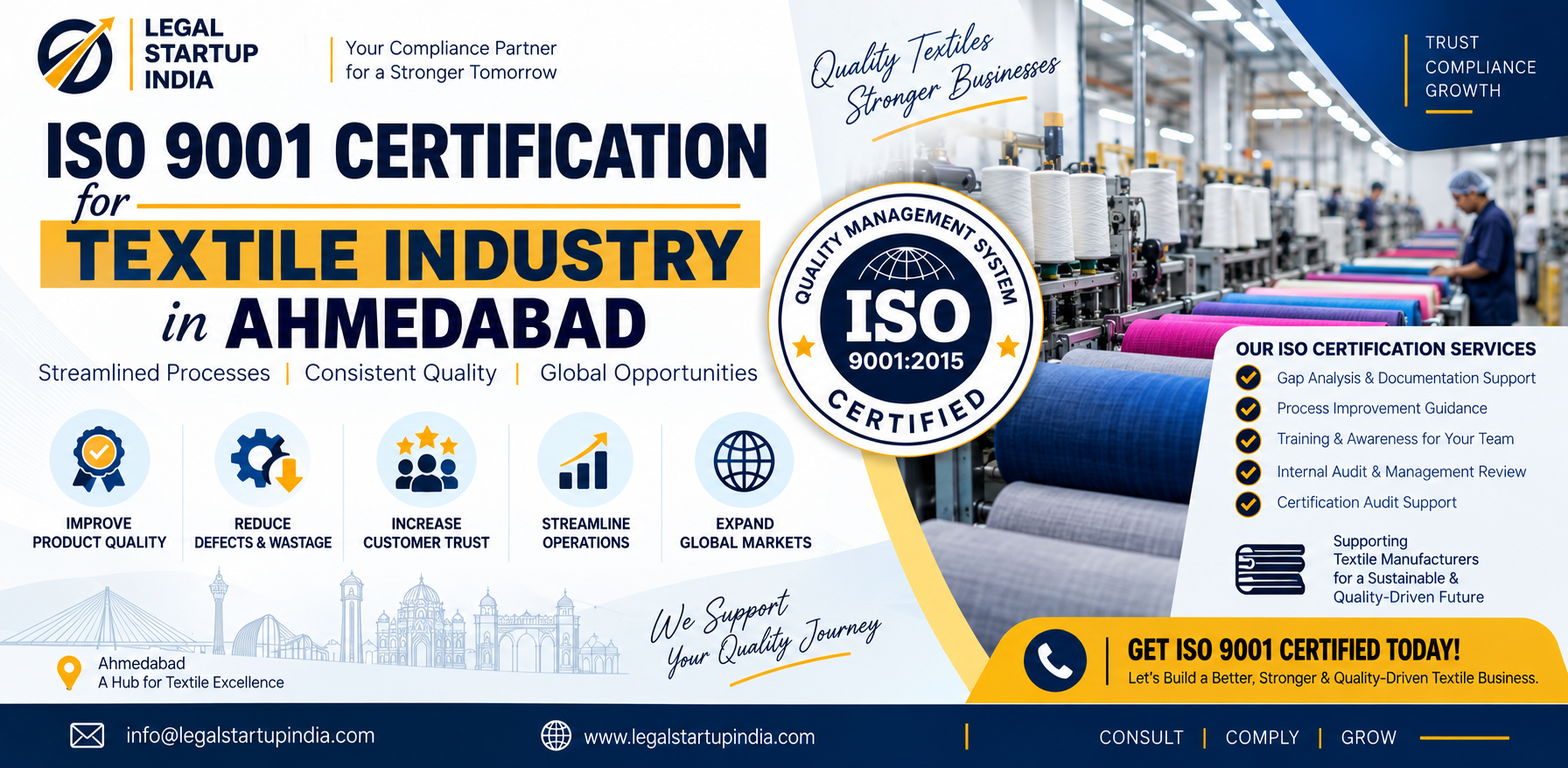 ISO 9001 Certification for Textile Industry in Ahmedabad
  ISO 9001 Certification for Manufacturing Industry in Ahmedabad
  ISO Certification for Pharmaceutical Companies in Ahmedabad
  ISO Certification for Textile Industries in Surat
  ISO Certification for Engineering Companies in Rajkot
  ISO Certification in Gandhinagar