
 31 Aug 2026
Admin ISO
51 Comment
31 Aug 2026
Admin ISO
51 Comment
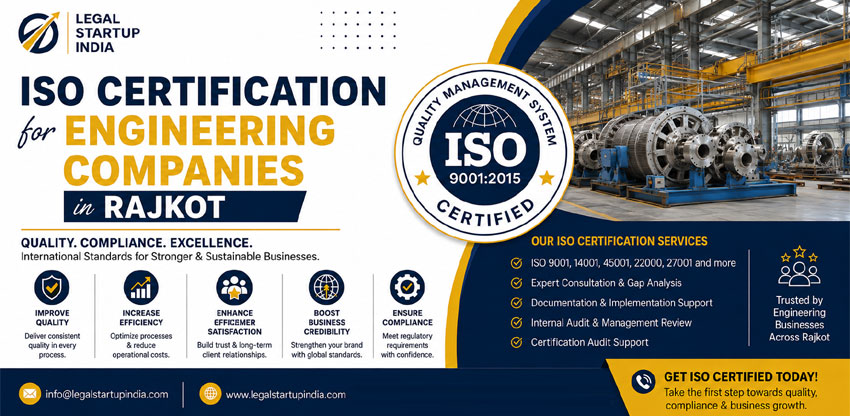
ISO Certification for Engineering Companies in Rajkot
Introduction
Rajkot is well known for its engineering, manufacturing and industrial businesses. From precision components and machine parts to automotive products, casting, fabrication and industrial equipment, engineering companies in the region serve customers across India and international markets.
In such a competitive environment, maintaining consistent quality is not optional. Customers want reliable products, controlled processes, timely delivery and clear quality standards.
This is where ISO Certification for Engineering Companies in Rajkot can provide meaningful business value.
For many engineering organizations, ISO 9001 Certification is a practical starting point because it provides a structured framework for quality management. Depending on the company's activities, other standards such as ISO 14001 for environmental management or ISO 45001 for occupational health and safety may also be relevant.
ISO certification should not be viewed simply as a certificate for tenders or marketing. When properly implemented, it can help an engineering company establish repeatable processes, identify risks, control nonconformities, monitor suppliers and improve customer satisfaction.
Legal Startup India helps engineering companies understand the appropriate ISO standard, prepare their management system, organize documentation and get ready for the certification audit.
Why Do Engineering Companies in Rajkot Need ISO Certification?
Engineering businesses often deal with complex processes involving raw materials, machining, fabrication, inspection, subcontracting, equipment maintenance and customer-specific specifications.
A small process failure can result in rejected components, rework, production delays or customer complaints.
For example, consider a Rajkot-based precision component manufacturer supplying parts to an automotive company. If incoming material inspection, machine calibration, production checks and final inspection are not consistently controlled, even a minor deviation can affect an entire customer order.
An effective quality management system creates a structured way to control these activities.
ISO 9001 focuses on establishing a quality management system that helps organizations consistently provide products and services that meet customer and applicable requirements.
Why Choose Legal Startup India?
Getting ISO certification is easier when the process is explained clearly and aligned with your actual business operations.
Legal Startup India provides practical assistance to engineering organizations rather than treating certification as a document-only exercise.
Our Support Includes
- Understanding your engineering and manufacturing activities
- Identifying the appropriate ISO standard
- Defining the certification scope
- Reviewing existing processes
- Supporting management-system documentation
- Guiding implementation
- Preparing employees for relevant procedures
- Supporting internal audit preparation
- Assisting with management review requirements
- Preparing the organization for certification audits
- Guiding corrective-action activities where required
An engineering company producing CNC components, for example, may require controls around customer specifications, raw material purchasing, production planning, inspection equipment, process monitoring and final product release.
The management system should reflect these real activities.
Key Benefits of ISO Certification for Engineering Companies in Rajkot
1. Consistent Product Quality
Engineering customers expect products to meet agreed specifications repeatedly.
A structured quality management system can help establish consistent inspection, production and verification processes.
2. Better Production Control
Documented processes and clearly assigned responsibilities can help employees understand what needs to be done at different stages of production.
3. Reduced Rework and Rejection
When organizations identify the causes of defects and take corrective action, they can reduce recurring quality problems.
4. Stronger Supplier Management
Engineering companies frequently depend on raw-material suppliers, subcontractors and external service providers.
A structured supplier evaluation and monitoring process can help businesses make more informed purchasing decisions.
5. Improved Customer Confidence
ISO certification can demonstrate that an independent certification body has assessed the organization's applicable management system.
This can strengthen credibility when approaching corporate customers, exporters, OEMs and institutional buyers.
6. Better Tender and Vendor Opportunities
Some tenders, contracts or customer qualification processes may specify ISO certification.
Having the required certification can help an engineering company meet applicable eligibility requirements, subject to the individual tender or customer's conditions.
7. Improved Risk Management
Engineering operations involve risks related to quality, machinery, materials, suppliers, delivery schedules and customer specifications.
A structured management system encourages businesses to identify and manage relevant risks.
8. Continuous Improvement
ISO management systems encourage organizations to monitor performance, identify problems, implement corrective actions and continually improve processes.
Which ISO Certification Is Suitable for Engineering Companies?
The appropriate standard depends on the company's business objectives and operational risks.
ISO 9001 – Quality Management
ISO 9001 Certification is often highly relevant for engineering and manufacturing companies because it focuses on quality management and consistent delivery of products and services.
It can cover areas such as:
- Customer requirements
- Production planning
- Purchasing
- Supplier control
- Inspection
- Nonconforming output
- Corrective action
- Customer satisfaction
- Process monitoring
ISO 14001 – Environmental Management
Engineering and manufacturing operations may generate waste, consume energy and use various materials or chemicals.
ISO 14001 provides a framework for managing relevant environmental aspects and improving environmental performance.
ISO 45001 – Occupational Health and Safety
Engineering facilities may involve machinery, welding, fabrication, material handling and other workplace hazards.
ISO 45001 can provide a structured occupational health and safety management framework.
ISO/IEC 27001 – Information Security
Engineering companies handling sensitive drawings, technical specifications, customer data or digital intellectual property may also consider ISO/IEC 27001.
The appropriate certification should be selected based on actual business requirements rather than simply choosing the largest number of certificates.
Step-by-Step ISO Certification Process
Step 1: Understand the Business Scope
The first stage is identifying the company's activities, products, services, locations and processes that will fall under the certification scope.
Step 2: Select the ISO Standard
The relevant ISO standard is selected based on business objectives and customer or industry requirements.
For many engineering manufacturers, ISO 9001 is an appropriate starting point.
Step 3: Gap Assessment
Existing processes are reviewed against the requirements of the selected standard.
This helps identify areas that need documentation, controls or improvement.
Step 4: Documentation
Relevant policies, procedures, process controls, forms and records are prepared.
For an engineering company, documentation may cover purchasing, production, inspection, equipment, supplier management, customer requirements and nonconforming products.
Step 5: Implementation
The documented system is implemented within the actual organization.
Employees need to understand their responsibilities and follow applicable processes.
Step 6: Internal Audit
An internal audit evaluates whether the management system has been properly implemented and identifies nonconformities or areas for improvement.
Step 7: Management Review
Top management reviews the performance of the management system and considers audit findings, objectives, customer feedback, risks and improvement opportunities.
Step 8: Certification Audit
An independent certification body conducts the external assessment.
The audit examines whether the management system conforms to the applicable ISO standard.
Step 9: Corrective Action and Certification
Where audit findings are raised, appropriate corrective action is taken. Once applicable certification requirements have been satisfied, certification can be granted by the certification body.
Documents Required for ISO Certification
The exact documents depend on the selected ISO standard, certification scope and organization.
Engineering companies may commonly need information and records such as:
- Company registration information
- Organization structure
- Business activity and certification scope
- Quality policy
- Quality objectives
- Process procedures
- Customer specifications
- Purchase and supplier records
- Raw material inspection records
- Production records
- Inspection and testing records
- Equipment maintenance records
- Calibration records, where applicable
- Employee training records
- Customer complaint records
- Nonconformity records
- Corrective-action records
- Internal audit reports
- Management review records
- Relevant statutory and regulatory information
The purpose of documentation is to support controlled processes. A business should avoid creating unnecessary paperwork that employees cannot practically maintain.
ISO Certification Cost for Engineering Companies in Rajkot
There is no universal ISO certification cost for engineering companies in Rajkot.
The final cost may depend on:
- ISO standard selected
- Number of employees
- Number of locations
- Certification scope
- Complexity of manufacturing processes
- Existing management system
- Audit duration
- Certification body
- Consultancy and implementation requirements
A customized assessment is therefore more useful than relying on a fixed online price.
Engineering companies should also understand that consultancy and certification are separate activities. ISO standards are developed by ISO, while certification is carried out by independent certification bodies.
Who Can Benefit from ISO Certification?
ISO certification can be relevant for many engineering businesses in Rajkot, including:
- CNC machining companies
- Auto component manufacturers
- Foundries
- Casting manufacturers
- Fabrication companies
- Machine manufacturers
- Industrial equipment manufacturers
- Precision engineering companies
- Pump and valve manufacturers
- Metal component manufacturers
- Engineering exporters
- Industrial suppliers
- MSME manufacturing units
The certification scope should accurately describe the organization's activities.
Frequently Asked Questions
1. Which ISO certification is best for engineering companies in Rajkot?
ISO 9001 is often a suitable certification for engineering and manufacturing companies because it provides a framework for quality management. Depending on business requirements, ISO 14001, ISO 45001 or ISO/IEC 27001 may also be relevant.
2. What are the benefits of ISO 9001 for engineering companies?
ISO 9001 can help engineering companies establish controlled processes for customer requirements, purchasing, production, inspection, nonconforming products, corrective action and continual improvement.
3. What documents are required for ISO certification for an engineering company?
Documents can include quality policies, objectives, production procedures, supplier records, inspection records, calibration and maintenance records, training records, internal audit reports, management review records and corrective-action records. Requirements vary according to the selected standard and scope.
4. How long does ISO certification take for an engineering company in Rajkot?
The timeline depends on company size, certification scope, selected standard, existing processes, documentation and implementation readiness. A company with mature systems may require less preparation than one developing a management system from the beginning.
5. Is ISO certification mandatory for engineering companies?
ISO certification is not automatically mandatory for every engineering company. However, specific customers, tenders, contracts or procurement requirements may require a particular certification. Companies should check the conditions applicable to each opportunity.
Conclusion
For engineering companies, quality is directly connected to reputation, customer retention and business growth. A structured management system can help control production processes, improve consistency, manage suppliers, reduce recurring problems and demonstrate a professional approach to customers.
ISO Certification for Engineering Companies in Rajkot can therefore be a strategic investment when the system is implemented around the company's real operations.
Whether you manufacture precision components, supply industrial equipment, operate a fabrication unit or run an engineering MSME, Legal Startup India can assist with understanding the applicable ISO standard and preparing for the certification process.
Start Your ISO Certification Journey
Want to strengthen your engineering company's quality management system?
Contact Legal Startup India today:
Email: info@legalstartupindia.com
Website: www.legalstartupindia.com
Get professional guidance for documentation, implementation and certification audit preparation tailored to your engineering business.
 ISO 9001 Certification for Automobile Industry in Sanand
  ISO 9001 Certification for Chemical Industry in Ahmedabad
  ISO 9001 Certification for Engineering Companies in Ahmedabad
  ISO 9001 Certification for Pharmaceutical Companies in Ahmedabad
  ISO 9001 Certification for Textile Industry in Ahmedabad
  ISO 9001 Certification for Manufacturing Industry in Ahmedabad
  ISO Certification for Pharmaceutical Companies in Ahmedabad
  ISO Certification for Textile Industries in Surat
 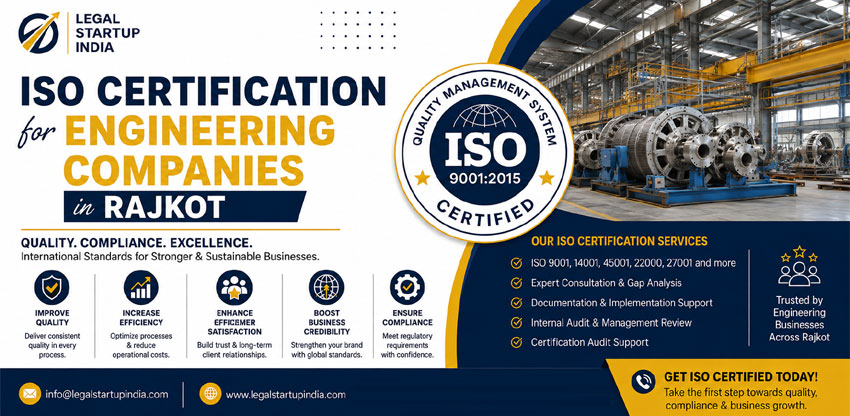 ISO Certification for Engineering Companies in Rajkot
  ISO Certification in Gandhinagar