
 02 Sep 2026
Admin ISO
51 Comment
02 Sep 2026
Admin ISO
51 Comment
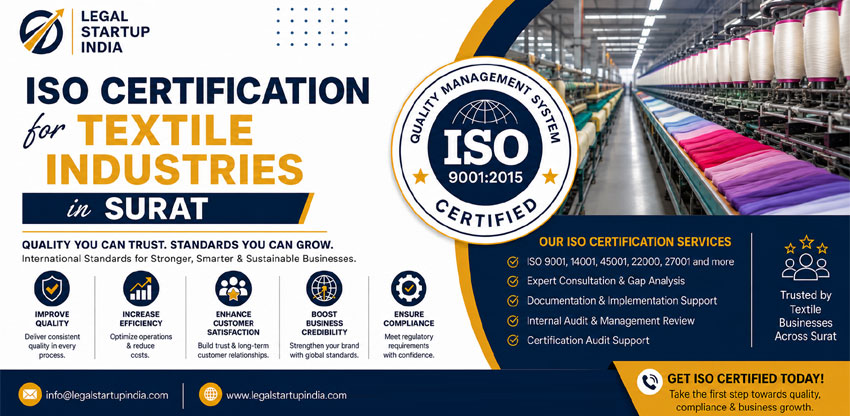
ISO Certification for Textile Industries in Surat
Introduction
Surat has built a strong reputation as one of India's major textile and diamond business centres. Its textile ecosystem includes manufacturers, processors, dyeing units, printing businesses, wholesalers, exporters and suppliers serving customers across India and international markets.
With such a large and competitive textile market, maintaining consistent quality is essential. Buyers expect fabric, yarn, garments and processed textile products to meet agreed specifications every time.
This is where ISO Certification for Textile Industries in Surat can provide practical value.
ISO certification gives an organization an independently assessed management system against the requirements of a specific ISO standard. For textile businesses, the most commonly relevant standard may be ISO 9001, depending on the organization's products, processes and customer requirements.
For example, a textile processing unit may need effective controls for raw materials, dyeing parameters, colour matching, inspection, customer specifications and finished-product quality. A textile exporter may place greater emphasis on consistent production, documentation, supplier control and customer requirements.
The objective should not be to obtain a certificate simply for display. A properly implemented ISO management system should improve the way the business operates.
Legal Startup India assists textile companies with ISO standard selection, documentation, implementation guidance, audit preparation and certification support.
Why Do Textile Industries in Surat Need ISO Certification?
Textile manufacturing involves multiple stages, and quality problems at one stage can affect the final product.
A fabric manufacturer may need to control yarn quality, weaving or knitting, dyeing, finishing, inspection and packing. A processing unit may need tighter controls over chemicals, process parameters, colour consistency and testing.
Imagine a Surat textile manufacturer receiving a large order from an overseas buyer. If fabric specifications, colour standards or inspection procedures are not consistently followed, the company could face rejection, rework, delayed shipment or customer complaints.
A structured management system helps establish clearer processes and responsibilities.
For organizations implementing ISO 9001, the focus is on consistently meeting customer and applicable requirements while improving the effectiveness of the quality management system.
Why Choose Legal Startup India?
ISO certification becomes easier when businesses receive practical guidance rather than generic documentation.
Legal Startup India works with organizations to understand their actual activities and prepare a certification approach suited to their business.
Our Support Includes
- Understanding your textile business and certification objectives
- Identifying the appropriate ISO standard
- Defining the certification scope
- Reviewing existing processes
- Supporting management-system documentation
- Guiding implementation
- Assisting with employee awareness
- Preparing for internal audit
- Supporting management review preparation
- Preparing the organization for certification audit
- Guiding corrective actions where required
For a textile dyeing unit, for example, documentation and controls may need to reflect dyeing processes, chemical handling, colour specifications, inspection and production records.
A garment manufacturer will have different process controls, while a textile exporter may need greater emphasis on customer specifications, supplier management and product conformity.
The management system should reflect these real differences.
Key Benefits of ISO Certification for Textile Industries in Surat
1. Consistent Textile Product Quality
Textile buyers expect consistency in colour, GSM, dimensions, strength, finishing and other agreed specifications.
A structured quality management system can help establish controlled processes for production and inspection.
2. Better Production Control
Defined procedures can help employees understand production requirements and responsibilities at different stages.
This is especially valuable where textile products pass through multiple departments before final dispatch.
3. Reduced Rejection and Rework
Quality problems can increase production costs.
By identifying nonconformities, investigating their causes and taking corrective action, businesses can work toward reducing recurring defects.
4. Improved Supplier Management
Textile companies often purchase yarn, dyes, chemicals, packaging materials and other inputs from different suppliers.
Supplier evaluation and monitoring can help businesses make more consistent purchasing decisions.
5. Increased Buyer Confidence
Independent certification can strengthen credibility with customers, corporate buyers, exporters and business partners.
It can be particularly useful when customers expect suppliers to maintain a recognized management system.
6. Support for Export Businesses
Textile exporters often work with buyers who have specific quality and documentation expectations.
An organized management system can help the company demonstrate a systematic approach to quality and process control.
ISO certification does not by itself guarantee export approval or acceptance by every buyer. Individual customer and destination-market requirements must still be met.
7. Better Internal Accountability
When responsibilities, procedures and records are clearly defined, employees can better understand their roles and management can monitor process performance.
8. Continuous Improvement
ISO management systems encourage organizations to monitor performance, evaluate problems and take corrective action.
This creates a foundation for ongoing improvement rather than treating quality as a one-time inspection activity.
Which ISO Certification Is Suitable for Textile Industries?
There is no single ISO standard for every textile company. The right choice depends on the organization's operations and objectives.
ISO 9001 – Quality Management System
ISO 9001 Certification is often highly relevant to textile manufacturers, processors and exporters.
It can help organizations establish systematic controls around:
- Customer requirements
- Production processes
- Supplier management
- Product inspection
- Nonconforming products
- Customer complaints
- Corrective action
- Process monitoring
- Quality objectives
ISO 14001 – Environmental Management
Textile processing, dyeing and printing operations can involve water consumption, wastewater, chemicals, energy use and waste generation.
ISO 14001 may be relevant for businesses seeking a structured environmental management system.
ISO 45001 – Occupational Health and Safety
Textile factories may involve machinery, chemicals, heat, electrical equipment and material handling.
ISO 45001 can help organizations establish a systematic occupational health and safety management approach.
ISO 50001 – Energy Management
Textile manufacturing and processing can consume significant amounts of energy.
Organizations looking for a structured approach to improving energy performance may consider ISO 50001.
The most suitable standard should be selected after considering the organization's activities, risks, customer expectations and business goals.
Step-by-Step ISO Certification Process for Textile Industries in Surat
Step 1: Understand the Business Scope
The first step is to identify the company's products, processes, locations and activities that will be covered by certification.
Step 2: Select the Appropriate ISO Standard
The selected standard should match the business objective.
For many textile manufacturers, ISO 9001 may be a logical starting point, while environmental, safety or energy standards may be added according to business needs.
Step 3: Conduct a Gap Assessment
Existing processes are reviewed against the requirements of the selected ISO standard.
This identifies gaps in documentation, controls, records and implementation.
Step 4: Prepare Documentation
Relevant policies, procedures, process controls, forms and records are prepared.
For a textile company, this may include controls for purchasing, production, inspection, customer requirements, suppliers, nonconformities and corrective actions.
Step 5: Implement the System
The documented processes are implemented in day-to-day operations.
Employees should understand the procedures relevant to their responsibilities.
Step 6: Internal Audit
An internal audit checks whether the management system has been implemented effectively and whether applicable requirements are being followed.
Step 7: Management Review
Top management reviews the system's performance, objectives, audit results, customer feedback, risks and improvement opportunities.
Step 8: Certification Audit
An independent certification body conducts the external audit.
The audit assesses the organization's management system against the applicable ISO requirements.
Step 9: Corrective Action and Certification
If audit findings are identified, the organization addresses them through appropriate corrective actions. Once certification requirements are met, the certification body can issue the applicable certificate.
Documents Required for ISO Certification
The exact documentation depends on the selected ISO standard, business activities and certification scope.
A textile organization may commonly need:
- Company registration details
- Organization structure
- Business activity information
- Certification scope
- Quality or relevant management policy
- Quality objectives
- Production procedures
- Customer specifications
- Supplier evaluation records
- Raw material purchase records
- Production records
- Inspection and testing records
- Equipment maintenance records
- Calibration records, where applicable
- Employee training records
- Customer complaint records
- Nonconformity records
- Corrective-action records
- Internal audit reports
- Management review records
- Applicable legal and regulatory information
The documentation should be practical and relevant. Creating excessive paperwork that employees do not actually use can reduce the effectiveness of the management system.
ISO Certification Cost for Textile Industries in Surat
The ISO certification cost for textile industries in Surat varies from one organization to another.
Factors that may affect the overall cost include:
- Selected ISO standard
- Number of employees
- Number of locations
- Certification scope
- Complexity of textile processes
- Existing management systems
- Audit duration
- Certification body
- Consultancy and implementation requirements
For this reason, businesses should request a requirement-based quotation rather than relying only on a fixed advertised price.
It is also important to understand that ISO consultancy and certification are separate activities. ISO develops the standards, while independent certification bodies conduct certification assessments and issue certificates when applicable requirements are met.
Who Can Benefit from ISO Certification?
ISO certification may be useful for various textile businesses in Surat, including:
- Textile manufacturing companies
- Textile mills
- Dyeing and processing units
- Textile printing companies
- Yarn manufacturers
- Fabric manufacturers
- Garment manufacturers
- Home textile manufacturers
- Textile exporters
- Textile wholesalers and suppliers
- Synthetic textile manufacturers
- Textile MSMEs
The certification scope should accurately represent the organization's actual business activities.
Frequently Asked Questions
1. Which ISO certification is best for textile industries in Surat?
ISO 9001 is often relevant for textile manufacturers, processors and exporters because it provides a framework for quality management. Depending on the organization's needs, ISO 14001, ISO 45001 or ISO 50001 may also be appropriate.
2. What are the benefits of ISO 9001 certification for textile companies?
ISO 9001 can help textile businesses improve process control, monitor quality, manage suppliers, address nonconformities, respond to customer requirements and establish a continual improvement system.
3. What documents are required for ISO certification for textile industries?
Common documents and records may include policies, objectives, production procedures, supplier records, inspection records, maintenance and calibration records, training records, internal audit reports, management review records and corrective-action records. Exact requirements vary by standard and certification scope.
4. How long does ISO certification take for a textile company in Surat?
The timeline depends on the selected standard, company size, certification scope, existing processes, documentation and implementation readiness. A business with established systems may require less preparation than a company building its management system from the beginning.
5. Is ISO certification mandatory for textile manufacturers?
ISO certification is not automatically mandatory for every textile manufacturer. However, particular customers, tenders, contracts or procurement requirements may specify certification. Businesses should verify the specific requirements applicable to their customers and markets.
Conclusion
For textile companies, consistent quality can directly affect customer relationships, production costs, delivery schedules and business reputation.
ISO Certification for Textile Industries in Surat can help organizations create a more structured approach to quality, supplier management, production control, customer requirements and continual improvement.
Whether you operate a textile mill, dyeing unit, printing facility, fabric manufacturing company, garment business or textile export organization, the right ISO management system can support your operational and commercial goals.
Legal Startup India can assist you with understanding the applicable ISO standard, preparing documentation, implementing the required system and getting ready for the certification audit.
Start Your ISO Certification Journey
If your textile business is planning ISO certification in Surat, contact Legal Startup India for professional guidance.
Email: info@legalstartupindia.com
Website: www.legalstartupindia.com
Discuss your business requirements with our team and take the next step toward a structured and credible management system.
 ISO 9001 Certification for Automobile Industry in Sanand
  ISO 9001 Certification for Chemical Industry in Ahmedabad
  ISO 9001 Certification for Engineering Companies in Ahmedabad
  ISO 9001 Certification for Pharmaceutical Companies in Ahmedabad
 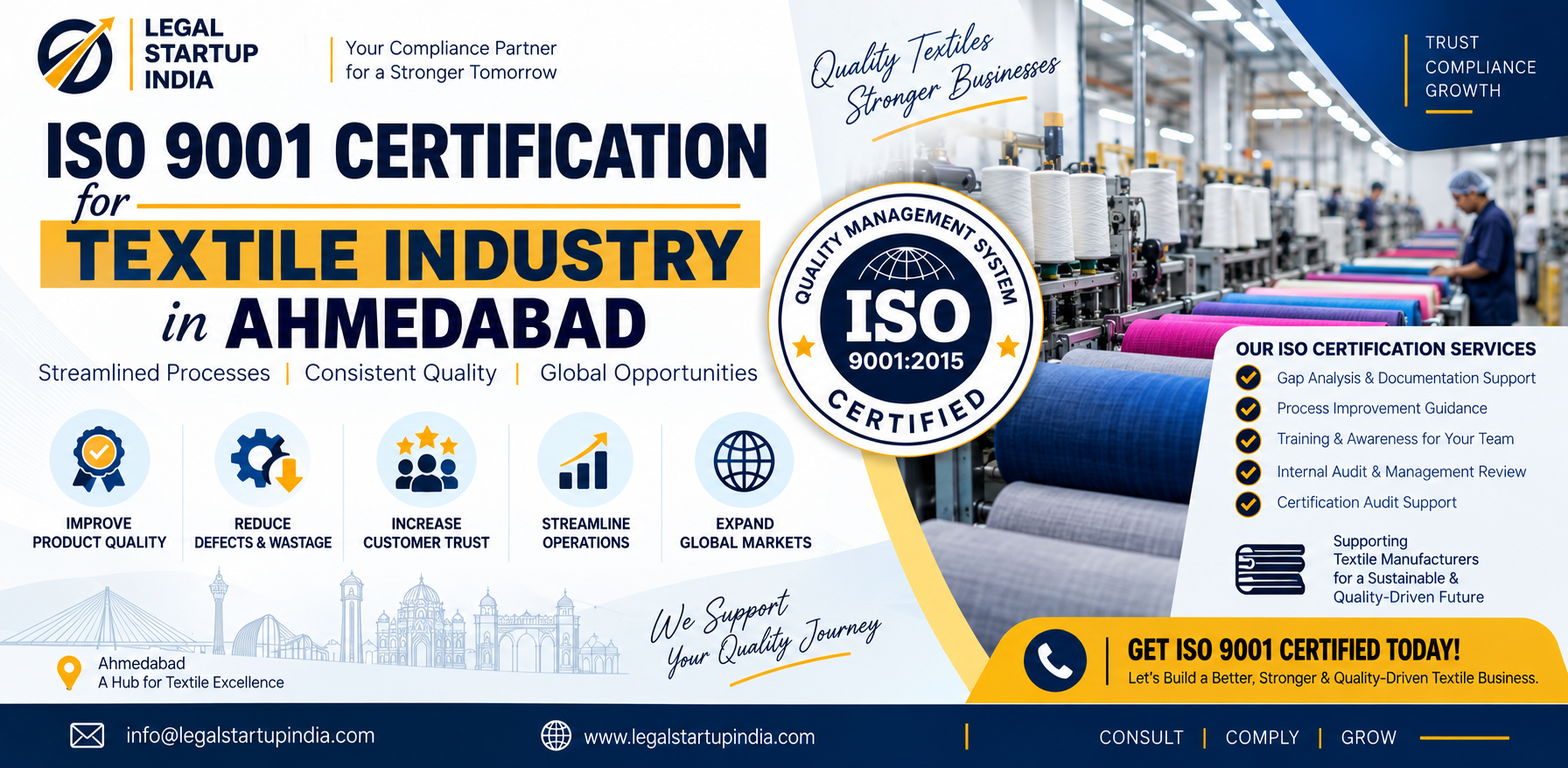 ISO 9001 Certification for Textile Industry in Ahmedabad
  ISO 9001 Certification for Manufacturing Industry in Ahmedabad
  ISO Certification for Pharmaceutical Companies in Ahmedabad
 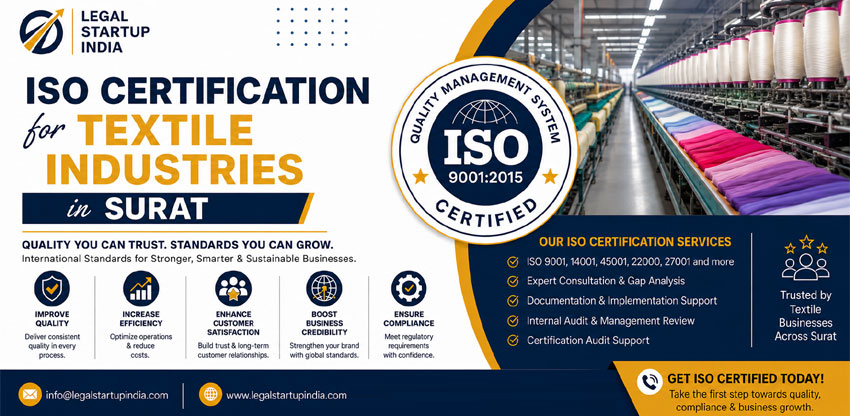 ISO Certification for Textile Industries in Surat
  ISO Certification for Engineering Companies in Rajkot
  ISO Certification in Gandhinagar