
 29 Aug 2026
Admin ISO
51 Comment
29 Aug 2026
Admin ISO
51 Comment
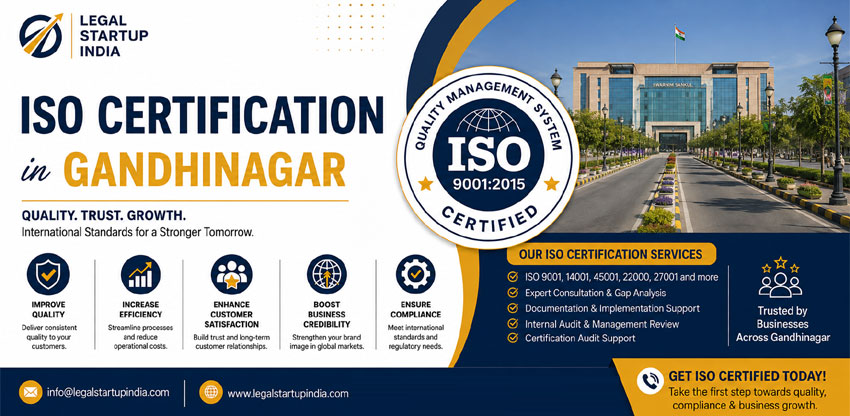
ISO Certification in Gandhinagar
Introduction
Businesses in Gandhinagar are operating in an increasingly competitive market. Whether you run a manufacturing unit, IT company, engineering firm, food business, consultancy, startup, or service organization, customers and business partners increasingly expect consistent quality, reliable processes, and professional systems.
This is where ISO Certification in Gandhinagar can make a practical difference.
ISO certification provides independent confirmation that an organization's management system meets the requirements of a particular ISO standard. The right certification can help a business organize its processes, manage risks, improve consistency, and demonstrate its commitment to quality and other business priorities.
For example, a manufacturing company may use ISO 9001 to strengthen quality controls and customer satisfaction. A food processing business may require ISO 22000 for food safety management, while an IT company handling sensitive information may consider ISO/IEC 27001.
The important point is that ISO certification should not be treated as just a certificate. A properly implemented management system should actually support the way your business operates.
Legal Startup India provides professional assistance for businesses seeking ISO certification in Gandhinagar, including standard selection, documentation, implementation guidance, audit preparation, and certification coordination.
What Is ISO Certification?
ISO certification is a third-party assessment of an organization's management system against the requirements of a specific ISO standard.
Different standards address different business requirements.
Common ISO Certifications
- ISO 9001: Quality Management System
- ISO 14001: Environmental Management System
- ISO 45001: Occupational Health and Safety Management System
- ISO 22000: Food Safety Management System
- ISO/IEC 27001: Information Security Management System
- ISO 50001: Energy Management System
- ISO 13485: Quality Management System for medical devices
- ISO 37001: Anti-bribery Management System
The appropriate standard depends on the organization's activities, objectives, customers, risks, and industry requirements.
ISO itself develops international standards but does not issue management-system certificates. Certification is performed by independent certification bodies.
Why Choose Legal Startup India for ISO Certification in Gandhinagar?
Choosing an ISO service provider should involve more than comparing prices. The provider should understand your business activities and help you establish a system that is practical for your organization.
At Legal Startup India, our approach focuses on simplifying the certification journey for business owners.
Our ISO Certification Support Includes
- Understanding your business activities and certification objectives
- Identifying the suitable ISO standard
- Explaining certification requirements clearly
- Preparing and organizing management-system documentation
- Providing implementation guidance
- Supporting employee awareness and process understanding
- Preparing the organization for internal audit requirements
- Assisting with management review preparation
- Supporting certification audit readiness
- Guiding the business on corrective actions, where applicable
For instance, an engineering manufacturer in Gandhinagar may need controls for production, inspection, supplier management, equipment, and customer requirements. An IT company may need a very different system covering information security, access control, risk management, and data protection.
A good ISO implementation reflects these differences rather than forcing every organization into the same documentation structure.
Key Benefits of ISO Certification in Gandhinagar
1. Better Business Processes
ISO management systems encourage businesses to define responsibilities, processes, controls, and performance measures. This can reduce confusion and make day-to-day operations more consistent.
2. Improved Quality
For businesses implementing ISO 9001, systematic quality controls can help identify problems, understand customer requirements, monitor performance, and improve processes.
3. Greater Customer Confidence
Independent certification can demonstrate that your organization has established a structured management system.
This can be especially useful when dealing with corporate buyers, institutional customers, suppliers, or business partners.
4. Better Risk Management
A structured management system helps organizations identify potential risks and opportunities and establish appropriate controls.
5. Support for Tenders and Business Opportunities
Certain customers, contracts, tenders, or procurement processes may specify particular certifications. Having an applicable ISO certification can help an eligible organization meet such requirements.
However, certification requirements vary by tender and industry, so businesses should check the specific eligibility conditions.
6. Continuous Improvement
ISO management systems emphasize monitoring, evaluation, corrective action, and continual improvement. This encourages businesses to review what is working and identify where processes can become better.
7. Stronger Organizational Discipline
When responsibilities and processes are clearly documented, employees have a better understanding of what is expected from them and what records need to be maintained.
Step-by-Step ISO Certification Process in Gandhinagar
The exact process depends on the selected standard, business size, scope, and certification body. However, most organizations generally follow these stages.
Step 1: Select the Appropriate ISO Standard
The first step is understanding what your organization actually needs.
For example:
Manufacturing company: ISO 9001
Food processing business: ISO 22000
IT company: ISO/IEC 27001
Construction organization: ISO 9001 and potentially ISO 45001
Environment-focused organization: ISO 14001
Selecting the correct standard prevents unnecessary documentation and helps keep the management system relevant.
Step 2: Define the Certification Scope
The scope explains what activities, products, services, locations, or organizational functions are covered by the management system.
A clear scope is important because the certification audit is performed against the defined scope.
Step 3: Conduct a Gap Assessment
The organization's current processes are compared with the requirements of the selected ISO standard.
This helps identify missing procedures, records, controls, responsibilities, and improvement areas.
Step 4: Prepare Documentation
Depending on the standard and business, documentation may include policies, procedures, process controls, objectives, risk assessments, registers, forms, and operational records.
The goal should be useful documentation—not unnecessary paperwork.
Step 5: Implement the Management System
The documented system is put into practice.
Employees should understand relevant procedures, responsibilities, controls, and record-keeping requirements.
Step 6: Conduct Internal Audit
An internal audit helps determine whether the management system is properly implemented and whether it meets the applicable requirements.
Any identified nonconformities or improvement opportunities can then be addressed.
Step 7: Management Review
Top management reviews the performance of the management system, including relevant objectives, audit results, risks, opportunities, customer feedback, and improvement requirements.
Step 8: Certification Audit
An independent certification body assesses the organization's management system.
If findings are identified, the organization may need to take appropriate corrective action before certification can be finalized.
Step 9: Certification
After the certification requirements have been successfully met, the certification body issues the applicable certificate.
Documents Required for ISO Certification
The documents required depend on the selected ISO standard and the organization's activities.
Common information and records may include:
- Business registration details
- Organization name and address
- Nature of business activities
- Certification scope
- Organization structure
- Employee and department details
- Quality or relevant management policies
- Objectives and performance indicators
- Process procedures
- Risk and opportunity information
- Supplier evaluation records
- Training and competency records
- Operational records
- Customer feedback records
- Internal audit records
- Management review records
- Corrective action records
- Applicable statutory or regulatory information
Not every business requires exactly the same documents. The documentation should reflect the actual size, activities, risks, and complexity of the organization.
Who Can Get ISO Certification in Gandhinagar?
ISO certification may be relevant to organizations across many sectors, including:
- Manufacturing companies
- Engineering businesses
- IT and software companies
- Food processing units
- Exporters and suppliers
- Construction companies
- Healthcare organizations
- Educational institutions
- Logistics companies
- Consulting firms
- Service providers
- Startups
- MSMEs
A small business does not necessarily need the same level of documentation or complexity as a large organization. The management system should be appropriate to the organization's circumstances.
ISO Certification for MSMEs and Startups in Gandhinagar
Gandhinagar has businesses ranging from emerging startups and service providers to established industrial and engineering organizations.
For an MSME, ISO certification can help bring structure to processes as the business grows. It can also provide a framework for monitoring quality, customer feedback, suppliers, employee competency, and operational performance.
For startups, establishing clear processes early can make future expansion easier. The focus should be on creating systems that employees can actually follow rather than preparing documents only for an audit.
ISO Certification Cost in Gandhinagar
The ISO certification cost in Gandhinagar is not the same for every organization.
Pricing may depend on:
- Selected ISO standard
- Number of employees
- Number of locations
- Business activity
- Certification scope
- Complexity of operations
- Existing management system
- Audit duration
- Certification body
- Consultancy and implementation requirements
Therefore, a customized quotation is generally more useful than relying on a generic advertised price.
Businesses should also understand the difference between consultancy support and certification. The certificate is issued by an independent certification body after its assessment.
Frequently Asked Questions About ISO Certification in Gandhinagar
1. What is ISO Certification in Gandhinagar?
ISO Certification in Gandhinagar is the independent certification of an organization's management system against the requirements of a relevant ISO standard. The applicable standard depends on the organization's business activities and objectives.
2. Which ISO certification is best for a business in Gandhinagar?
There is no single ISO certification suitable for every business. ISO 9001 is widely used for quality management, ISO 14001 for environmental management, ISO 45001 for occupational health and safety, ISO 22000 for food safety, and ISO/IEC 27001 for information security.
3. What documents are required for ISO certification?
Documents may include policies, procedures, objectives, process records, risk information, training records, internal audit reports, management review records, corrective action records, and business information. Exact requirements depend on the selected standard and certification scope.
4. How long does ISO certification take in Gandhinagar?
The timeline varies according to the ISO standard, organization size, scope, existing processes, documentation, implementation readiness, and audit requirements. Businesses with established systems may require less preparation than organizations starting from the beginning.
5. Is ISO certification mandatory for every business?
No. ISO management-system certification is generally voluntary. However, certification may become necessary or commercially useful when a customer, tender, contract, industry requirement, or business partner specifies it.
Conclusion
Obtaining ISO Certification in Gandhinagar can be a valuable step for businesses that want to improve their processes, demonstrate professionalism, strengthen customer confidence, and build a structured foundation for growth.
The most important part is choosing the right ISO standard and implementing it according to the actual needs of your organization.
Whether you are an MSME, startup, manufacturer, service provider, food business, IT company, or established enterprise, Legal Startup India can guide you through the certification journey.
Start Your ISO Certification Journey
For professional assistance with ISO Certification in Gandhinagar, contact Legal Startup India today.
Email: info@legalstartupindia.com
Website: www.legalstartupindia.com
Discuss your business requirements with our team and understand the appropriate ISO certification pathway for your organization.
 ISO 9001 Certification for Automobile Industry in Sanand
  ISO 9001 Certification for Chemical Industry in Ahmedabad
  ISO 9001 Certification for Engineering Companies in Ahmedabad
 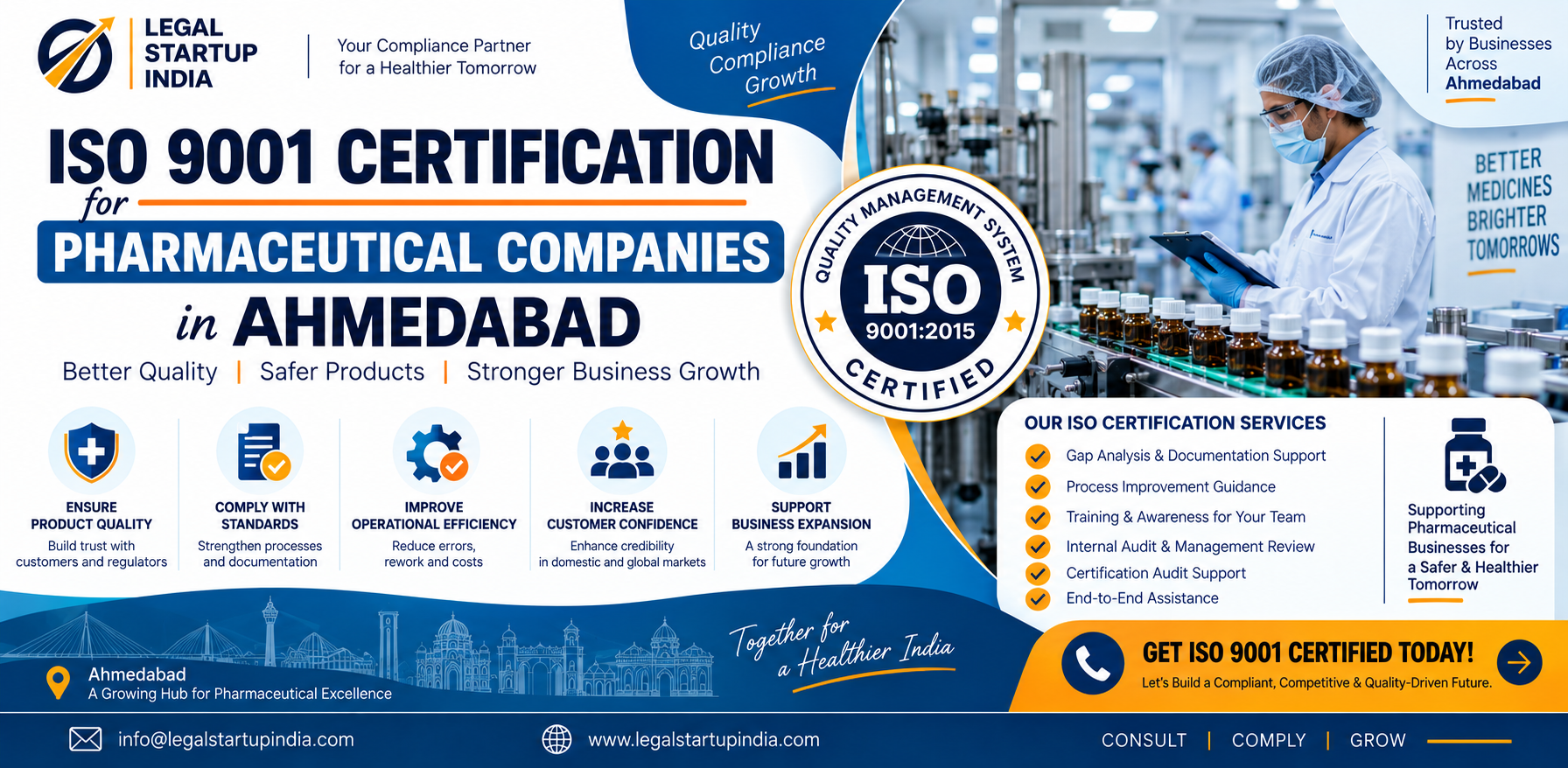 ISO 9001 Certification for Pharmaceutical Companies in Ahmedabad
 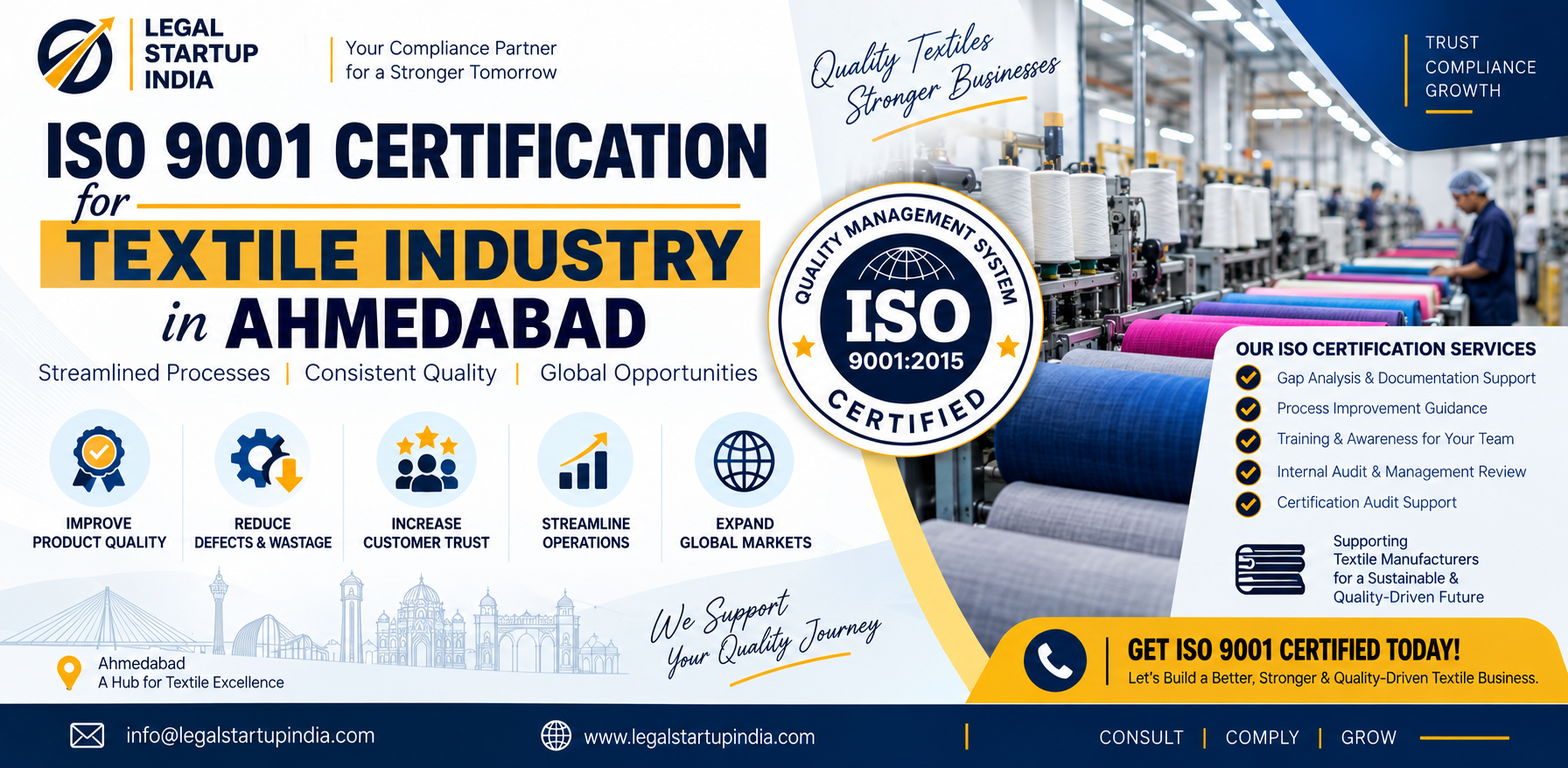 ISO 9001 Certification for Textile Industry in Ahmedabad
 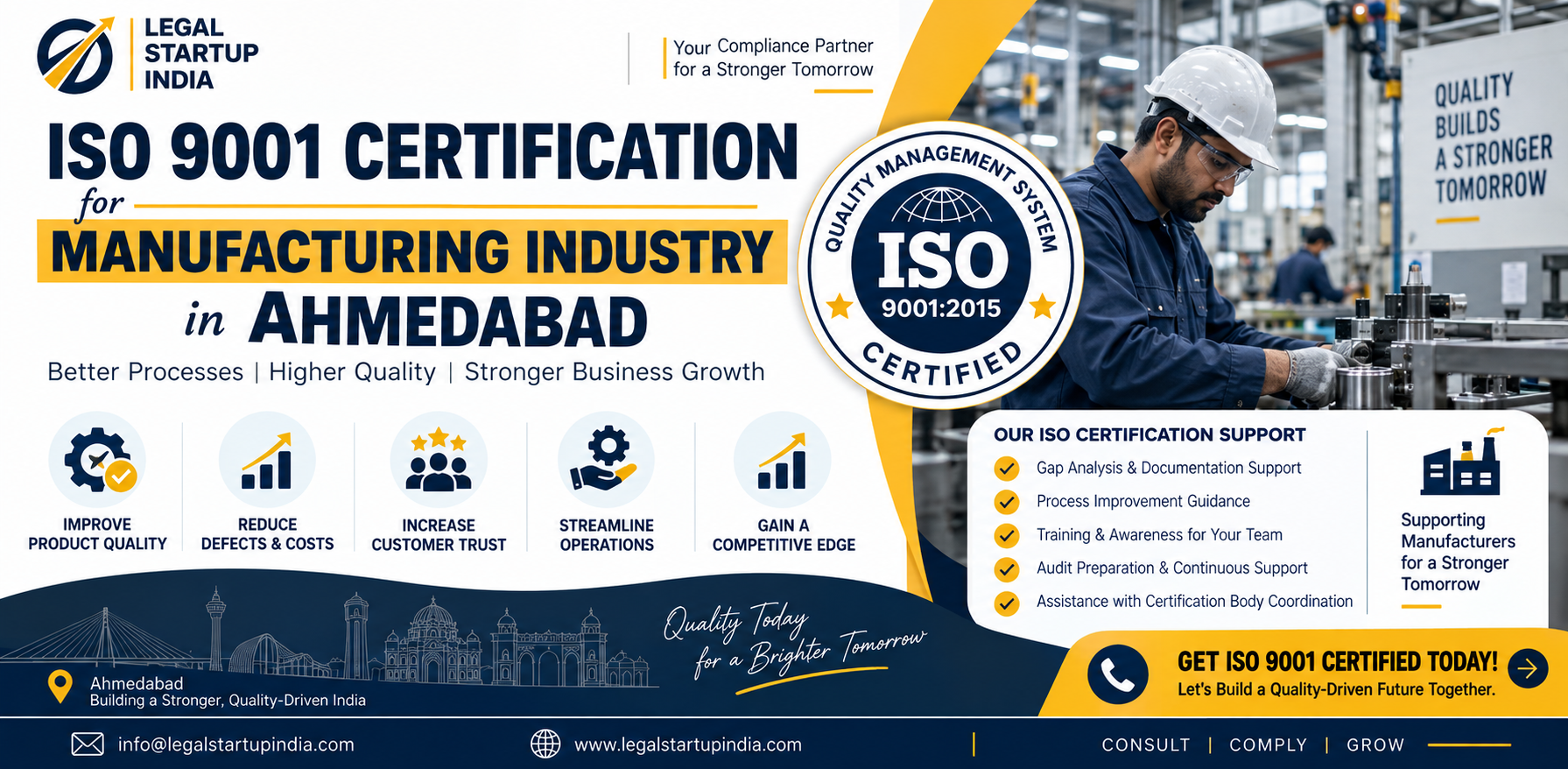 ISO 9001 Certification for Manufacturing Industry in Ahmedabad
  ISO Certification for Pharmaceutical Companies in Ahmedabad
  ISO Certification for Textile Industries in Surat
  ISO Certification for Engineering Companies in Rajkot
 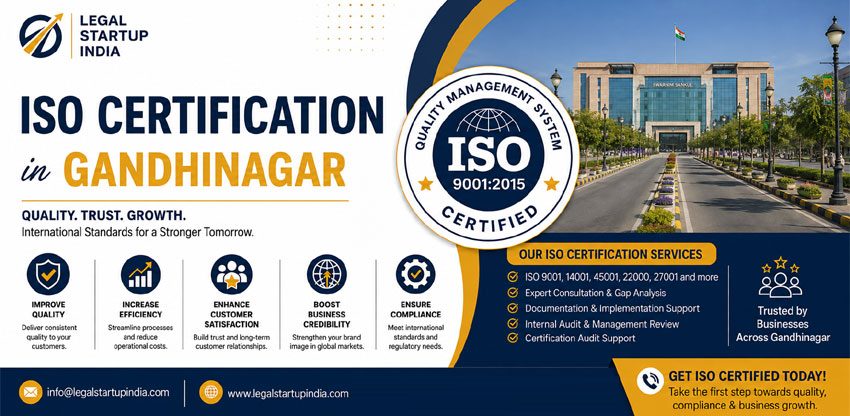 ISO Certification in Gandhinagar