
 27 Aug 2026
Admin ISO
51 Comment
27 Aug 2026
Admin ISO
51 Comment
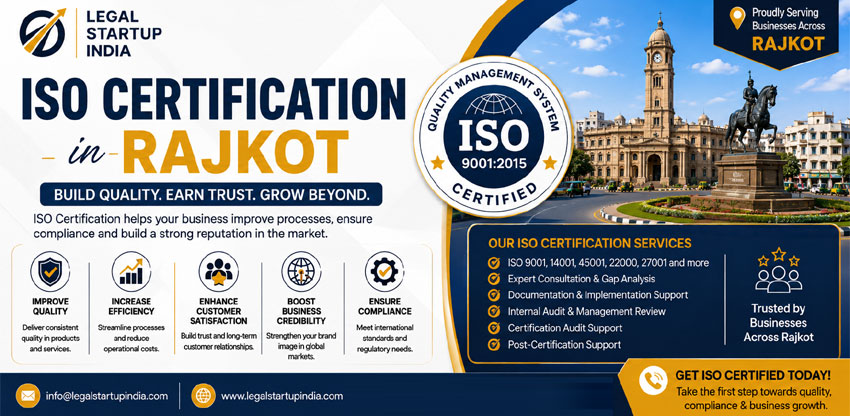
ISO Certification in Rajkot
Introduction
Rajkot is one of Gujarat's important manufacturing and commercial centres, with businesses operating in engineering, machine tools, automotive components, foundries, casting, jewellery, food processing, plastics, pharmaceuticals, trading and professional services.
As businesses grow, maintaining consistent quality and organized processes becomes increasingly important. Customers, corporate buyers and business partners often want evidence that an organization follows reliable and controlled processes.
This is where ISO Certification in Rajkot can provide meaningful business value.
ISO certification confirms that an organization's management system has been assessed against the requirements of a particular ISO standard by an independent certification body. The appropriate standard depends on the organization's activities and objectives.
For example, an engineering manufacturer may choose ISO 9001 for quality management, while an industrial company may also consider ISO 14001 for environmental management or ISO 45001 for occupational health and safety. Food businesses may consider ISO 22000, while companies handling sensitive digital information may consider ISO 27001.
The goal should not be to obtain a certificate simply for display. A properly implemented ISO management system should become part of the way the business operates.
What Is ISO Certification?
ISO certification is an independent assessment of an organization's management system against the requirements of a specified ISO standard.
The International Organization for Standardization develops international standards, while independent certification bodies conduct certification audits.
ISO 9001 is one of the most widely used management-system standards and focuses on quality management. It helps organizations establish processes for consistently delivering products and services that meet customer and applicable requirements while supporting continual improvement.
Businesses in Rajkot can select different ISO standards depending on their operational requirements.
Common ISO Standards for Rajkot Businesses
- ISO 9001 – Quality Management System
- ISO 14001 – Environmental Management System
- ISO 45001 – Occupational Health & Safety Management System
- ISO 22000 – Food Safety Management System
- ISO 27001 – Information Security Management System
- ISO 13485 – Medical Device Quality Management System
- ISO 50001 – Energy Management System
- ISO 10002 – Customer Complaint Management
Selecting the right standard is more important than simply choosing the most popular certification.
Why Choose Us for ISO Certification in Rajkot?
Understanding ISO requirements can be difficult when business owners are simultaneously managing production, employees, customers and daily operations.
Legal Startup India helps businesses understand the certification requirements and prepare for the certification process in a structured manner.
Our approach focuses on the organization's actual activities, processes and certification objectives rather than using identical documentation for every company.
Our ISO Certification Support Includes
- Initial business consultation
- Identification of the suitable ISO standard
- Certification scope guidance
- Gap analysis
- Documentation assistance
- Policy and procedure preparation
- Implementation support
- Employee awareness guidance
- Internal audit preparation
- Corrective-action assistance
- Management review preparation
- Certification audit support
- Post-certification guidance
For a Rajkot manufacturer, this approach can help connect ISO requirements with real processes such as purchasing, production, inspection, supplier evaluation, customer complaints and delivery.
Key Benefits of ISO Certification in Rajkot
1. Improves Quality and Consistency
ISO management systems encourage organizations to establish controlled and repeatable processes.
For example, a machine-component manufacturer can define inspection procedures, quality responsibilities and methods for handling nonconforming products.
This can help improve consistency from one production cycle to another.
2. Builds Customer Confidence
Customers want reliable suppliers.
An ISO certification can demonstrate that an organization has implemented a structured management system and is committed to monitoring and improving its processes.
This can be particularly useful when working with corporate buyers, institutional customers and export clients.
3. Reduces Errors and Rework
Recurring mistakes can increase production costs and waste valuable time.
A systematic approach helps businesses identify problems, investigate their causes and introduce corrective actions.
The objective is not merely to fix an individual error but to improve the process that caused it.
4. Supports Tender and Vendor Opportunities
Some tenders, contracts or vendor qualification systems may specify ISO certification as one of their requirements.
Having the relevant certification can therefore support participation in such opportunities when certification is explicitly required.
Businesses should always review the individual tender or customer requirements rather than assuming that ISO certification guarantees eligibility.
5. Strengthens Business Credibility
ISO certification can provide an additional trust signal when approaching new customers, suppliers, investors and business partners.
For Rajkot businesses looking to expand beyond local markets, a recognized management-system certification can support a more professional business profile.
6. Encourages Continuous Improvement
ISO management systems encourage organizations to monitor results and identify opportunities for improvement.
Instead of treating quality as the responsibility of one department, businesses can build quality-related responsibilities into their broader operating processes.
7. Creates Better Internal Accountability
Clearly defined responsibilities help employees understand their roles.
This becomes increasingly important as a business grows from a small operation into a larger organization with multiple departments and teams.
ISO Certification for Different Industries in Rajkot
Rajkot's industrial ecosystem includes a wide range of businesses, and ISO certification requirements can vary significantly.
Engineering and Machine Tool Companies
Engineering businesses can use ISO 9001 to establish controlled processes for design, production, inspection, purchasing and customer feedback.
Auto Component Manufacturers
Automotive component businesses can benefit from systematic quality controls, supplier management, inspection procedures and corrective-action processes.
Foundries and Casting Units
Foundries can use structured quality management systems to monitor production processes, inspection activities and nonconforming outputs.
Food Processing Companies
Food manufacturers and processors may consider ISO 22000 where a formal food safety management system is appropriate to their operations.
Pharmaceutical Businesses
Pharmaceutical and related organizations may require management systems covering quality, safety, regulatory and operational requirements depending on their specific activities.
IT and Service Companies
IT businesses can consider ISO 9001 for quality management and ISO 27001 where information security is a major business concern.
Step-by-Step ISO Certification Process in Rajkot
The exact process varies according to the selected standard, business size, certification scope and certification body. A typical process includes the following stages.
Step 1: Initial Consultation
The first step is to understand the organization.
Important details include business activities, products or services, number of employees, locations, departments and certification objectives.
This information helps establish a suitable certification scope.
Step 2: Gap Analysis
Existing processes are reviewed against the requirements of the selected ISO standard.
The gap analysis identifies what the organization already has and what needs to be developed or improved.
Step 3: Documentation Preparation
Relevant policies, procedures, process documents, forms and records are prepared or updated.
Good ISO documentation should reflect the organization's actual activities rather than creating unnecessary paperwork.
Step 4: Implementation
The management system is introduced into everyday operations.
Employees should understand relevant responsibilities and follow applicable procedures.
Records should be maintained as evidence that processes are being implemented.
Step 5: Internal Audit
An internal audit is conducted to identify potential nonconformities and improvement opportunities before the certification audit.
Step 6: Management Review
Management reviews relevant performance information, audit findings, customer feedback, objectives and improvement opportunities as applicable to the selected standard.
Step 7: Certification Audit
An independent certification body evaluates the management system.
Depending on the standard and scope, auditors may review documents and records, interview employees and examine operational processes.
Step 8: Certification
When applicable requirements have been successfully met, the certification body issues the ISO certificate for the approved scope.
The organization must then maintain the management system and meet ongoing certification requirements.
Documents Required for ISO Certification
The exact documents required depend on the selected standard and the organization's size and activities.
Common information may include:
- Business registration documents
- PAN and GST details
- Business address information
- Organization structure
- Scope of business activities
- Management policies
- Process flow information
- Standard Operating Procedures
- Risk and opportunity records
- Employee training records
- Supplier evaluation records
- Customer feedback records
- Inspection and monitoring records
- Internal audit records
- Corrective-action records
- Management review records
Not every company requires the same documentation.
For instance, a small consulting firm may need a relatively simple management system, while a Rajkot-based engineering manufacturer with several production departments may require significantly more operational controls and records.
ISO Certification Cost in Rajkot
There is no single fixed ISO Certification Cost in Rajkot applicable to every organization.
The overall cost can depend on several factors, including:
- ISO standard selected
- Number of employees
- Number of business locations
- Certification scope
- Business complexity
- Audit requirements
- Certification body
- Documentation and implementation requirements
Therefore, businesses should obtain a quotation based on their actual certification scope rather than choosing a provider only because it advertises the lowest price.
A clear quotation should explain what is included in the consultancy, documentation, implementation and certification activities.
How Long Does ISO Certification Take?
The certification timeline depends on the organization's readiness, size, processes and certification scope.
A small organization with established processes may require less preparation than a manufacturing company with multiple departments, locations or complex operational controls.
The practical approach is to begin with a gap assessment, identify the required improvements and establish an implementation schedule before the certification audit.
Businesses should also be cautious about providers promising instant certification without meaningful assessment. A credible certification process requires appropriate evaluation of the management system.
How to Choose an ISO Certification Consultant in Rajkot
Before selecting an ISO consultant, consider the following:
- Does the consultant understand your industry?
- Is the ISO standard clearly explained?
- Is the certification scope defined properly?
- Are documentation requirements explained?
- Is implementation support available?
- Is the certification body clearly identified?
- Are costs communicated transparently?
- Is audit preparation included?
- Can the consultant explain post-certification requirements?
The cheapest option is not necessarily the best option. The objective should be a credible certification supported by a management system that provides practical value to the business.
Frequently Asked Questions
1. What is ISO Certification in Rajkot?
ISO Certification in Rajkot is the process of having an organization's management system independently assessed against the requirements of a specific ISO standard. The appropriate standard depends on the organization's business activities and objectives.
2. Which ISO certification is best for a business in Rajkot?
There is no single ISO certification that is best for every Rajkot business. ISO 9001 is commonly used for quality management, while ISO 14001, ISO 45001, ISO 22000 and ISO 27001 address environmental management, occupational health and safety, food safety and information security respectively.
3. How can I get ISO Certification in Rajkot?
The process generally includes selecting the appropriate standard, defining the certification scope, conducting a gap analysis, preparing documentation, implementing the management system, completing internal review and undergoing an external certification audit.
4. What documents are required for ISO Certification in Rajkot?
Requirements depend on the selected ISO standard and business activities. Common documents and records may include business details, organizational information, policies, procedures, training records, supplier records, customer feedback, internal audit records and corrective-action records.
5. Is ISO certification mandatory for businesses in Rajkot?
ISO certification is not automatically mandatory for every business. However, a specific customer, tender, contract or industry requirement may require a particular ISO certification. Businesses should check the requirements applicable to their individual situation.
Conclusion
For businesses in Rajkot, ISO certification can be a practical framework for improving processes, strengthening quality controls and building customer confidence.
Whether you operate an engineering company, machine tool business, auto component unit, foundry, food processing company, pharmaceutical organization, IT company or service business, the appropriate ISO standard should be selected according to your actual requirements.
The real benefit of certification comes from implementing a management system that employees can use in their everyday work. A certificate alone does not improve a business; consistent processes, monitoring and continual improvement do.
Legal Startup India supports businesses with ISO standard selection, documentation, implementation guidance, internal audit preparation and certification audit support.
If you are looking for ISO Certification in Rajkot, contact our team to discuss your business activities, certification scope and requirements.
Email: info@legalstartupindia.com
Website: www.legalstartupindia.com
Take the next step toward a more organized, credible and growth-ready business with professional ISO certification support from Legal Startup India.
 ISO 9001 Certification for Automobile Industry in Sanand
  ISO 9001 Certification for Chemical Industry in Ahmedabad
  ISO 9001 Certification for Engineering Companies in Ahmedabad
  ISO 9001 Certification for Pharmaceutical Companies in Ahmedabad
  ISO 9001 Certification for Textile Industry in Ahmedabad
  ISO 9001 Certification for Manufacturing Industry in Ahmedabad
  ISO Certification for Pharmaceutical Companies in Ahmedabad
  ISO Certification for Textile Industries in Surat
  ISO Certification for Engineering Companies in Rajkot
  ISO Certification in Gandhinagar