
 ISO 9001
ISO 14001
ISO 45001
ISO 9001
ISO 14001
ISO 45001
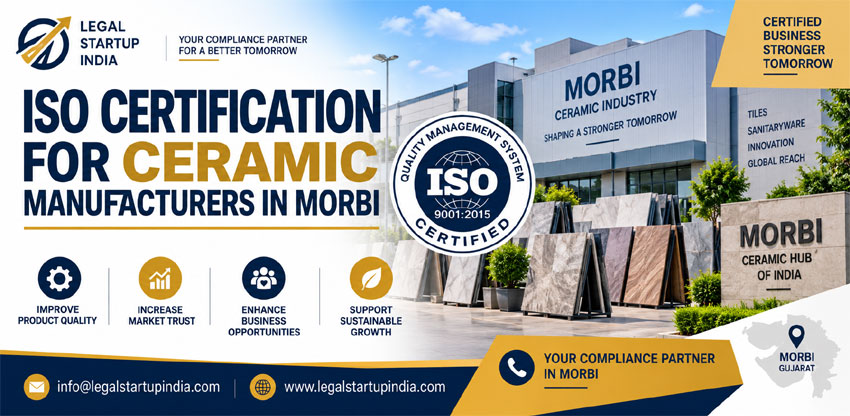
ISO Certification for Ceramic Manufacturers in Morbi
Morbi is one of India’s leading ceramic manufacturing hubs, known for its tiles, sanitaryware, wall and floor coverings, vitrified tiles, porcelain products, and other ceramic solutions. With strong domestic demand and a growing export market, ceramic manufacturers in Morbi are increasingly focusing on consistent quality, environmental responsibility, workplace safety, and efficient production systems.
ISO Certification for Ceramic Manufacturers in Morbi helps businesses establish structured management systems that improve manufacturing processes, reduce operational risks, meet customer expectations, and strengthen their credibility in competitive markets.
Whether you are a tile manufacturer, sanitaryware producer, ceramic raw-material supplier, glaze manufacturer, or an exporter, selecting the right ISO standard can help your business build a more reliable and professionally managed operation.
Why ISO Certification Is Important for Ceramic Manufacturers in Morbi
Ceramic manufacturing involves several interconnected activities, including raw-material procurement, mixing, pressing, glazing, firing, polishing, packaging, storage, quality inspection, and dispatch. Even a small process variation can affect the final product.
An ISO-based management system helps manufacturers document these processes, define responsibilities, monitor performance, and continuously improve operations.
ISO certification can help ceramic businesses in Morbi to:
- Improve product and process consistency
- Reduce defects, rejection, and customer complaints
- Improve production planning and process control
- Strengthen quality inspection and testing procedures
- Manage environmental impacts more systematically
- Improve workplace health and safety
- Meet buyer and export-market requirements
- Build greater confidence among customers and business partners
- Improve documentation and traceability
- Create a culture of continual improvement
Which ISO Certifications Are Suitable for Ceramic Manufacturers?
The appropriate ISO certification depends on the company's activities, customers, products, risks, and business objectives. Ceramic manufacturers commonly consider the following standards.
1. ISO 9001:2015 Certification for Ceramic Manufacturers
ISO 9001:2015 Certification focuses on Quality Management Systems (QMS). For ceramic manufacturers, it can help create better control over production, inspection, supplier management, customer requirements, corrective actions, and continual improvement.
A ceramic manufacturer can use ISO 9001 to establish documented procedures for activities such as raw-material inspection, production control, quality testing, handling of non-conforming products, packaging, and customer feedback.
2. ISO 14001:2015 Certification for Ceramic Industries
Ceramic manufacturing can involve energy consumption, emissions, wastewater, dust, packaging waste, raw-material usage, and other environmental considerations. ISO 14001:2015 Certification provides a structured Environmental Management System (EMS) for identifying and managing significant environmental aspects.
It can help ceramic manufacturers establish environmental objectives, monitor resource consumption, manage waste, maintain compliance-related processes, and improve environmental performance.
3. ISO 45001:2018 Certification for Ceramic Manufacturers
Ceramic factories involve machinery, kilns, high temperatures, electrical equipment, material handling, dust, chemicals, and other workplace hazards. ISO 45001:2018 Certification focuses on Occupational Health and Safety Management Systems.
It helps organizations systematically identify workplace hazards, assess risks, implement controls, conduct safety training, investigate incidents, and improve occupational health and safety performance.
4. ISO 22000:2018 Certification for Relevant Ceramic Businesses
ISO 22000:2018 Certification is designed for organizations involved in the food chain. It is generally not applicable simply because a company manufactures ceramics.
However, it may be relevant to a business supplying products, materials, packaging, or services that form part of the food chain, depending on its activities and applicable requirements. Businesses should determine the scope of certification based on their actual operations.
5. ISO 27001:2022 Certification for Ceramic Manufacturers
Modern ceramic manufacturers increasingly depend on ERP systems, production software, customer databases, digital drawings, supplier information, financial records, and other business data. ISO 27001:2022 Certification focuses on Information Security Management Systems (ISMS).
It can help businesses identify information-security risks and establish controls for protecting confidential information, managing access, handling incidents, and improving information security.
ISO Certification Process for Ceramic Manufacturers in Morbi
The certification process should be practical and based on the company's actual manufacturing activities. A typical process includes:
- Initial consultation: Understand the organization, products, processes, locations, and intended certification scope.
- Gap assessment: Review existing systems against the requirements of the selected ISO standard.
- Documentation: Develop or improve policies, procedures, objectives, records, and process controls.
- Implementation: Put the documented management system into practice across relevant departments.
- Employee awareness: Train employees regarding their responsibilities and applicable procedures.
- Internal audit: Conduct an internal audit to identify gaps and areas requiring improvement.
- Management review: Evaluate the effectiveness and performance of the management system.
- Certification audit: An independent certification body assesses the implemented system.
- Corrective actions: Address any identified nonconformities where applicable.
- Certification: Upon successful completion of the applicable audit requirements, the certification body issues the ISO certificate.
Documents Required for ISO Certification
The exact documentation depends on the ISO standard, organization size, manufacturing process, and certification scope. Ceramic manufacturers may need records and documents related to:
- Quality or management system policy
- Organization structure and responsibilities
- Production and process-control procedures
- Raw-material inspection records
- Product inspection and testing records
- Supplier evaluation and purchase controls
- Equipment maintenance records
- Calibration records, where applicable
- Training and competency records
- Customer complaint records
- Corrective and improvement records
- Internal audit reports
- Management review records
- Environmental records for ISO 14001
- Occupational health and safety records for ISO 45001
- Information-security records for ISO 27001
How ISO Certification Helps Ceramic Exporters in Morbi
Morbi's ceramic industry has a strong connection with international markets. Buyers often evaluate suppliers based on product quality, consistency, delivery capability, documentation, compliance, and management practices.
ISO certification can support exporters by providing a structured management framework and demonstrating that the organization follows defined processes. It can also strengthen supplier evaluations and help businesses respond more professionally to customer requirements.
However, ISO certification should not be presented as a guarantee of export orders or product acceptance. Importing-country regulations, buyer specifications, product standards, testing requirements, and contractual conditions may still apply.
ISO Certification for Different Ceramic Businesses in Morbi
ISO management systems can be relevant to different types of ceramic businesses, including:
- Ceramic tile manufacturers
- Vitrified tile manufacturers
- Porcelain tile manufacturers
- Wall and floor tile manufacturers
- Sanitaryware manufacturers
- Ceramic tableware manufacturers
- Ceramic raw-material suppliers
- Ceramic glaze and frit manufacturers
- Ceramic machinery and equipment suppliers
- Ceramic packaging and allied businesses
- Ceramic exporters and traders
Cost of ISO Certification for Ceramic Manufacturers in Morbi
The cost of ISO certification in Morbi is not the same for every company. It can depend on factors such as the selected ISO standard, number of employees, number of locations, certification scope, complexity of manufacturing processes, audit requirements, and certification-body fees.
A small ceramic unit with a single location may have a different certification cost from a large manufacturer with multiple production facilities and a broader certification scope.
For an accurate estimate, businesses should first define their certification scope and applicable ISO standard rather than relying on a generic price.
How Long Does ISO Certification Take?
The timeline depends on the organization's size, existing management practices, documentation, implementation level, audit availability, and complexity of operations.
Companies with well-established systems may require less preparation, while organizations starting from the beginning may need additional time for documentation, implementation, employee awareness, internal audits, and corrective actions.
Why Choose a Professional ISO Consultant in Morbi?
A professional ISO consultant can help ceramic manufacturers understand the applicable requirements and build a management system around their actual business processes rather than creating unnecessary paperwork.
A good consultant can assist with gap assessment, documentation, implementation support, employee awareness, internal audit preparation, management review, and certification-audit readiness.
Businesses should also verify the credentials and scope of the certification body before relying on an ISO certificate, particularly when certification is required by an international customer, tender, regulator, or supply-chain partner.
Frequently Asked Questions
1. What is ISO Certification for Ceramic Manufacturers in Morbi?
ISO Certification for Ceramic Manufacturers in Morbi confirms that an organization has implemented a management system that has been assessed against the requirements of a relevant ISO standard. The applicable standard depends on the organization's activities and objectives.
2. Which ISO certification is best for ceramic tile manufacturers?
ISO 9001:2015 is commonly relevant to ceramic tile manufacturers because it focuses on quality management and process consistency. ISO 14001 and ISO 45001 may also be considered for environmental and occupational health and safety management.
3. Is ISO 9001 useful for ceramic manufacturers?
Yes. ISO 9001 can help ceramic manufacturers establish structured processes for production, inspection, supplier management, customer requirements, nonconformity management, and continual improvement.
4. Is ISO 14001 suitable for ceramic industries?
Yes. ISO 14001 can be suitable for ceramic manufacturers that want a systematic approach to managing environmental aspects such as waste, resource consumption, emissions, and other environmental impacts within their defined scope.
5. Why should ceramic factories consider ISO 45001?
ISO 45001 helps organizations systematically manage occupational health and safety risks. This can be particularly relevant in manufacturing environments involving machinery, high temperatures, material handling, chemicals, and other workplace hazards.
6. Can a Morbi ceramic exporter obtain multiple ISO certifications?
Yes. An organization can implement multiple management systems when they are relevant to its activities. For example, a manufacturer may combine quality, environmental, occupational health and safety, and information-security management systems.
7. What documents are required for ISO certification?
Documents and records vary according to the selected standard and certification scope. They may include policies, procedures, process records, inspection records, training records, internal audit reports, management review records, and corrective-action records.
8. How much does ISO certification cost in Morbi?
The cost depends on factors such as the selected standard, organization size, number of employees, locations, certification scope, audit requirements, and certification-body charges. A customized quotation is more reliable than a fixed generic price.
9. How can I get ISO Certification for my ceramic manufacturing company in Morbi?
You can begin by identifying the appropriate ISO standard and certification scope, conducting a gap assessment, implementing the required management system, completing internal audits and management review, and undergoing an audit by an independent certification body.
Conclusion
ISO Certification for Ceramic Manufacturers in Morbi can help businesses build more organized, consistent, and customer-focused management systems. For ceramic manufacturers dealing with demanding customers, large production volumes, exports, environmental responsibilities, and workplace risks, a properly implemented ISO system can provide a practical framework for continual improvement.
From ISO 9001:2015 for quality management to ISO 14001:2015 for environmental management and ISO 45001:2018 for occupational health and safety, businesses should select standards according to their actual needs. ISO 22000 and ISO 27001 can be considered where the organization's activities make those standards relevant.
The key is not simply obtaining an ISO certificate, but implementing a management system that genuinely supports the day-to-day operations and long-term growth of the ceramic manufacturing business.