
 04 Aug 2026
Admin ISO
51 Comment
04 Aug 2026
Admin ISO
51 Comment
ISO 9001 Certification for Automobile Manufacturers in Sanand
Introduction
Sanand has become an important automotive and industrial manufacturing destination in Gujarat. The region has a growing ecosystem of automobile manufacturers, auto-component suppliers, engineering companies, fabrication units and supporting industries.
In this environment, product quality is not something a manufacturer can compromise on. A dimensional variation in a component, incorrect raw material, missed inspection or inconsistent production process can result in rejection, rework, delayed deliveries and customer complaints.
This is where ISO 9001 Certification for Automobile Manufacturers in Sanand can provide a structured approach to quality management.
ISO 9001 is an internationally recognized Quality Management System (QMS) standard. It helps organizations establish, implement, maintain and continually improve processes that support consistent products and services and customer satisfaction.
For an automobile manufacturer, the value of ISO 9001 is not simply having a certificate displayed in the reception area. The real benefit comes from having controlled processes across procurement, production, inspection, maintenance, dispatch and customer feedback.
For example, consider an auto-component manufacturer in Sanand supplying precision parts to an automotive customer. If two production shifts use different inspection methods, the company may face inconsistent results even when the machines are functioning correctly.
A properly implemented QMS helps define responsibilities, process controls, inspection requirements and corrective actions so that quality does not depend solely on individual experience.
Why Choose ISO 9001 Certification for Automobile Manufacturers in Sanand?
Automotive manufacturing involves strict customer specifications, multiple suppliers, production targets and continuous quality monitoring. A structured quality management system can help bring these activities together.
ISO 9001 can help automobile manufacturers and component suppliers:
-
Standardize manufacturing processes
-
Improve product consistency
-
Strengthen incoming material inspection
-
Improve supplier evaluation
-
Reduce production errors and rework
-
Establish clearer quality responsibilities
-
Improve customer complaint handling
-
Monitor quality objectives and process performance
-
Maintain reliable quality records
-
Support continual improvement
ISO 9001 is designed for organizations across different sectors and sizes. Its requirements focus on establishing an effective QMS rather than prescribing one particular manufacturing method.
ISO 9001 and Automotive Manufacturing
Automotive businesses often operate within complex supply chains. A manufacturer may purchase raw materials from one supplier, outsource specific processes, manufacture components internally and then supply products to another company.
Every handoff creates a potential quality risk.
A QMS provides a framework for identifying and controlling these process risks. It can cover areas such as supplier performance, production controls, inspection, nonconforming products, customer feedback and corrective action.
For businesses supplying automotive OEMs or Tier 1 and Tier 2 customers, this structured approach can also make quality expectations easier to communicate and manage.
Key Benefits of ISO 9001 Certification
1. Consistent Product Quality
Automotive customers expect components to meet agreed specifications repeatedly—not just during one production batch.
ISO 9001 supports process control and performance monitoring so manufacturers can work toward greater consistency.
2. Better Production Process Control
Clearly defined procedures and responsibilities help employees understand how important manufacturing and quality activities should be performed.
This can reduce variation caused by inconsistent working methods.
3. Reduced Rework and Rejection
Manufacturing defects can increase material costs, production downtime and delivery pressure.
A structured QMS encourages organizations to identify nonconformities, investigate causes and take corrective action instead of repeatedly treating the same symptoms.
4. Improved Supplier Management
Automotive manufacturers depend on reliable suppliers for metals, plastics, electrical components, fasteners, packaging and other inputs.
Supplier evaluation and monitoring can help businesses identify suppliers that consistently meet quality requirements.
5. Better Customer Complaint Handling
A customer complaint should be treated as useful quality information.
A QMS provides a systematic approach for recording complaints, investigating causes, implementing corrective action and checking whether the solution has been effective.
6. Improved Traceability and Documentation
Production and inspection records can help a company understand how a product was manufactured and checked.
This can be valuable when investigating quality issues or responding to customer queries.
7. Increased Business Credibility
ISO 9001 certification can strengthen the professional profile of an automobile manufacturer when dealing with corporate buyers, suppliers, tenders and new business opportunities.
However, certification should not be treated as a guarantee of supplier approval or a particular customer contract.
8. Continual Improvement
ISO 9001 emphasizes monitoring, evaluation and continual improvement of the QMS. ISO identifies customer focus, leadership, process approach and improvement among its quality management principles.
This makes the standard useful for manufacturers that want quality management to become part of their everyday operations.
Step-by-Step ISO 9001 Certification Process for Automobile Manufacturers
The certification process varies according to the size and complexity of the organization, but the following stages provide a practical overview.
Step 1: Initial Consultation and Gap Assessment
The process begins with an assessment of the company's current quality practices.
For an automobile manufacturer, the review may cover:
-
Production processes
-
Incoming material inspection
-
In-process inspection
-
Final product inspection
-
Supplier management
-
Machine maintenance
-
Calibration
-
Employee competency
-
Customer complaints
-
Nonconforming products
-
Existing documentation
-
Quality objectives
The purpose is to identify gaps between current practices and ISO 9001 requirements.
Step 2: Define the QMS Scope
The company must determine which activities, products, departments and locations are included within its Quality Management System.
For example, the scope could cover manufacturing and supply of automotive components from a particular Sanand manufacturing facility.
A clearly defined scope helps establish what the certification applies to.
Step 3: Prepare QMS Documentation
The required documented information is developed around the organization's actual operations.
Depending on the business, this may include:
-
Quality policy
-
Quality objectives
-
Process procedures
-
SOPs
-
Work instructions
-
Inspection procedures
-
Supplier controls
-
Records and forms
Documentation should be practical. Simply downloading generic ISO documents and changing the company name is unlikely to create an effective management system.
Step 4: Implement the QMS
The next step is implementation.
Employees should understand the procedures relevant to their roles. Production, inspection, procurement and other departments should follow defined processes and maintain required records.
The QMS should become part of normal operations rather than a separate system used only when an auditor visits.
Step 5: Conduct an Internal Audit
An internal audit checks whether the QMS is being followed and whether it is effective.
For an automobile manufacturer, internal auditors may examine production controls, inspection records, supplier evaluation, calibration, maintenance, complaints and corrective actions.
Identified nonconformities should be addressed before the certification audit.
Step 6: Management Review
Top management reviews the performance of the QMS and considers information such as:
-
Audit results
-
Customer feedback
-
Quality objectives
-
Process performance
-
Nonconformities
-
Corrective actions
-
Supplier performance
-
Improvement opportunities
This ensures that quality management remains connected to business priorities.
Step 7: Certification Audit
An independent certification body evaluates the organization's QMS against the applicable ISO 9001 requirements.
If the organization demonstrates conformity and successfully completes the certification process, the certification body can issue the certificate.
Importantly, ISO itself does not issue ISO 9001 certificates. Certification is carried out by independent certification bodies.
Documents Required for ISO 9001 Certification
The exact documents depend on the organization's size, processes and certification scope. Common QMS documents and records for an automobile manufacturer may include:
-
QMS scope
-
Quality policy
-
Quality objectives
-
Process flow charts
-
Standard Operating Procedures
-
Work instructions
-
Raw-material inspection records
-
In-process inspection records
-
Final inspection reports
-
Supplier evaluation records
-
Purchase records
-
Machine maintenance records
-
Calibration records
-
Employee training records
-
Competency records
-
Customer complaint records
-
Nonconformity reports
-
Corrective action records
-
Internal audit reports
-
Management review records
-
Applicable statutory and regulatory information
Not every organization will require identical documentation.
The right approach is to create documented information based on the organization's actual processes, risks, customer requirements and QMS scope.
ISO 9001 and Automotive-Specific Quality Requirements
Automobile manufacturers should also understand that ISO 9001 is a general Quality Management System standard.
Depending on their position in the automotive supply chain and customer requirements, organizations may need to consider additional automotive-specific requirements or standards.
For example, IATF 16949 is specifically associated with quality management systems for organizations in the automotive production and relevant service-parts sector. It evolved from earlier automotive quality requirements and is distinct from simply holding ISO 9001 certification.
Therefore, an automobile manufacturer should first identify what its customers, contracts and supply-chain requirements actually demand instead of assuming ISO 9001 alone covers every automotive quality requirement.
This distinction is particularly important for suppliers working with major automotive OEMs.
Why Choose Legal Startup India?
Implementing ISO 9001 can seem complicated when a manufacturing company is already managing production schedules, customer requirements and daily operational issues.
Legal Startup India can help simplify the certification journey by providing structured guidance based on the organization's requirements.
For automobile manufacturers and auto-component businesses in Sanand, support can include:
-
Initial ISO consultation
-
Gap assessment
-
QMS documentation support
-
Process implementation guidance
-
Employee awareness support
-
Internal audit preparation
-
Corrective-action guidance
-
Certification audit preparation
-
Assistance throughout the certification process
The objective should be to develop a quality management system that fits the manufacturer's actual operations.
A practical QMS is easier for employees to follow, easier for management to monitor and more useful for continual improvement.
ISO 9001 Revision Update for 2026
Businesses planning certification in 2026 should pay attention to the upcoming ISO 9001 revision.
As of August 2026, ISO 9001:2015 remains the published edition, while ISO's revised ISO 9001 edition is under publication and is expected to replace ISO 9001:2015 in September 2026. ISO has stated that organizations certified to ISO 9001:2015 will have a transition period to migrate to the revised edition.
The upcoming edition places additional emphasis on areas such as leadership, quality culture, risks and opportunities, while retaining the familiar quality-management framework.
For this reason, businesses starting their ISO journey now should work with a provider that keeps its implementation approach aligned with official ISO updates.
Internal Linking Suggestions
To build a strong internal SEO cluster on Legal Startup India, this article can be linked naturally to:
-
ISO Certification in Ahmedabad – for users looking for ISO services in Ahmedabad and nearby industrial areas.
-
ISO 9001 Certification for Industrial Manufacturers in Sanand GIDC – useful for general manufacturing audiences.
-
ISO 9001 Certification for Engineering Industries in Odhav GIDC – relevant to engineering and component manufacturers.
-
ISO 9001 Certification for Chemical Industries in Vatva GIDC – useful for businesses comparing ISO requirements across industries.
-
ISO 9001 Certification Process and Cost in India – useful for readers researching the overall certification journey.
Use descriptive, natural anchor text and avoid linking every page with the exact same keyword.
External Authority Reference Suggestion
For authoritative information, link to the official International Organization for Standardization (ISO) resources on ISO 9001.
The official ISO material explains the purpose of ISO 9001, its Quality Management System requirements and the current revision status.
For automotive-specific quality requirements, businesses should also review the official information available from the relevant automotive quality-standard organizations before deciding whether additional certification is required.
Frequently Asked Questions
1. What is ISO 9001 Certification for Automobile Manufacturers in Sanand?
ISO 9001 Certification for Automobile Manufacturers in Sanand demonstrates that an automobile manufacturer or component supplier has established a Quality Management System that conforms to applicable ISO 9001 requirements.
2. Why is ISO 9001 important for automobile manufacturers?
ISO 9001 can help automobile manufacturers improve process consistency, quality control, supplier management, customer complaint handling, documentation and continual improvement.
3. What documents are required for ISO 9001 certification in the automobile industry?
Common documents include quality policies, objectives, SOPs, process documentation, inspection records, supplier evaluation records, maintenance and calibration records, training records, internal audit reports, corrective-action records and management review records.
4. Is ISO 9001 enough for an automotive component manufacturer?
Not necessarily. ISO 9001 is a general QMS standard. Depending on customer and supply-chain requirements, an automotive organization may also need to consider automotive-specific requirements such as IATF 16949.
5. How long does ISO 9001 certification take for an automobile manufacturer?
There is no fixed timeline. It depends on the company's size, manufacturing complexity, number of locations, existing quality practices, documentation, employee readiness and certification scope.
Conclusion
For automobile manufacturers and auto-component suppliers in Sanand, quality management is directly connected to customer satisfaction, production efficiency, delivery performance and long-term business growth.
ISO 9001 Certification for Automobile Manufacturers in Sanand provides a structured framework for controlling processes, monitoring performance, managing nonconformities and continually improving the Quality Management System.
The certificate itself is only one part of the process. The real value comes from creating a system that employees understand and management can continuously improve.
If your automobile manufacturing or auto-component business operates in Sanand and you are planning ISO 9001 certification, Legal Startup India can help you understand the requirements and prepare your organization for the certification journey.
Start Your ISO 9001 Certification Journey
Email: info@legalstartupindia.com
Website: www.legalstartupindia.com
Contact Legal Startup India today for professional guidance on ISO 9001 certification and build a quality management system designed around your actual manufacturing operations.
 ISO 9001 Certification for Textile Exporters in Narol
  ISO 9001 Certification for Food Processing Industries in Bavla GIDC
  ISO 9001 Certification for Pharmaceutical Manufacturers in Sarkhej
  ISO 9001 Certification for Plastic Manufacturers in Changodar GIDC
  ISO 9001 Certification for Industrial Manufacturers in Sanand GIDC
  ISO 9001 Certification for Engineering Companies in Kathwada GIDC
 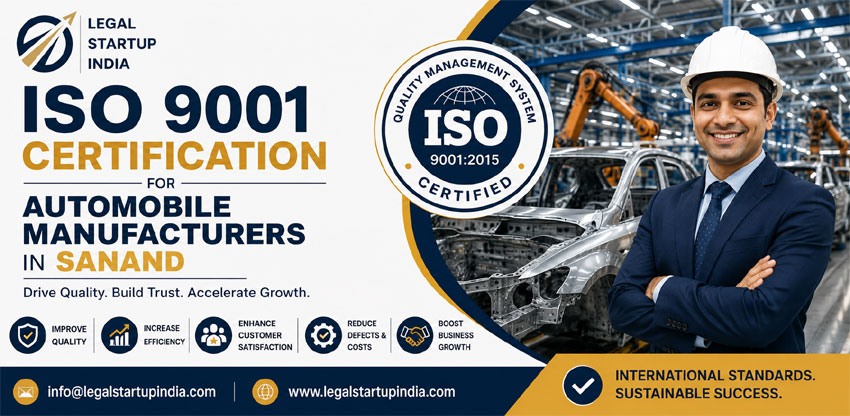 ISO 9001 Certification for Automobile Manufacturers in Sanand
  ISO 9001 Certification for Industrial Manufacturers in Sanand GIDC
  ISO 9001 Certification for Chemical Industries in Vatva GIDC
  ISO 9001 Certification for Manufacturing Companies in Vatva GIDC