
 08 Oct 2026
Admin ISO
51 Comment
08 Oct 2026
Admin ISO
51 Comment
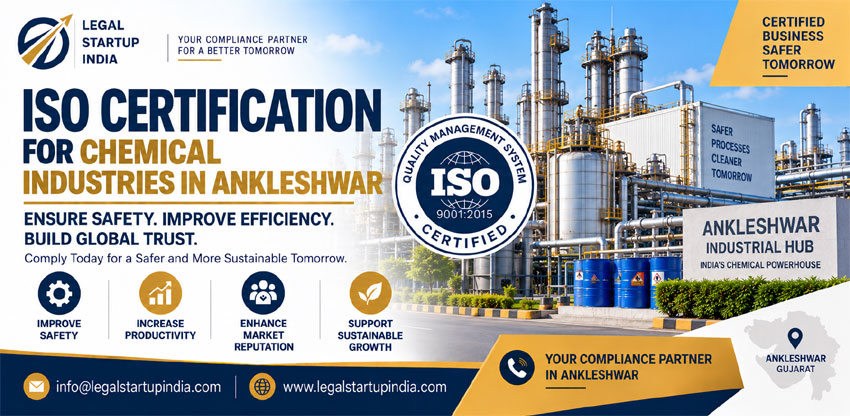
ISO Certification for Chemical Industries in Ankleshwar
Introduction
Ankleshwar is one of Gujarat's important industrial centres, with a strong presence of chemical manufacturing, pharmaceutical intermediates, dyes, pigments, specialty chemicals, and industrial processing units. For businesses operating in this competitive environment, maintaining consistent product quality, workplace safety, and environmental responsibility is essential for long-term growth.
ISO certification for chemical industries in Ankleshwar helps businesses establish systematic processes, manage operational risks, improve product quality, and demonstrate their commitment to recognised management standards. It can also strengthen customer confidence and help companies meet the qualification requirements of buyers, distributors, and industrial procurement teams.
For example, a chemical manufacturer supplying raw materials to a pharmaceutical company may need documented quality controls, batch traceability, and consistent testing procedures. An effective ISO management system can help the manufacturer organise these activities and demonstrate that its processes are properly controlled.
Legal Startup India helps businesses understand the applicable ISO standards, prepare documentation, and navigate the certification process according to their operational requirements.
Why Is ISO Certification Important for Chemical Industries in Ankleshwar?
Chemical manufacturing involves activities that require careful control, including handling raw materials, managing production processes, storing hazardous substances, monitoring product specifications, and controlling waste.
ISO certification provides a structured framework for managing these responsibilities. The right standard depends on the company's activities, customer expectations, and business objectives.
Commonly relevant standards include:
-
ISO 9001:2015 – Quality Management System: Helps chemical manufacturers improve product consistency, customer satisfaction, process control, and corrective action.
-
ISO 14001:2015 – Environmental Management System: Supports the identification and management of environmental impacts, including waste, emissions, and resource consumption.
-
ISO 45001:2018 – Occupational Health and Safety Management System: Helps organisations manage workplace hazards, improve safety procedures, and reduce occupational risks.
-
ISO 22000 – Food Safety Management System: May be relevant to businesses manufacturing chemicals or ingredients specifically intended for food-related applications, depending on their role in the supply chain.
ISO certification does not automatically replace statutory approvals, pollution control permissions, factory licences, or chemical safety obligations. Businesses must continue to comply with applicable Indian laws and regulatory requirements.
Key Benefits of ISO Certification for Chemical Industries
1. Better Product Quality and Consistency
ISO 9001 helps chemical manufacturers establish procedures for raw material inspection, production monitoring, laboratory testing, final product approval, and handling customer complaints.
These controls can reduce avoidable errors and improve consistency between batches.
2. Improved Environmental Management
Chemical units may generate wastewater, emissions, process residues, and other waste streams. ISO 14001 helps businesses identify significant environmental aspects, set improvement objectives, and monitor environmental performance.
This structured approach can support better resource management and environmental oversight, alongside applicable regulatory compliance.
3. Stronger Workplace Safety
ISO 45001 supports a systematic approach to identifying hazards, assessing risks, training employees, and improving emergency preparedness.
For a chemical processing unit, this may include procedures for chemical handling, appropriate protective equipment, equipment safety, and emergency response.
4. Greater Customer Confidence
Industrial buyers often evaluate suppliers based on quality controls, documentation, reliability, and recognised management systems. Holding relevant ISO certification can strengthen a company's credibility during vendor registration and supplier assessments.
Certification alone does not guarantee a purchase order, but it can help demonstrate that the organisation follows a documented management framework.
5. Improved Operational Efficiency
Documented procedures and clearly assigned responsibilities can help reduce process variation, unnecessary rework, material wastage, and repeated mistakes. Over time, these improvements may support more efficient operations and better customer service.
6. Support for Business Expansion
Chemical companies in Ankleshwar seeking new industrial customers, larger contracts, or export opportunities may find ISO certification useful when buyers specify particular management system requirements.
The applicable standard should always be selected according to the target market and customer's requirements.
Why Choose Legal Startup India?
Choosing the right certification approach is important for chemical businesses because their operations, risk profiles, and documentation requirements can differ considerably.
Legal Startup India assists businesses with the preparation and coordination required for ISO certification.
Reasons to work with Legal Startup India include:
-
Standard selection guidance: Understand which ISO standard is appropriate for your manufacturing, processing, laboratory, or supply activities.
-
Documentation support: Organise quality manuals, procedures, policies, registers, and other relevant records according to the selected standard.
-
Process guidance: Understand the stages involved in management system implementation, audit preparation, and certification.
-
Industry-focused assistance: Identify documentation and operational controls relevant to chemical industry activities.
-
Clear communication: Receive guidance on requirements, responsibilities, and the next steps involved in the process.
The exact scope, fees, timeline, and certification requirements depend on the business, the selected standard, and the certification body's assessment. Certification should be issued by an appropriate certification body following the required assessment, rather than being treated as a guaranteed document-only approval.
Step-by-Step ISO Certification Process in Ankleshwar
Chemical manufacturers can follow these steps to prepare for ISO certification.
Step 1: Identify the Applicable ISO Standard
Determine whether your primary requirement concerns quality management, environmental management, occupational health and safety, or another relevant system.
For example, a specialty chemical manufacturer may prioritise ISO 9001, while a business seeking a structured environmental management system may also consider ISO 14001.
Step 2: Define the Certification Scope
Identify the activities, products, processes, departments, and locations that will be covered by the management system.
The scope should accurately reflect the organisation's operations and must not make unsupported claims about its products or facilities.
Step 3: Conduct a Gap Analysis
Review current procedures against the applicable ISO standard. Identify missing documents, inconsistent practices, training needs, and operational controls that require improvement.
Step 4: Prepare the Required Documentation
Develop or update the relevant policies, procedures, work instructions, records, risk assessments, and monitoring arrangements.
For chemical industries, documentation may cover raw material handling, production controls, testing, storage, waste management, employee safety, and emergency preparedness, depending on the standard.
Step 5: Implement the Management System
Put the documented procedures into practice. Assign responsibilities, train employees, maintain records, and monitor whether the system is working as intended.
Step 6: Conduct an Internal Audit
Review the implementation of the management system to identify nonconformities and areas for improvement. Corrective actions should be recorded and verified.
Step 7: Complete Management Review
Management should evaluate the system's performance, audit findings, customer feedback, objectives, risks, and improvement opportunities, as applicable to the standard.
Step 8: Certification Audit and Final Decision
The certification body assesses the management system against the applicable standard. If nonconformities are identified, the organisation must address them according to the certification body's requirements.
Certification is granted only after the necessary assessment and certification decision have been completed.
Documents Required for ISO Certification
The documents required for ISO certification for chemical industries in Ankleshwar vary according to the standard, certification scope, and organisation's activities.
Commonly requested documents and records may include:
-
Company registration certificate or other applicable business registration documents.
-
Company PAN and GST registration details, where applicable.
-
Business address and facility details.
-
Description of manufacturing activities, products, and certification scope.
-
Organisation structure and employee responsibilities.
-
Quality, environmental, or occupational health and safety policy, as applicable.
-
Relevant process flowcharts, standard operating procedures, and work instructions.
-
Raw material inspection and finished product testing records, where relevant.
-
Equipment maintenance and calibration records, where applicable.
-
Employee training and competency records.
-
Internal audit reports and corrective action records.
-
Management review records.
-
Risk assessments and operational control records relevant to the chosen standard.
-
Applicable environmental permissions, monitoring records, safety records, and statutory documents, where required.
Not every document applies to every company. The final checklist should be prepared after reviewing the selected ISO standard and the organisation's actual operations.
Cost and Timeline for ISO Certification
The cost of ISO certification for chemical industries in Ankleshwar depends on the selected standard, number of employees, operational complexity, number of sites, certification scope, and certification body's fees.
The time required also varies according to the readiness of the management system, the availability of records, and whether corrective actions are needed after an audit.
Businesses should request a transparent quotation that distinguishes consultancy or documentation support from certification body charges. Avoid choosing a provider solely on the promise of the lowest price or immediate certification.
Frequently Asked Questions (FAQs)
1. Which ISO certification is best for chemical industries in Ankleshwar?
ISO 9001 is commonly considered by chemical manufacturers seeking to improve quality management. ISO 14001 may be suitable for environmental management, while ISO 45001 addresses occupational health and safety. The best combination depends on the company's activities and customer requirements.
2. How much does ISO certification cost for a chemical company in Ankleshwar?
The cost varies according to the ISO standard, company size, number of sites, audit requirements, and certification body. Request a business-specific quotation after defining the certification scope.
3. How long does it take to obtain ISO certification?
There is no single timeline for every chemical company. The duration depends on management system readiness, documentation, implementation, audit scheduling, and the resolution of any nonconformities.
4. Is ISO certification mandatory for all chemical industries in Ankleshwar?
ISO certification is not universally mandatory for every chemical manufacturer. However, particular customers, contracts, tenders, or sector-specific requirements may call for a relevant certification. Applicable statutory and environmental obligations remain separate.
5. Can a small chemical manufacturing unit apply for ISO certification?
Yes. Small and medium-sized chemical businesses can pursue an appropriate ISO management system. The system and its documentation should be proportionate to the organisation's size, activities, risks, and selected standard.
Conclusion: Get ISO Certification Support in Ankleshwar
ISO certification can help chemical manufacturers build more consistent processes, improve workplace safety, strengthen environmental management, and demonstrate their commitment to recognised business practices.
For companies operating in Ankleshwar's industrial environment, selecting the right standard and preparing the management system properly are important first steps. A structured approach can make the certification process clearer and help the business maintain its system after certification.
Looking for ISO certification for chemical industries in Ankleshwar? Contact Legal Startup India for guidance on standard selection, documentation, audit preparation, and certification requirements.
Email: info@legalstartupindia.com
Website: https://legalstartupindia.com/
Discuss your business activities and certification objectives with the team to understand the most suitable next steps for your organisation.
 ISO Certification for Brass Industries in Jamnagar
  ISO Certification for Ceramic Manufacturers in Morbi
  ISO Certification for Chemical Industries in Ankleshwar
  ISO Certification in Odhav GIDC
  ISO Certification in Jamnagar
  ISO Certification in Morbi
  ISO Certification in Vapi
  ISO Certification in Ankleshwar
  ISO Certification in Bharuch
  ISO 9001 Certification for Logistics Companies in Ahmedabad