
 24 Sep 2026
Admin ISO
51 Comment
24 Sep 2026
Admin ISO
51 Comment
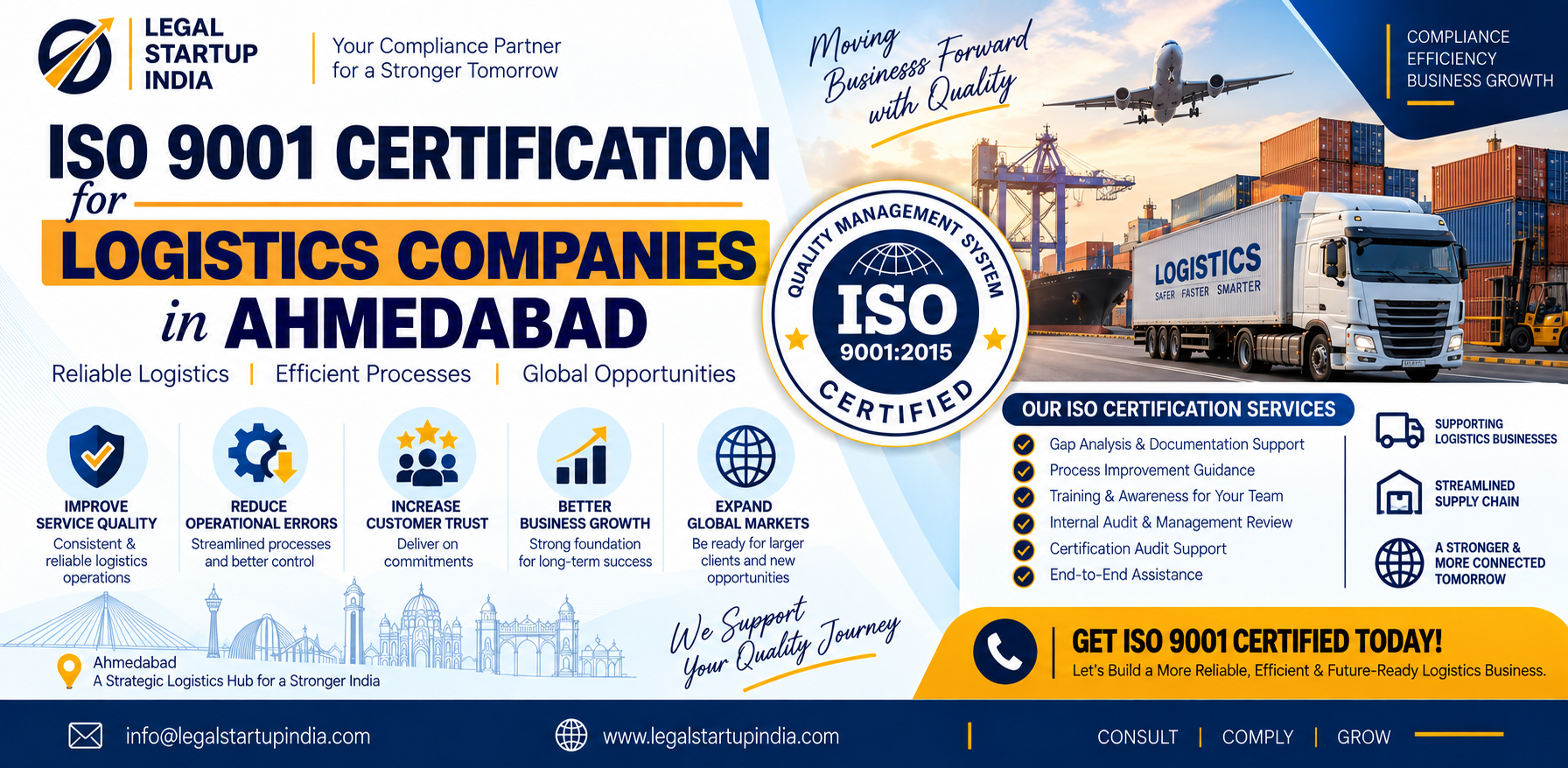
ISO 9001 Certification for Logistics Companies in Ahmedabad
Introduction
Ahmedabad is an important business and industrial centre in Gujarat, with logistics companies supporting manufacturing, e-commerce, pharmaceuticals, textiles, chemicals, food products, engineering goods, and exports. With customers expecting faster deliveries and better shipment visibility, logistics businesses need more than transportation capacity. They need reliable, measurable, and well-controlled processes.
This is where ISO 9001 Certification for Logistics Companies in Ahmedabad can add real business value.
ISO 9001 is an internationally recognized Quality Management System (QMS) standard. It provides a systematic framework for managing customer requirements, operational processes, supplier relationships, performance monitoring, nonconformities, and continual improvement.
For a logistics company, quality is not limited to whether a vehicle reaches its destination. It can involve accurate order processing, shipment handling, documentation, inventory coordination, route planning, delivery commitments, communication, complaint handling, and performance monitoring.
For example, if a logistics company repeatedly experiences delayed deliveries, damaged consignments, incorrect documentation, or poor communication, simply correcting individual shipments may not solve the underlying issue. A properly implemented QMS helps the organization identify process weaknesses and establish controls to prevent recurring problems.
Why Choose Us for ISO 9001 Certification in Ahmedabad?
At Legal Startup India, we understand that logistics operations can vary significantly from one business to another.
A freight-forwarding company may have different processes from a warehouse operator, transportation company, courier business, third-party logistics provider, or supply-chain service provider.
Our approach focuses on developing a QMS around the organization's actual activities.
Our ISO 9001 certification support includes:
- Initial consultation and requirement assessment
- QMS scope identification
- Gap analysis
- Process mapping
- Documentation support
- Quality policy and objective guidance
- Implementation assistance
- Employee awareness and training
- Internal audit support
- Management review preparation
- Corrective-action guidance
- Certification audit preparation
The aim is to help your logistics business create a practical quality system that supports daily operations rather than unnecessary paperwork.
Key Benefits of ISO 9001 Certification for Logistics Companies
1. Improve Delivery Reliability
Customers depend on logistics companies to move shipments according to agreed requirements.
ISO 9001 encourages organizations to establish controlled processes and monitor performance.
This can help logistics companies identify factors contributing to delays and develop corrective actions.
Relevant performance indicators may include:
- On-time delivery
- Shipment accuracy
- Transit-related issues
- Order processing time
- Customer complaints
- Delivery exceptions
- Documentation errors
2. Reduce Operational Errors
A logistics operation involves many interconnected activities.
A small mistake in order entry, shipment identification, documentation, loading, routing, or delivery information can create problems further down the supply chain.
A process-based QMS helps identify where controls are needed and who is responsible for each activity.
This can reduce avoidable errors and improve operational consistency.
3. Improve Customer Satisfaction
Logistics customers often care about more than price.
They want accurate information, dependable delivery, responsive communication, and quick resolution when something goes wrong.
ISO 9001 places strong emphasis on understanding customer requirements and monitoring customer satisfaction.
A structured complaint and feedback process can help management identify recurring service problems.
4. Better Supplier and Transporter Management
Many logistics companies work with external transporters, fleet partners, warehouse providers, customs agents, or other service providers.
Their performance can directly influence customer experience.
A structured supplier evaluation and monitoring process can help businesses assess relevant external providers using appropriate criteria such as reliability, service quality, responsiveness, and delivery performance.
5. Stronger Documentation and Traceability
Logistics businesses handle substantial operational information.
Depending on the service, records may include:
- Customer orders
- Transport documents
- Delivery records
- Shipment details
- Vehicle information
- Warehouse records
- Inspection records
- Customer complaints
- Supplier performance records
A QMS can help organizations establish appropriate controls for documented information and records.
6. Improve Employee Competence
Logistics quality depends heavily on employees.
Dispatch teams, warehouse personnel, drivers, supervisors, customer-service teams, documentation staff, and managers all influence service performance.
ISO 9001 encourages organizations to identify necessary competencies and ensure that employees performing relevant work are appropriately competent.
Training and awareness can therefore become a planned part of quality management.
7. Support Business Growth
A growing logistics company needs processes that can scale.
Without clear responsibilities and controlled processes, increasing shipment volumes can lead to inconsistent service.
ISO 9001 provides a structured framework that can help businesses formalize important processes while maintaining customer focus.
8. Build Customer and Vendor Confidence
ISO 9001 certification can strengthen the professional credibility of a logistics organization.
It may be useful when dealing with corporate customers, vendor qualification processes, supply-chain partners, or organizations that expect suppliers to demonstrate a structured quality-management approach.
Certification should, however, be represented accurately and should not be confused with statutory licenses or sector-specific approvals.
Step-by-Step ISO 9001 Certification Process
Step 1: Understand the Logistics Operation
The first stage is to understand your company's services, customers, locations, employees, suppliers, technology, operational processes, and business requirements.
This helps establish an appropriate QMS scope.
Step 2: Conduct a Gap Analysis
Existing processes are reviewed against applicable ISO 9001 requirements.
The assessment may identify gaps involving:
- Customer requirements
- Service processes
- Supplier management
- Performance monitoring
- Documentation
- Employee competency
- Customer feedback
- Nonconformity management
- Internal audits
- Management review
Step 3: Develop QMS Documentation
Documentation is prepared based on the organization's actual processes.
It may include:
- Quality policy
- Quality objectives
- QMS scope
- Process procedures
- Work instructions
- Supplier evaluation methods
- Customer complaint procedures
- Nonconformity and corrective-action procedures
- Internal audit arrangements
- Management review arrangements
Documentation should remain appropriate to the size and complexity of the logistics company.
Step 4: Implement the QMS
The defined processes are introduced into everyday operations.
Employees should understand their responsibilities and how their activities affect service quality.
For example, a dispatch employee may need to follow defined order-verification controls, while customer-service personnel may record and escalate complaints through an established process.
Step 5: Conduct an Internal Audit
An internal audit checks whether the QMS is implemented and operating effectively.
It also gives management an opportunity to identify weaknesses before the external certification assessment.
Step 6: Take Corrective Action
When nonconformities are identified, the organization determines suitable corrective actions.
Root-cause analysis is useful when problems are recurring because it focuses on preventing repetition rather than simply correcting the immediate issue.
Step 7: Management Review
Top management reviews QMS performance and determines whether changes or improvements are required.
The review can consider customer feedback, audit results, process performance, quality objectives, nonconformities, corrective actions, risks, and improvement opportunities.
Step 8: Certification Audit
A competent certification body evaluates the implemented QMS against the applicable ISO 9001 requirements.
After successfully completing the certification body's assessment process, the organization can receive ISO 9001 certification subject to the applicable certification rules.
Documents Required for ISO 9001 Certification
The exact documentation depends on the logistics company's activities and QMS scope.
Common documents and records may include:
- QMS scope
- Quality policy
- Quality objectives
- Organization and process information
- Customer requirement records
- Order and shipment records
- Delivery records
- Supplier and transporter evaluation records
- Service-performance records
- Employee training and competency records
- Equipment or vehicle-related records, where applicable
- Customer complaint records
- Nonconformity records
- Corrective-action records
- Internal audit records
- Management review records
- Monitoring and measurement records
The organization should also maintain any additional records required by applicable laws, contracts, customer requirements, or sector-specific regulations.
Who Can Benefit from ISO 9001 Certification?
ISO 9001 Certification for Logistics Companies in Ahmedabad can be relevant to:
- Logistics service providers
- Transportation companies
- Freight-forwarding businesses
- Third-party logistics providers
- Warehousing companies
- Supply-chain service providers
- Courier and delivery businesses
- Distribution companies
- Cargo-handling service providers
- E-commerce logistics companies
- Import-export logistics providers
The QMS scope should accurately describe the services and activities covered by certification.
Frequently Asked Questions
1. What is ISO 9001 Certification for Logistics Companies in Ahmedabad?
ISO 9001 Certification for Logistics Companies in Ahmedabad confirms that a logistics organization's Quality Management System has been assessed against applicable ISO 9001 requirements. It provides a framework for managing processes, customer requirements, performance, corrective actions, and continual improvement.
2. What are the benefits of ISO 9001 for logistics companies?
ISO 9001 can help logistics companies improve process consistency, reduce operational errors, strengthen supplier management, improve customer complaint handling, monitor service performance, and increase customer confidence.
3. What documents are required for ISO 9001 certification for logistics companies?
Common documentation may include the QMS scope, quality policy, quality objectives, customer and shipment records, supplier evaluations, training records, service-performance records, customer complaints, corrective actions, internal audits, and management reviews.
4. Is ISO 9001 useful for small logistics companies in Ahmedabad?
Yes. Small logistics businesses can use ISO 9001 to establish clearer responsibilities, standardize important processes, improve customer communication, monitor performance, and create a structured approach to continual improvement.
5. How can a logistics company get ISO 9001 certification in Ahmedabad?
A logistics company generally begins by defining its QMS scope, conducting a gap assessment, developing and implementing the QMS, conducting internal audits and management review, addressing identified issues, and completing an assessment through a competent certification body.
Conclusion
For a logistics company, quality is reflected in every stage of service—from receiving an order to coordinating transportation, managing documentation, tracking shipments, communicating with customers, and completing delivery.
ISO 9001 Certification for Logistics Companies in Ahmedabad provides a structured framework for bringing greater consistency and control to these activities.
A well-implemented QMS can help logistics businesses identify recurring problems, improve operational performance, strengthen customer relationships, and create a foundation for continual improvement.
At Legal Startup India, we can support your organization through the ISO 9001 certification journey, including gap assessment, QMS documentation, implementation guidance, internal audit preparation, management review support, and certification audit readiness.
Start Your ISO 9001 Certification Journey
📧 Email: info@legalstartupindia.com
🌐 Website: www.legalstartupindia.com
Ready to strengthen your logistics operations and demonstrate your commitment to quality? Contact Legal Startup India today to discuss your ISO 9001 certification requirements.
 1
1 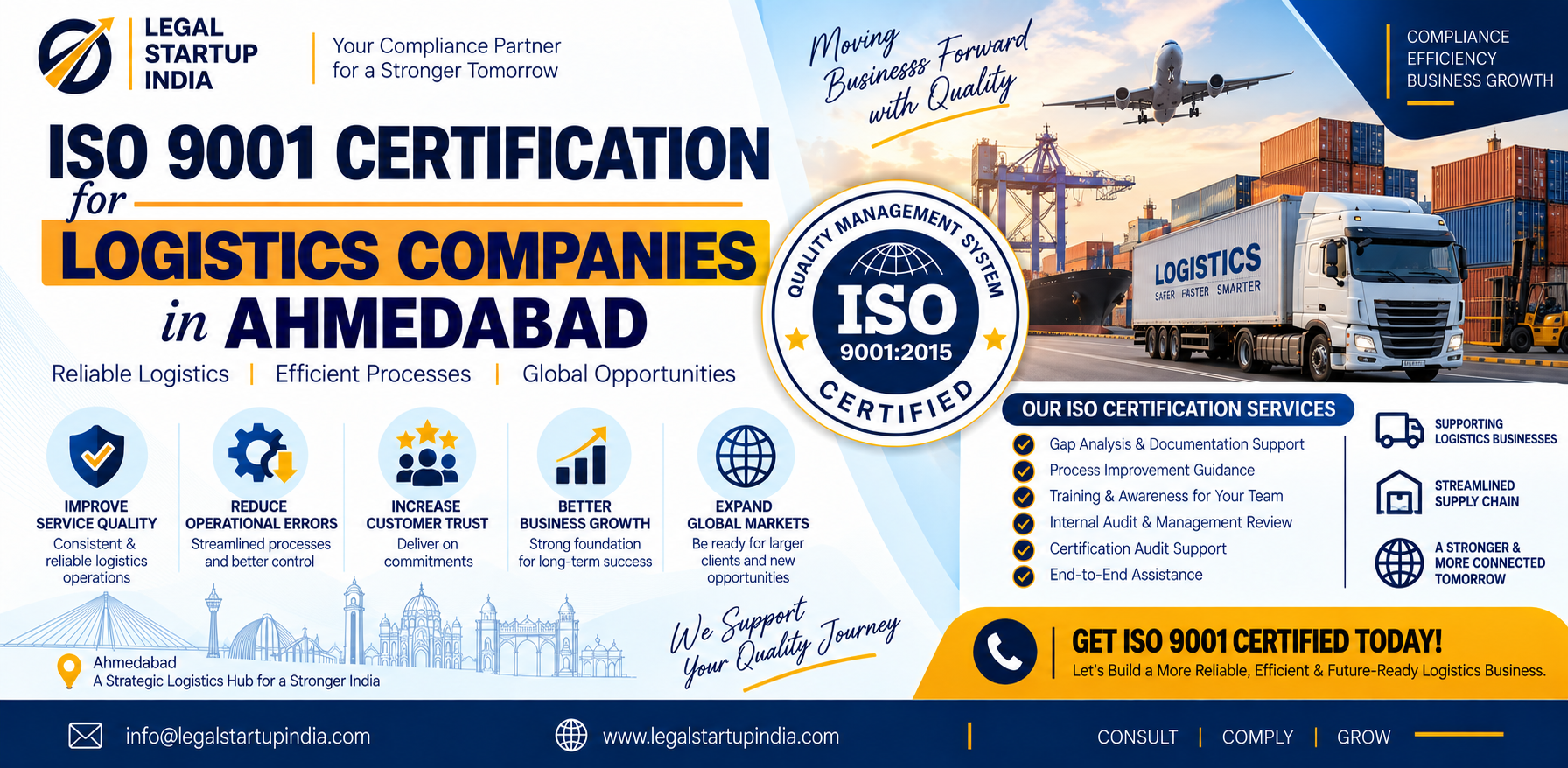 ISO 9001 Certification for Logistics Companies in Ahmedabad
 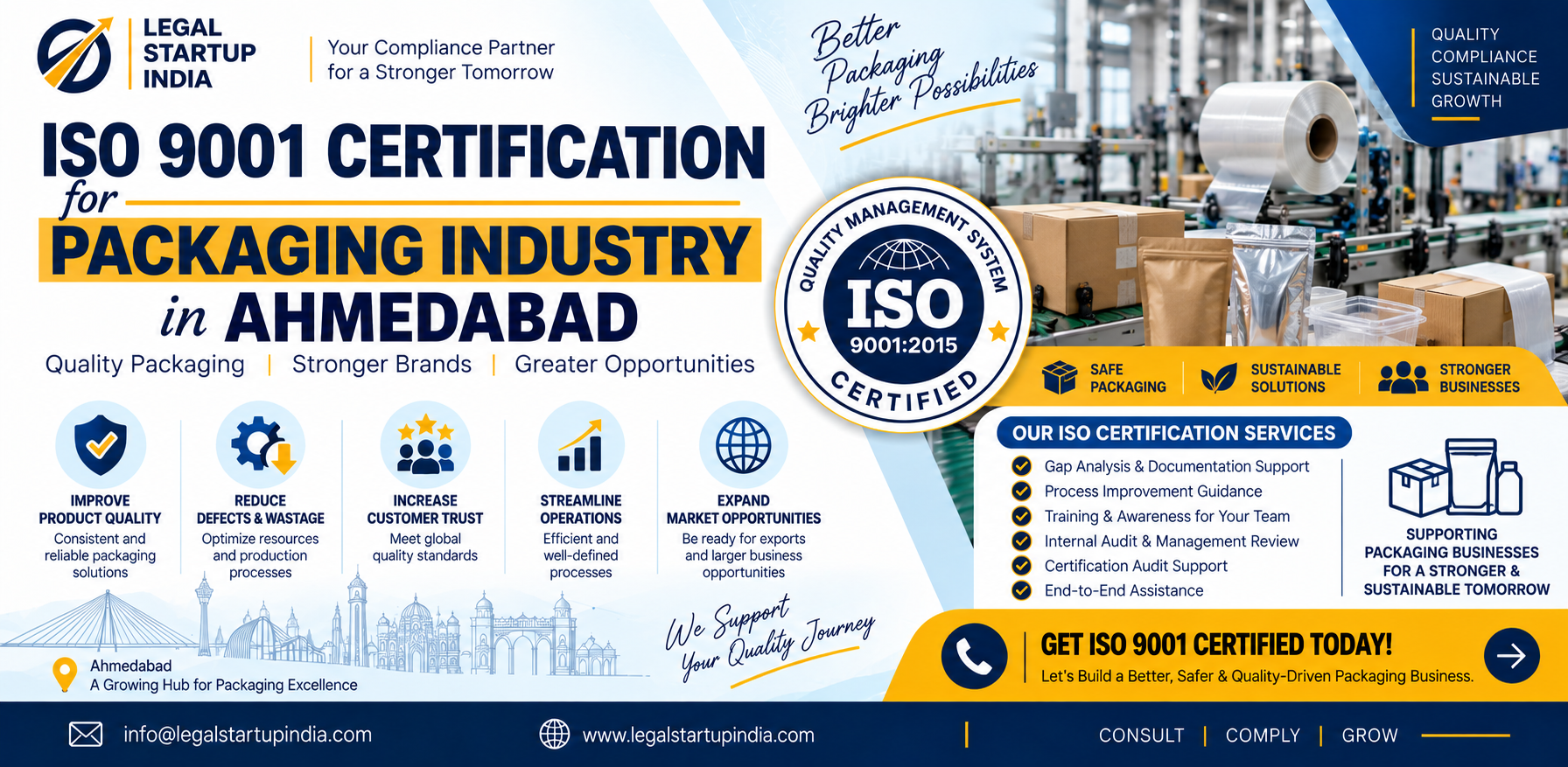 ISO 9001 Certification for Packaging Industry in Ahmedabad
 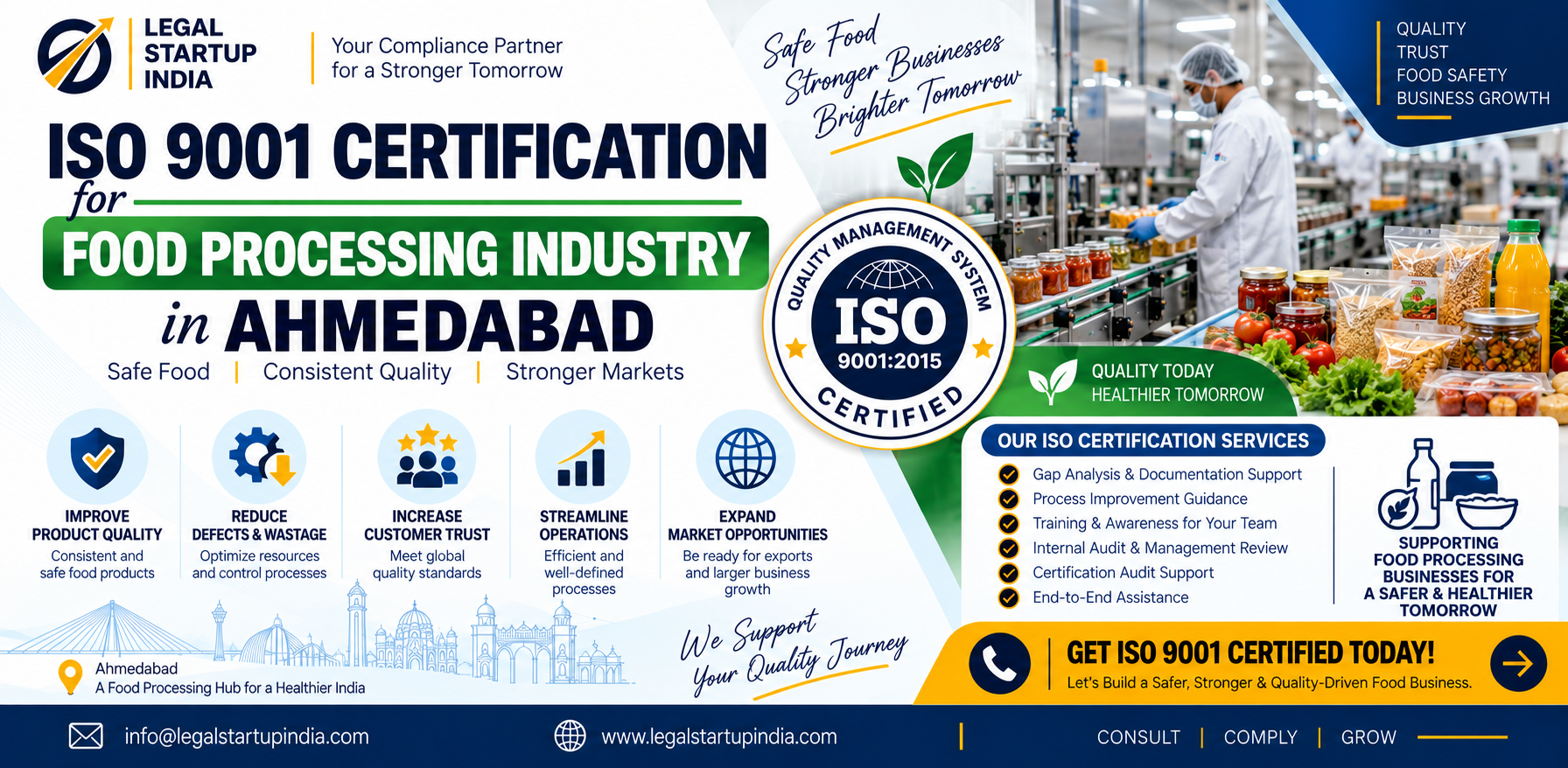 ISO 9001 Certification for Food Processing Industry in Ahmedabad
  ISO 9001 Certification for Plastic Manufacturing Companies in Ahmedabad
  ISO 9001 Certification for Automobile Industry in Sanand
  ISO 9001 Certification for Chemical Industry in Ahmedabad
  ISO 9001 Certification for Engineering Companies in Ahmedabad
  ISO 9001 Certification for Pharmaceutical Companies in Ahmedabad
  ISO 9001 Certification for Textile Industry in Ahmedabad