
 10 Sep 2026
Admin ISO
51 Comment
10 Sep 2026
Admin ISO
51 Comment
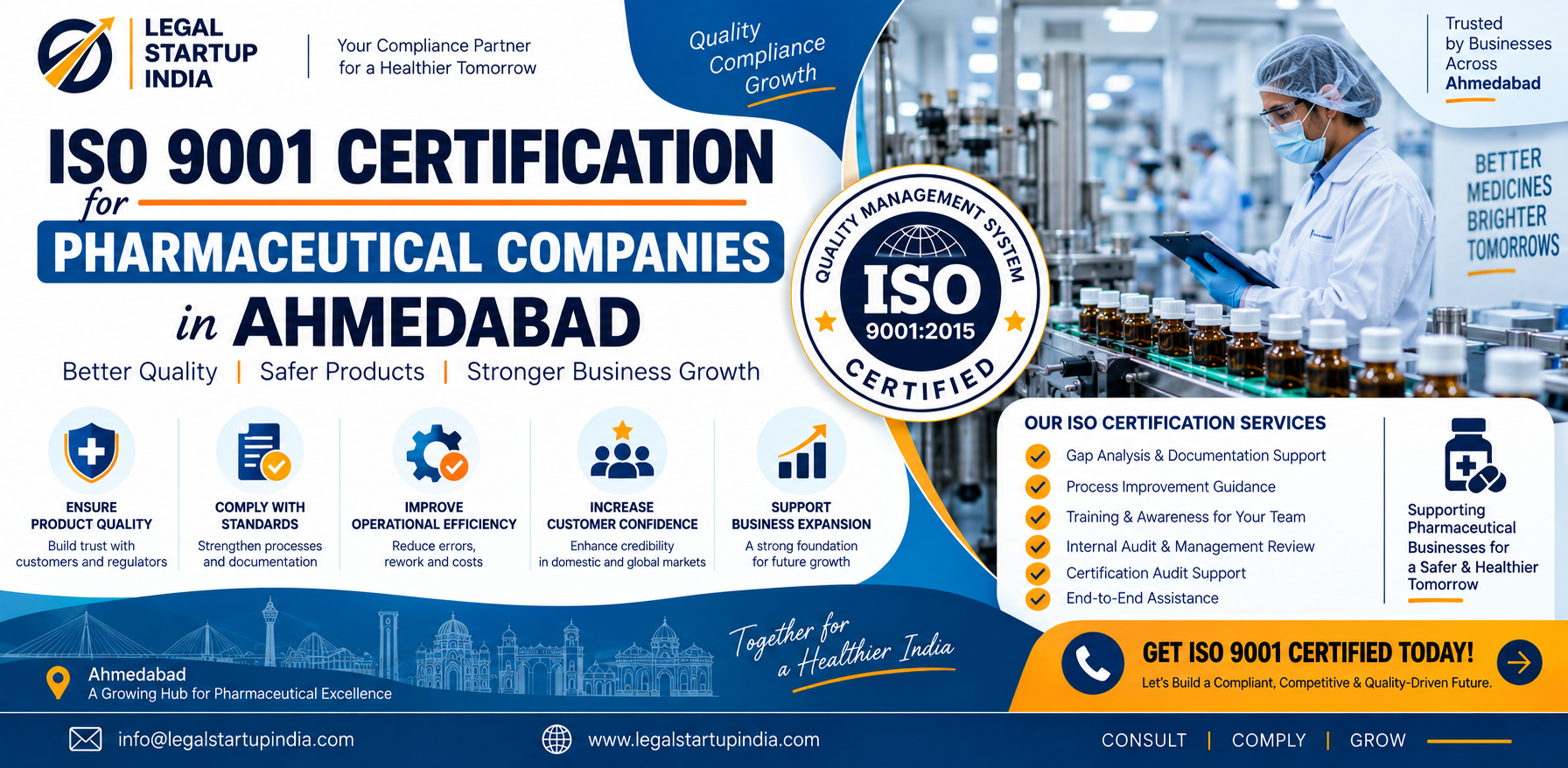
ISO 9001 Certification for Pharmaceutical Companies in Ahmedabad
Introduction
Ahmedabad has a strong pharmaceutical and healthcare manufacturing ecosystem, with companies involved in formulations, APIs, medical products, packaging, laboratory operations, and related services. In such a highly controlled industry, consistent processes and reliable quality systems are essential.
ISO 9001 Certification for Pharmaceutical Companies in Ahmedabad provides a structured framework for establishing and maintaining an effective Quality Management System (QMS).
ISO 9001 focuses on areas such as customer requirements, process control, risk-based thinking, performance evaluation, documented information, corrective action, and continual improvement. For pharmaceutical businesses, this approach can complement the organization's existing regulatory and quality requirements.
For example, if a pharmaceutical manufacturer experiences recurring documentation errors or inconsistent production records, simply correcting individual mistakes may not be enough. A systematic QMS encourages the company to examine the process, identify contributing causes, establish controls, train employees, and monitor whether the improvement is effective.
The objective is therefore not just to obtain an ISO certificate. The greater value lies in creating repeatable, controlled, and measurable business processes.
Why Choose Us for ISO 9001 Certification in Ahmedabad?
At Legal Startup India, we understand that pharmaceutical companies operate in an environment where documentation, process discipline, traceability, and quality are particularly important.
Our certification support is designed around the organization's actual activities rather than using a one-size-fits-all approach.
Our support can include:
- Understanding your organization's pharmaceutical operations
- Defining the appropriate QMS scope
- Gap assessment against applicable ISO 9001 requirements
- QMS documentation support
- Process and procedure development
- Implementation guidance
- Employee awareness and training support
- Internal audit preparation
- Management review support
- Corrective-action guidance
- Certification audit preparation
We focus on making ISO requirements easier for business owners and quality teams to understand and apply in everyday operations.
Important: ISO 9001 certification does not replace pharmaceutical regulatory requirements, GMP obligations, or other applicable statutory requirements. Companies should continue meeting all regulations and industry-specific requirements relevant to their activities.
Key Benefits of ISO 9001 Certification for Pharmaceutical Companies
1. Consistent Quality Management
Pharmaceutical operations depend on controlled and repeatable processes. ISO 9001 provides a systematic framework for managing those processes and monitoring their effectiveness.
2. Better Process Control
A pharmaceutical organization may have numerous interconnected activities, including purchasing, production, testing, storage, documentation, maintenance, and customer service.
A QMS helps define how these processes interact and how their performance can be monitored.
3. Reduction in Errors and Rework
Process-related mistakes can consume time and resources.
By identifying risks, monitoring process performance, investigating nonconformities, and implementing corrective actions, organizations can work toward reducing recurring problems.
4. Improved Customer Confidence
Pharmaceutical companies often work with distributors, healthcare businesses, institutional buyers, exporters, and other organizations that expect consistent quality and reliable processes.
ISO 9001 certification can provide additional evidence of a structured quality management approach.
5. Stronger Supplier Management
Quality can be affected by the performance of suppliers and external providers.
A QMS can help establish appropriate methods for supplier evaluation, selection, monitoring, and re-evaluation.
6. Better Documentation and Traceability
Documented information is an important part of an effective management system.
A structured approach can help organizations control relevant documents and maintain appropriate records relating to their processes.
7. Continual Improvement
ISO 9001 promotes an improvement-oriented approach.
Organizations can use audit findings, customer feedback, process data, nonconformities, and other information to identify opportunities for improvement.
8. Support for Business Expansion
A structured management system can help growing pharmaceutical businesses maintain greater consistency as their workforce, suppliers, products, customers, and operational complexity increase.
Step-by-Step ISO 9001 Certification Process
Step 1: Understand the Organization
The first stage involves understanding the company's activities, products, processes, locations, interested parties, and QMS requirements.
This information helps determine an appropriate certification scope.
Step 2: Conduct a Gap Assessment
Existing processes are reviewed against applicable ISO 9001 requirements.
Potential gaps may involve areas such as:
- Quality objectives
- Process controls
- Supplier management
- Employee competency
- Documentation
- Customer feedback
- Internal audits
- Corrective actions
- Performance monitoring
Step 3: Prepare QMS Documentation
The required documented information is developed according to the organization's actual operations.
Depending on the business, this may include:
- Quality policy
- Quality objectives
- QMS scope
- Process documentation
- Work instructions
- Supplier evaluation procedures
- Inspection and testing controls
- Document-control arrangements
- Nonconformity management
- Corrective-action procedures
- Internal audit process
- Management review process
Documentation should be practical and relevant to the organization's operations.
Step 4: Implement the QMS
The documented system is put into practice.
Relevant employees need to understand their responsibilities, follow applicable processes, and maintain required records.
Step 5: Conduct an Internal Audit
An internal audit evaluates whether the QMS has been implemented effectively and identifies areas requiring corrective action.
This is an important preparation stage before the external certification assessment.
Step 6: Correct Identified Issues
Where nonconformities or process weaknesses are identified, corrective actions are implemented.
The organization should consider the underlying causes and verify whether the corrective action has been effective.
Step 7: Management Review
Top management reviews the performance and suitability of the QMS.
The review can consider audit results, customer feedback, quality objectives, process performance, nonconformities, risks, opportunities, and improvement requirements.
Step 8: Certification Audit
A competent certification body assesses the organization's Quality Management System against applicable ISO 9001 requirements.
Successful completion of the certification body's process can lead to ISO 9001 certification.
Documents Required for ISO 9001 Certification
The exact documentation required depends on the pharmaceutical company's size, activities, QMS scope, processes, and risks.
Common documents and records may include:
- QMS scope
- Quality policy
- Quality objectives
- Process information
- Organizational responsibilities
- Production-related records
- Inspection and testing records
- Supplier evaluation records
- Purchasing information
- Equipment maintenance records
- Calibration records, where applicable
- Employee competency and training records
- Customer complaint records
- Nonconformity records
- Corrective-action records
- Internal audit records
- Management review records
- Monitoring and measurement records
Pharmaceutical organizations should also consider the relationship between their ISO 9001 QMS and other applicable regulatory, statutory, contractual, and industry requirements.
Who Can Benefit from ISO 9001 Certification?
ISO 9001 can be relevant to various pharmaceutical and pharmaceutical-support organizations in Ahmedabad, including:
- Pharmaceutical manufacturing companies
- API manufacturers
- Formulation manufacturers
- Pharmaceutical packaging companies
- Contract manufacturing organizations
- Medical product manufacturers
- Pharmaceutical suppliers
- Laboratory-related organizations
- Healthcare product businesses
- Pharmaceutical exporters
The certification scope should clearly represent the activities covered by the organization's Quality Management System.
Frequently Asked Questions
1. What is ISO 9001 Certification for Pharmaceutical Companies in Ahmedabad?
ISO 9001 Certification for Pharmaceutical Companies in Ahmedabad is certification of a pharmaceutical organization's Quality Management System against applicable ISO 9001 requirements. It provides a framework for process control, customer focus, performance evaluation, risk-based thinking, and continual improvement.
2. What are the benefits of ISO 9001 certification for pharmaceutical companies?
ISO 9001 can help pharmaceutical companies improve process consistency, strengthen supplier controls, reduce recurring process problems, improve documentation practices, increase customer confidence, and establish a structured approach to continual improvement.
3. What documents are required for ISO 9001 certification in pharmaceutical companies?
Documents and records vary according to the organization's QMS scope and activities. They may include quality objectives, process documentation, supplier records, production and inspection records, training records, customer complaints, corrective actions, internal audit records, and management review records.
4. Is ISO 9001 the same as GMP certification for pharmaceutical companies?
No. ISO 9001 and GMP are different frameworks with different purposes and requirements. ISO 9001 focuses on the Quality Management System, while applicable GMP requirements address pharmaceutical manufacturing and quality practices. An organization should determine which regulatory and industry requirements apply to its specific activities.
5. How can a pharmaceutical company get ISO 9001 certification in Ahmedabad?
The company can begin by defining its QMS scope, assessing existing processes, identifying gaps, developing and implementing the QMS, conducting internal audits and management review, addressing identified issues, and completing the certification audit conducted by a competent certification body.
Conclusion
In pharmaceutical manufacturing, quality cannot depend only on final inspection. It needs to be supported by controlled processes, competent employees, reliable suppliers, accurate documentation, effective monitoring, and continual improvement.
ISO 9001 Certification for Pharmaceutical Companies in Ahmedabad provides a structured framework for managing these areas and building a more consistent Quality Management System.
For pharmaceutical businesses looking to strengthen their processes, meet customer expectations, improve operational discipline, or demonstrate a formal quality-management approach, ISO 9001 can be a valuable strategic step.
If you are planning certification, Legal Startup India can assist you in understanding the requirements, preparing the QMS, implementing relevant processes, and getting ready for the certification assessment.
Start Your ISO 9001 Certification Journey
📧 Email: info@legalstartupindia.com
🌐 Website: www.legalstartupindia.com
Build stronger processes. Improve quality. Strengthen customer confidence. Contact Legal Startup India today to discuss your ISO 9001 certification requirements.
 ISO 9001 Certification for Automobile Industry in Sanand
  ISO 9001 Certification for Chemical Industry in Ahmedabad
  ISO 9001 Certification for Engineering Companies in Ahmedabad
 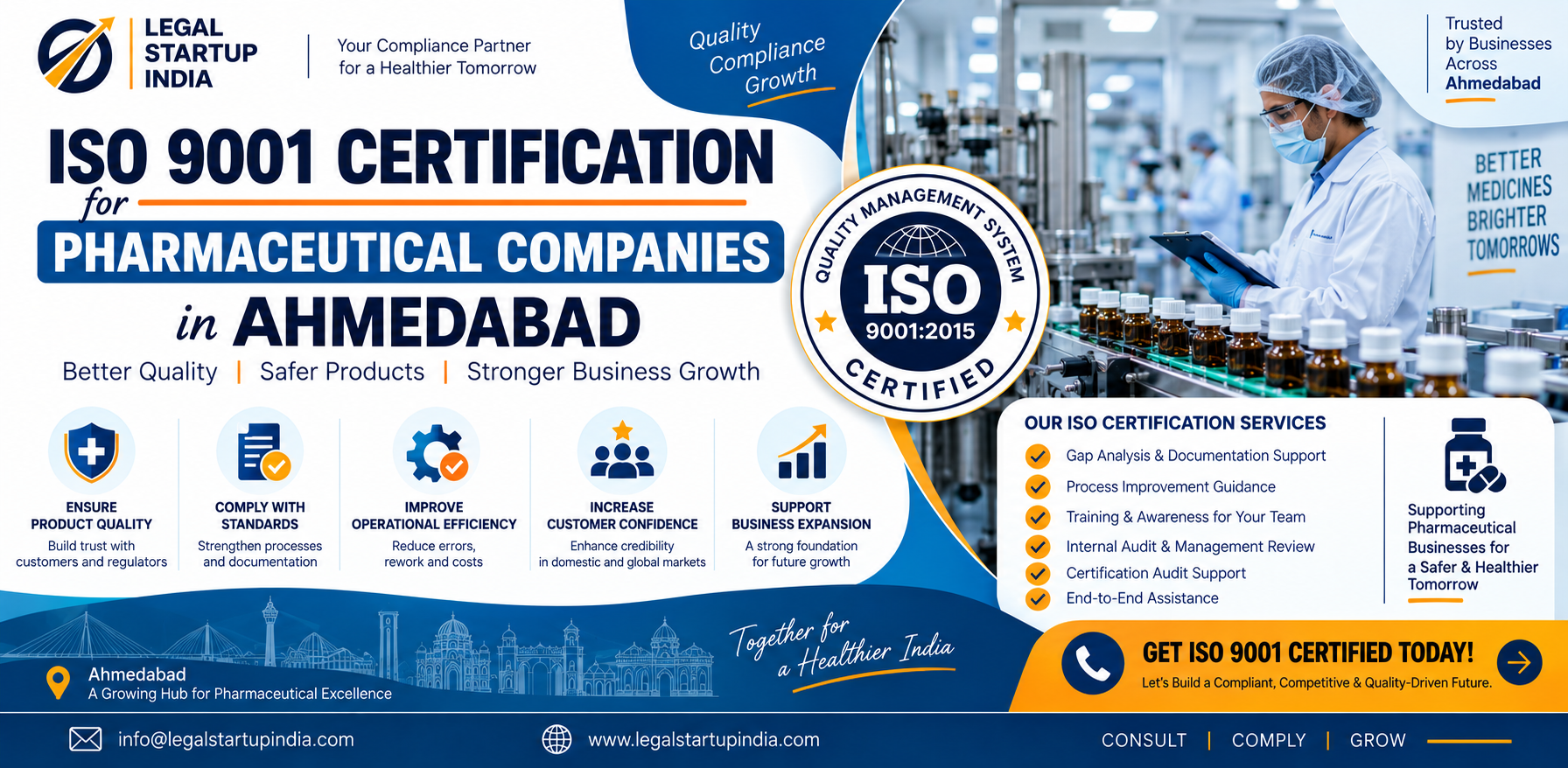 ISO 9001 Certification for Pharmaceutical Companies in Ahmedabad
  ISO 9001 Certification for Textile Industry in Ahmedabad
  ISO 9001 Certification for Manufacturing Industry in Ahmedabad
  ISO Certification for Pharmaceutical Companies in Ahmedabad
  ISO Certification for Textile Industries in Surat
  ISO Certification for Engineering Companies in Rajkot
  ISO Certification in Gandhinagar