
 04 Sep 2026
Admin ISO
51 Comment
04 Sep 2026
Admin ISO
51 Comment
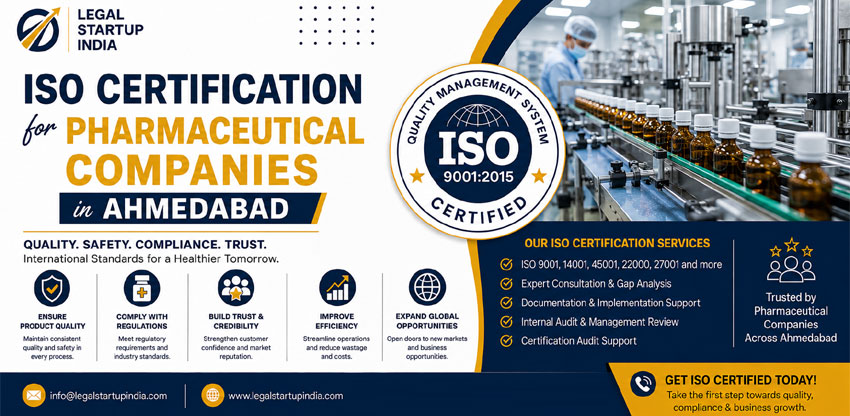
ISO Certification for Pharmaceutical Companies in Ahmedabad
Introduction
Ahmedabad and the surrounding industrial regions have a strong base of pharmaceutical manufacturers, formulation companies, laboratories, healthcare suppliers, contract manufacturers and allied businesses. For organizations operating in this sector, consistent processes and controlled quality are critical.
A pharmaceutical company cannot afford avoidable errors in areas such as raw materials, manufacturing, testing, packaging, storage or documentation. Customers, business partners and regulators expect organizations to maintain appropriate systems and controls.
This is where ISO Certification for Pharmaceutical Companies in Ahmedabad can provide meaningful business value.
ISO certification involves an independent assessment of a management system against the requirements of a particular ISO standard. The most suitable standard depends on the company's activities and objectives.
For example, ISO 9001 Certification can provide a framework for quality management, while ISO 14001 may be relevant to environmental management and ISO 45001 to occupational health and safety. Pharmaceutical organizations may also need to meet separate statutory, regulatory, GMP and product-specific requirements depending on their activities.
ISO certification does not replace pharmaceutical regulations or Good Manufacturing Practices. Instead, an appropriate management system can complement an organization's existing quality and compliance framework.
Legal Startup India helps pharmaceutical companies understand suitable ISO standards, prepare management-system documentation, implement relevant processes and prepare for certification audits.
Why Choose Legal Startup India?
Pharmaceutical organizations have different processes, risks and regulatory responsibilities. A generic documentation package may not reflect the actual way a pharmaceutical company operates.
Our approach starts with understanding your organization.
Our ISO Certification Support Includes
- Understanding your pharmaceutical business activities
- Identifying the appropriate ISO standard
- Defining the certification scope
- Reviewing existing processes
- Supporting management-system documentation
- Guiding implementation
- Assisting with employee awareness
- Preparing for internal audit requirements
- Supporting management review preparation
- Helping organize certification audit readiness
- Guiding corrective actions where applicable
For example, a pharmaceutical formulation manufacturer may need controls covering raw-material suppliers, production processes, quality checks, documentation, storage and customer requirements.
A pharmaceutical packaging or contract service provider may have a different scope and set of controls.
The management system should therefore be designed around the organization's actual operations.
Key Benefits of ISO Certification for Pharmaceutical Companies in Ahmedabad
1. Stronger Quality Management
A structured quality management system can help organizations establish consistent processes for monitoring, evaluation and improvement.
For companies implementing ISO 9001, this can support a systematic approach to customer requirements, process control, nonconformities and corrective action.
2. Better Process Consistency
Pharmaceutical manufacturing involves multiple interconnected activities.
Clearly defined processes and responsibilities can help reduce variation and improve operational consistency.
3. Improved Risk Management
Pharmaceutical businesses face operational risks involving materials, equipment, processes, suppliers, documentation and product quality.
A management system can provide a structured method for identifying and addressing relevant risks.
4. Greater Customer Confidence
Independent certification can strengthen credibility when dealing with corporate customers, suppliers, distributors and business partners.
However, ISO certification should not be represented as proof of regulatory approval or product safety unless the specific regulatory requirement has separately been satisfied.
5. Better Supplier Control
Pharmaceutical businesses often depend on suppliers for raw materials, packaging components, laboratory requirements and other inputs.
A structured supplier evaluation and monitoring process can help organizations make more consistent procurement decisions.
6. Improved Corrective Action
Quality problems should not simply be fixed once. Organizations need to understand why problems occurred and determine whether corrective actions are effective.
A management system encourages a systematic approach to nonconformity and improvement.
7. Support for Business Growth
As a pharmaceutical organization expands its products, employees, customers or locations, clearly defined processes can make operational management easier.
8. Stronger Internal Accountability
Documented responsibilities, procedures and performance objectives can help employees understand their roles and provide management with better visibility into operational performance.
Which ISO Certification Is Suitable for Pharmaceutical Companies?
There is no single ISO certification suitable for every pharmaceutical organization.
ISO 9001 – Quality Management System
ISO 9001 Certification is often relevant to pharmaceutical companies seeking a structured quality management system.
It can address areas such as:
- Customer requirements
- Process management
- Supplier evaluation
- Quality objectives
- Nonconforming outputs
- Corrective action
- Internal audits
- Management review
- Continual improvement
ISO 9001 should be implemented alongside applicable pharmaceutical regulations and quality requirements.
ISO 14001 – Environmental Management
Pharmaceutical manufacturing can involve energy use, water consumption, waste generation and environmental aspects associated with production.
ISO 14001 can provide a structured framework for identifying and managing relevant environmental aspects.
ISO 45001 – Occupational Health and Safety
Pharmaceutical facilities may involve chemicals, machinery, laboratory activities, material handling and other workplace hazards.
ISO 45001 can help establish a systematic occupational health and safety management approach.
ISO/IEC 27001 – Information Security
Pharmaceutical organizations may handle sensitive research information, customer data, clinical information, intellectual property and commercially confidential documents.
ISO/IEC 27001 can help organizations establish an information security management system based on identified risks and appropriate controls.
The right combination depends on the organization's business model and objectives.
Step-by-Step ISO Certification Process
Step 1: Understand the Organization and Scope
The first step is to identify the pharmaceutical company's products, services, locations, departments and activities that will be covered by certification.
Step 2: Select the Appropriate ISO Standard
The selected standard should match the organization's objectives.
For quality management, ISO 9001 may be relevant. Environmental, occupational health and safety, or information-security standards can be considered based on business requirements.
Step 3: Conduct a Gap Assessment
Existing processes are reviewed against the requirements of the selected ISO standard.
This identifies gaps in documentation, implementation, monitoring and controls.
Step 4: Prepare Documentation
Relevant policies, procedures, objectives, process controls and records are established.
For a pharmaceutical organization, documentation may relate to purchasing, supplier controls, production processes, inspection, storage, complaints, nonconformities and corrective actions.
Step 5: Implement the Management System
The system is put into practical use.
Employees should understand relevant responsibilities and follow applicable procedures and record-keeping requirements.
Step 6: Conduct Internal Audit
An internal audit checks whether the management system has been implemented effectively and whether applicable requirements are being followed.
Step 7: Management Review
Top management reviews system performance, objectives, audit results, customer feedback, risks, opportunities and improvement requirements.
Step 8: Certification Audit
An independent certification body conducts the external assessment.
The audit determines whether the management system conforms to the requirements of the selected standard.
Step 9: Corrective Action and Certification
If findings are identified, the organization addresses them through appropriate corrective actions.
After the applicable certification requirements have been met, the certification body can make the certification decision and issue the relevant certificate.
Documents Required for ISO Certification
The exact documentation depends on the selected ISO standard, certification scope and organization's activities.
Pharmaceutical companies may commonly need:
- Company registration details
- Organization structure
- Business activity information
- Certification scope
- Quality or relevant management policy
- Quality objectives
- Process procedures
- Supplier evaluation records
- Purchasing records
- Production-related records
- Inspection and testing records
- Equipment maintenance records
- Calibration records, where applicable
- Training and competency records
- Customer complaint records
- Nonconformity records
- Corrective-action records
- Internal audit reports
- Management review records
- Applicable statutory and regulatory information
The actual requirements should be determined according to the selected standard and the organization's scope.
Pharmaceutical companies should also maintain all applicable regulatory and GMP documentation separately where required. ISO certification should not be presented as a substitute for regulatory compliance.
ISO Certification Cost for Pharmaceutical Companies in Ahmedabad
The ISO certification cost for pharmaceutical companies in Ahmedabad varies according to individual requirements.
Factors that may affect the overall cost include:
- Selected ISO standard
- Number of employees
- Number of locations
- Certification scope
- Complexity of operations
- Existing management systems
- Audit duration
- Certification body
- Consultancy and implementation requirements
A pharmaceutical manufacturer with multiple departments and complex processes may have different certification requirements from a small pharmaceutical service provider.
For this reason, businesses should request a customized assessment and quotation rather than relying on a generic fixed price.
It is also important to distinguish between consultancy support and certification. ISO develops standards, while independent certification bodies conduct certification assessments and issue certificates when applicable requirements have been satisfied.
Who Can Benefit from ISO Certification?
ISO certification may be relevant to different pharmaceutical and healthcare-related organizations in Ahmedabad, including:
- Pharmaceutical manufacturers
- Formulation manufacturers
- Contract manufacturing organizations
- Pharmaceutical packaging companies
- Pharmaceutical distributors
- Laboratory service providers
- Healthcare product suppliers
- Pharmaceutical exporters
- Research-oriented organizations
- Pharmaceutical MSMEs
- Supporting manufacturing and service companies
The appropriate standard and certification scope should reflect the organization's actual activities.
ISO Certification and Pharmaceutical Compliance
This distinction is important for pharmaceutical businesses.
ISO certification is a management-system certification. Pharmaceutical companies may also be subject to applicable laws, regulations, GMP requirements, licensing conditions and customer-specific quality requirements.
Therefore, an organization should not assume that obtaining ISO certification automatically means it has fulfilled every pharmaceutical regulatory requirement.
A strong approach is to integrate the applicable ISO management-system principles with the organization's existing regulatory and quality framework.
Frequently Asked Questions
1. Which ISO certification is best for pharmaceutical companies in Ahmedabad?
ISO 9001 is often relevant for pharmaceutical organizations seeking a structured quality management system. Depending on their operations, companies may also consider ISO 14001, ISO 45001 or ISO/IEC 27001.
2. What are the benefits of ISO 9001 certification for pharmaceutical companies?
ISO 9001 can help pharmaceutical organizations establish structured processes for customer requirements, supplier management, process monitoring, nonconformity handling, corrective action, internal auditing and continual improvement.
3. Is ISO certification a replacement for GMP compliance?
No. ISO certification and pharmaceutical GMP requirements are different. A pharmaceutical company must continue to meet applicable regulatory, licensing and GMP requirements. ISO certification can complement an organization's management system but does not automatically establish regulatory compliance.
4. What documents are required for pharmaceutical ISO certification?
Documents may include policies, objectives, procedures, supplier records, production and inspection records, training records, internal audit reports, management review records and corrective-action records. Exact requirements depend on the selected ISO standard and certification scope.
5. How long does ISO certification take for a pharmaceutical company?
The timeline depends on the selected standard, company size, certification scope, existing management system, documentation and implementation readiness. A company with established processes may require less preparation than an organization developing a management system from scratch.
Conclusion
For pharmaceutical organizations, quality and process discipline are closely connected to customer confidence, operational efficiency and long-term business reputation.
ISO Certification for Pharmaceutical Companies in Ahmedabad can provide a structured management-system framework for improving processes, managing risks, controlling suppliers, monitoring performance and supporting continual improvement.
However, ISO certification should always be approached as part of a broader quality and compliance strategy. It should complement—not replace—applicable pharmaceutical regulations, GMP requirements and statutory obligations.
If your pharmaceutical company is considering ISO certification, Legal Startup India can help you understand the appropriate standard, prepare relevant documentation, implement the management system and prepare for the certification audit.
Start Your ISO Certification Journey
Get professional guidance tailored to your pharmaceutical business requirements.
Email: info@legalstartupindia.com
Website: www.legalstartupindia.com
Contact Legal Startup India to discuss your certification requirements and take the next step toward a structured management system.
 ISO 9001 Certification for Automobile Industry in Sanand
  ISO 9001 Certification for Chemical Industry in Ahmedabad
  ISO 9001 Certification for Engineering Companies in Ahmedabad
 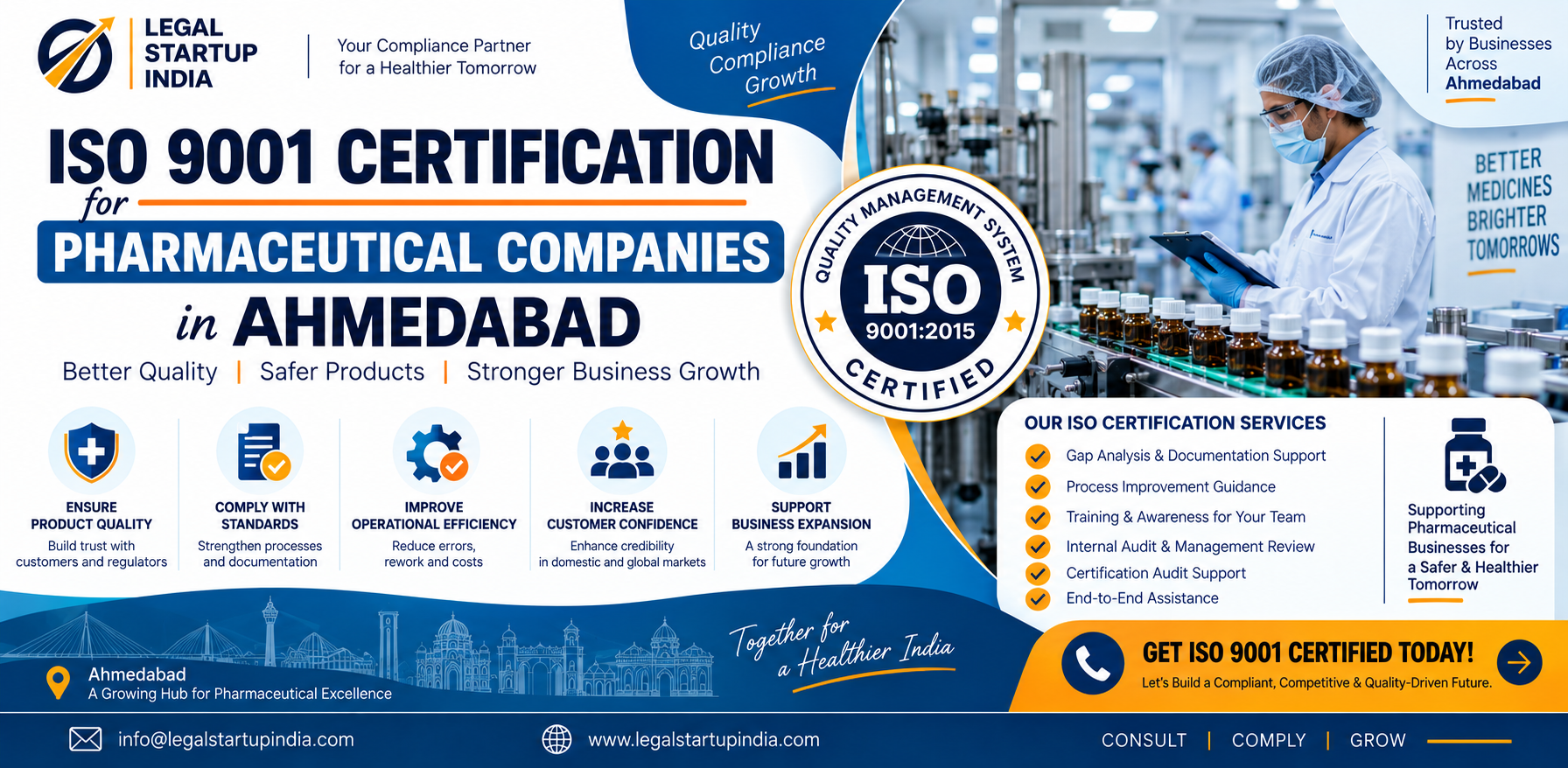 ISO 9001 Certification for Pharmaceutical Companies in Ahmedabad
  ISO 9001 Certification for Textile Industry in Ahmedabad
  ISO 9001 Certification for Manufacturing Industry in Ahmedabad
 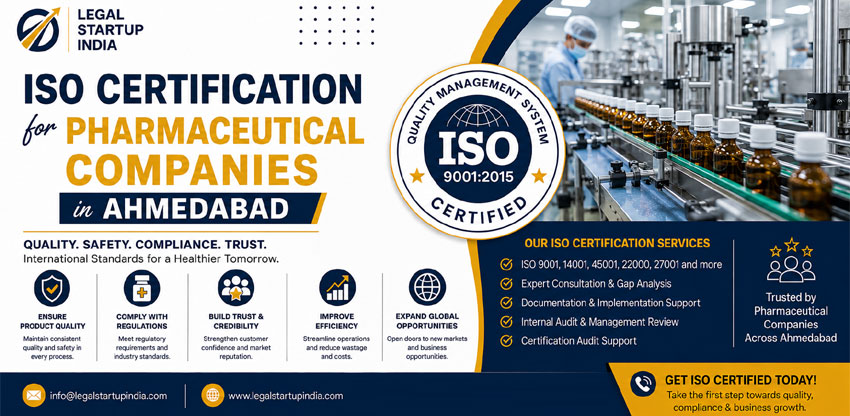 ISO Certification for Pharmaceutical Companies in Ahmedabad
  ISO Certification for Textile Industries in Surat
  ISO Certification for Engineering Companies in Rajkot
  ISO Certification in Gandhinagar