
 20 Sep 2026
Admin ISO
51 Comment
20 Sep 2026
Admin ISO
51 Comment
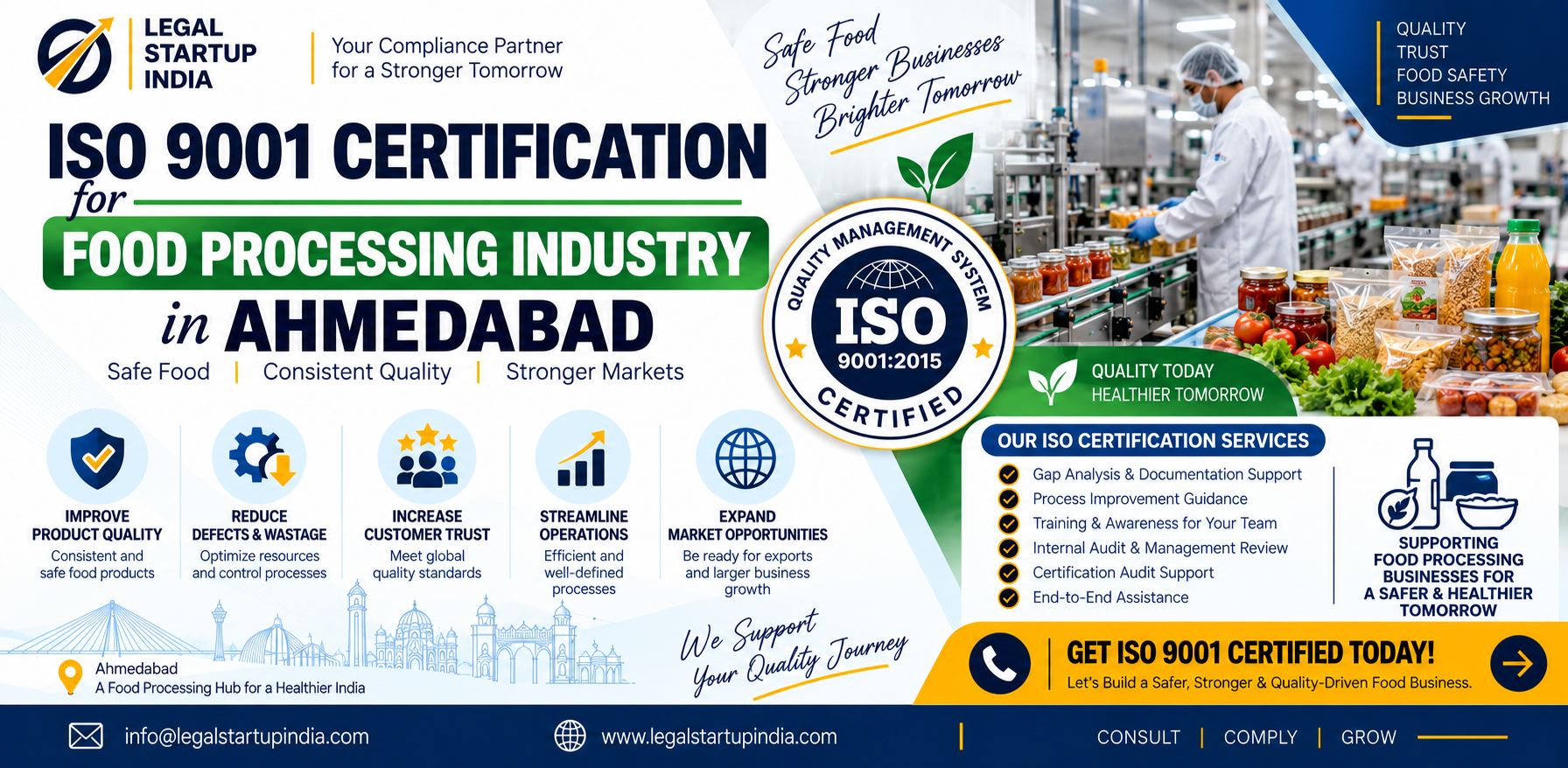
ISO 9001 Certification for Food Processing Industry in Ahmedabad
Introduction
Ahmedabad is home to a growing food-processing ecosystem covering snacks, spices, dairy products, packaged foods, beverages, grains, edible products, ready-to-eat foods, ingredients, and other food-related manufacturing activities. As competition increases, food businesses need reliable processes that deliver consistent quality from raw-material receipt to final dispatch.
This is where ISO 9001 Certification for Food Processing Industry in Ahmedabad can make a meaningful difference.
ISO 9001 is an internationally recognized Quality Management System (QMS) standard. It helps an organization establish controlled processes for understanding customer requirements, managing operations, monitoring performance, handling nonconformities, and continually improving its system.
For example, consider a food-processing company manufacturing packaged snacks. Variations in raw materials, production settings, weighing, packaging, labelling, or inspection can lead to inconsistent products. ISO 9001 encourages the business to identify these process risks, define suitable controls, monitor results, and take corrective action when problems occur.
Importantly, ISO 9001 is a quality management standard, not a food-safety certification by itself. Businesses may need additional food-safety, regulatory, customer, or product-specific requirements depending on their operations and market.
Why Choose Us for ISO 9001 Certification in Ahmedabad?
At Legal Startup India, we understand that every food-processing business operates differently.
A spice manufacturer may have different quality controls from a dairy processor, packaged-food manufacturer, beverage producer, or ready-to-eat food company.
Our certification support is therefore aligned with your actual processes and business requirements.
Our ISO 9001 support includes:
- Initial consultation
- QMS scope identification
- Gap assessment
- Documentation support
- Process mapping
- Quality objective development
- Implementation guidance
- Employee awareness and training
- Internal audit support
- Management review preparation
- Corrective-action guidance
- Certification audit preparation
The objective is to help create a QMS that employees can understand and use in everyday operations instead of building unnecessary paperwork.
Key Benefits of ISO 9001 Certification for Food Processing Industry
1. Consistent Product Quality
Food-processing businesses need consistency across production batches.
ISO 9001 supports a process-based approach that helps businesses identify quality requirements and establish appropriate controls throughout production.
This can be particularly useful for controlling factors such as:
- Product specifications
- Weight and quantity
- Packaging quality
- Processing parameters
- Labelling requirements
- Inspection activities
- Final-product conformity
2. Reduce Production Defects and Waste
Rejected batches, incorrect packaging, rework, material wastage, and customer complaints can increase operating costs.
A QMS provides a structured method for recording nonconformities, investigating their causes, implementing corrective actions, and checking whether those actions have worked.
This can help food manufacturers move from simply fixing problems to understanding why problems happen.
3. Better Raw-Material Management
Food manufacturers depend heavily on consistent raw materials and ingredients.
Depending on the business, these may include grains, spices, oils, dairy ingredients, flavours, additives, packaging materials, and other inputs.
Supplier evaluation and incoming-material controls can help businesses identify unsuitable materials before they affect production.
4. Improved Process Control
Food processing may involve several connected stages:
Purchasing → Receiving → Storage → Processing → Inspection → Packaging → Final Verification → Dispatch
A QMS helps an organization understand these processes and establish suitable controls, responsibilities, monitoring methods, and performance measures.
Better process visibility can make it easier to identify where quality problems originate.
5. Stronger Customer Satisfaction
Food-processing companies may supply distributors, retailers, restaurants, institutions, exporters, and large corporate buyers.
Each customer may have different specifications and expectations.
ISO 9001 places strong emphasis on understanding customer requirements and monitoring customer satisfaction. A systematic approach can help businesses manage complaints and feedback more effectively.
6. Better Supplier Performance
Supplier quality can directly affect finished-product quality.
A structured supplier evaluation process can help food-processing businesses assess relevant suppliers based on appropriate criteria such as quality, reliability, delivery performance, and consistency.
This creates a more informed approach to supplier management.
7. Employee Competence and Awareness
Quality is not the responsibility of the quality department alone.
Production operators, supervisors, warehouse employees, procurement teams, packaging staff, maintenance personnel, and management can all influence product quality.
ISO 9001 encourages organizations to identify required competencies and ensure that people performing relevant work are appropriately competent.
8. Improved Business Credibility
ISO 9001 certification can demonstrate that a food-processing organization has established a formal Quality Management System.
For businesses dealing with institutional buyers, large customers, vendor qualification processes, or export markets, this can strengthen their professional image.
However, certification should be presented accurately and should not be treated as proof of food safety unless the organization holds the relevant food-safety certification or approvals.
9. Continual Improvement
A mature QMS creates a cycle of reviewing performance, identifying weaknesses, taking corrective action, and looking for opportunities to improve.
For a growing food business, this can help quality management become part of normal business decision-making rather than an activity performed only before an audit.
Step-by-Step ISO 9001 Certification Process
Step 1: Understand Your Business
The first step is to understand your products, processes, customers, suppliers, employees, facilities, equipment, and organizational requirements.
The QMS scope should accurately reflect the activities covered by the certification.
Step 2: Conduct a Gap Assessment
Existing practices are compared with applicable ISO 9001 requirements.
Potential gaps may relate to:
- Customer requirements
- Quality objectives
- Production controls
- Supplier management
- Monitoring and measurement
- Employee competence
- Documented information
- Customer complaints
- Nonconformity management
- Internal audits
- Management review
Step 3: Develop QMS Documentation
Documentation is prepared according to the organization's actual processes.
Common QMS documents may include:
- Quality policy
- Quality objectives
- QMS scope
- Process procedures
- Work instructions
- Inspection procedures
- Supplier evaluation procedures
- Corrective-action procedures
- Internal audit process
- Management review arrangements
Not every organization needs the same level of documentation. The system should be appropriate to the company's size, complexity, and operations.
Step 4: Implement the QMS
The documented processes are put into practice.
Employees should understand their responsibilities and know how quality requirements apply to their work.
For instance, warehouse personnel may control receiving and storage records, while production staff follow defined processing controls and quality personnel monitor relevant inspection activities.
Step 5: Conduct an Internal Audit
Internal audits help determine whether the QMS is implemented and working effectively.
They also provide an opportunity to identify issues before the external certification assessment.
Step 6: Correct Identified Issues
Where nonconformities are found, the organization should take suitable corrective action.
Root-cause analysis can help prevent recurring problems instead of repeatedly treating the same symptom.
Step 7: Conduct Management Review
Top management reviews QMS performance and determines whether improvements or changes are required.
The review may consider customer feedback, audit results, quality objectives, process performance, nonconformities, corrective actions, risks, and improvement opportunities.
Step 8: Certification Audit
A certification body evaluates the organization's QMS against applicable ISO 9001 requirements.
If the certification body's assessment is successfully completed, the organization can receive its ISO 9001 certification subject to the certification body's applicable rules.
Documents Required for ISO 9001 Certification
Documentation varies according to the organization's activities and QMS scope.
Typical documents and records may include:
- QMS scope
- Quality policy
- Quality objectives
- Process information
- Customer requirement records
- Production records
- Incoming-material inspection records
- In-process inspection records
- Final inspection records
- Supplier evaluation records
- Purchase records
- Equipment maintenance records
- Calibration or verification records, where applicable
- Training and competency records
- Customer complaint records
- Nonconformity records
- Corrective-action records
- Internal audit records
- Management review records
- Monitoring and measurement records
Food businesses should also maintain any additional records required by applicable food laws, regulations, customer specifications, or other relevant standards.
Who Can Benefit from ISO 9001 Certification?
ISO 9001 Certification for Food Processing Industry in Ahmedabad can be relevant to:
- Food-processing manufacturers
- Packaged-food companies
- Spice manufacturers
- Snack manufacturers
- Dairy-processing businesses
- Beverage manufacturers
- Grain and cereal processors
- Ready-to-eat food manufacturers
- Food ingredient manufacturers
- Frozen-food businesses
- Private-label food manufacturers
- Food packaging and processing units
- Food exporters
The actual QMS scope should clearly identify the organization's certified activities.
Frequently Asked Questions
1. What is ISO 9001 Certification for Food Processing Industry in Ahmedabad?
ISO 9001 Certification for Food Processing Industry in Ahmedabad confirms that a food-processing organization's Quality Management System meets applicable ISO 9001 requirements. It provides a structured approach to process control, customer requirements, performance monitoring, corrective action, and continual improvement.
2. What are the benefits of ISO 9001 certification for food-processing companies?
ISO 9001 can help food-processing companies improve product consistency, control production processes, reduce defects and rework, strengthen supplier management, improve customer complaint handling, and establish a continual-improvement approach.
3. Is ISO 9001 a food-safety certification?
No. ISO 9001 focuses on quality management. It does not by itself certify that a food business meets every applicable food-safety or regulatory requirement. Businesses should identify the additional food-safety and statutory requirements relevant to their products and operations.
4. What documents are required for ISO 9001 certification in the food-processing industry?
Common QMS documentation can include quality policies and objectives, process information, production and inspection records, supplier evaluations, training records, equipment maintenance and relevant calibration records, customer complaints, corrective actions, internal audits, and management reviews.
5. How can a food-processing company get ISO 9001 certification in Ahmedabad?
The organization generally begins by defining its QMS scope, conducting a gap assessment, developing and implementing the QMS, conducting internal audits and management review, addressing identified issues, and completing the certification body's assessment process.
Conclusion
For a food-processing company, quality needs to be built into everyday operations. Consistent raw materials, controlled processes, trained employees, reliable suppliers, accurate inspections, and effective customer-feedback systems all contribute to a stronger business.
ISO 9001 Certification for Food Processing Industry in Ahmedabad provides a structured framework for managing these quality-related activities and supporting continual improvement.
Legal Startup India can assist your organization through the certification journey, from gap assessment and QMS documentation to implementation support, internal audit preparation, and certification audit readiness.
Start Your ISO 9001 Certification Journey
📧 Email: info@legalstartupindia.com
🌐 Website: www.legalstartupindia.com
Want to build a more consistent and quality-focused food-processing business? Contact Legal Startup India today to discuss your ISO 9001 certification requirements.
 1
1  ISO 9001 Certification for Logistics Companies in Ahmedabad
  ISO 9001 Certification for Packaging Industry in Ahmedabad
  ISO 9001 Certification for Food Processing Industry in Ahmedabad
  ISO 9001 Certification for Plastic Manufacturing Companies in Ahmedabad
  ISO 9001 Certification for Automobile Industry in Sanand
  ISO 9001 Certification for Chemical Industry in Ahmedabad
  ISO 9001 Certification for Engineering Companies in Ahmedabad
  ISO 9001 Certification for Pharmaceutical Companies in Ahmedabad
  ISO 9001 Certification for Textile Industry in Ahmedabad