
 22 Sep 2026
Admin ISO
51 Comment
22 Sep 2026
Admin ISO
51 Comment
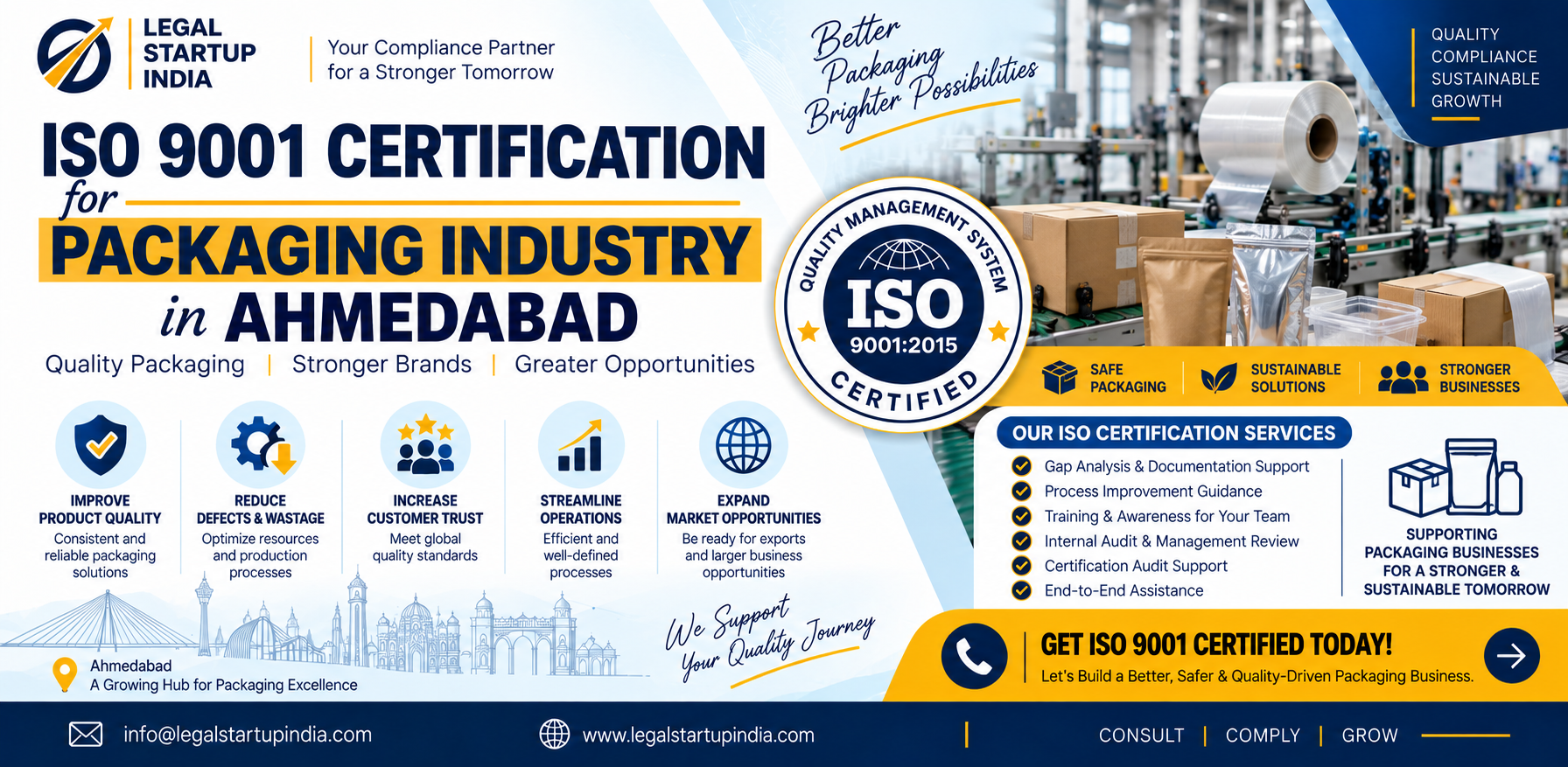
ISO 9001 Certification for Packaging Industry in Ahmedabad
Introduction
Ahmedabad has a diverse packaging manufacturing ecosystem serving food and beverage, pharmaceuticals, chemicals, textiles, consumer goods, engineering, e-commerce, and other industries. Packaging companies manufacture everything from flexible packaging and corrugated boxes to plastic containers, labels, films, pouches, cartons, and industrial packaging products.
In such a competitive market, customers expect more than attractive packaging. They want consistent quality, accurate specifications, reliable delivery, controlled production, and quick response to complaints.
This makes ISO 9001 Certification for Packaging Industry in Ahmedabad highly relevant for businesses looking to establish a systematic Quality Management System (QMS).
ISO 9001 is an internationally recognized quality management standard. It provides a framework for understanding customer requirements, controlling operational processes, monitoring performance, addressing nonconformities, and continually improving the organization.
Consider a packaging manufacturer producing thousands of printed pouches every day. If colour variation, incorrect dimensions, sealing defects, printing errors, or material inconsistencies are repeatedly found, simply rejecting defective products does not solve the underlying problem. A properly implemented QMS encourages the company to identify why the problem occurred and improve the process that caused it.
Therefore, ISO 9001 is not merely about obtaining a certificate. Its practical purpose is to create more controlled, consistent, and customer-focused business processes.
Why Choose Us for ISO 9001 Certification in Ahmedabad?
At Legal Startup India, we understand that packaging businesses can have very different manufacturing processes.
A corrugated-box manufacturer may need different controls from a flexible-packaging company, label manufacturer, plastic-container producer, or pharmaceutical packaging supplier.
Our approach is therefore based on the organization's actual activities and QMS requirements.
Our ISO 9001 certification support includes:
- Understanding your packaging operations
- Defining the QMS scope
- Conducting a gap assessment
- QMS documentation support
- Process and procedure development
- Implementation guidance
- Employee awareness and training
- Internal audit preparation
- Management review support
- Corrective-action guidance
- Certification audit preparation
We aim to make the Quality Management System practical for your business rather than creating unnecessary documentation.
The result should be a system that your employees can actually use in daily operations.
Key Benefits of ISO 9001 Certification for Packaging Industry
1. Improve Packaging Product Quality
Packaging products often need to meet precise requirements relating to dimensions, thickness, strength, printing, sealing, colour, material, finish, weight, and functionality.
ISO 9001 helps organizations establish appropriate controls over processes that influence product conformity.
This can improve consistency between production batches and help reduce avoidable quality variations.
2. Reduce Defects, Waste and Rework
Packaging production can generate significant costs when defective products require rework or disposal.
A systematic QMS helps businesses identify nonconformities, investigate their causes, implement corrective actions, and evaluate their effectiveness.
This can support efforts to reduce:
- Production defects
- Material wastage
- Printing errors
- Incorrect dimensions
- Sealing problems
- Rework
- Customer complaints
- Product rejection
3. Better Raw-Material Control
Packaging manufacturers may purchase paper, paperboard, polymers, films, inks, adhesives, laminates, corrugated sheets, plastic resins, labels, and other materials.
Poor-quality or inconsistent inputs can directly affect finished products.
A structured supplier and incoming-material control process can help identify problems earlier and reduce the risk of unsuitable materials entering production.
4. Stronger Production Process Control
Packaging manufacturing can involve multiple processes, such as:
- Customer requirement review
- Production planning
- Procurement
- Incoming inspection
- Printing
- Lamination
- Cutting
- Folding
- Pouch making
- Extrusion
- Moulding
- Corrugation
- Gluing
- Final inspection
- Packaging and dispatch
ISO 9001 encourages a process-based approach, helping businesses determine where controls and performance monitoring are required.
5. Improve Customer Satisfaction
Packaging companies often work with demanding B2B customers.
A food company may require specific packaging dimensions and print quality. A pharmaceutical customer may have tightly defined packaging specifications. An e-commerce company may prioritize strength and delivery reliability.
A QMS helps an organization systematically understand customer requirements, monitor feedback, manage complaints, and identify improvement opportunities.
6. Better Supplier Performance
External suppliers can significantly influence packaging quality.
ISO 9001 supports a systematic approach to evaluating and monitoring relevant externally provided products, processes, and services.
This can help businesses make supplier performance a measurable part of their quality-management process.
7. Improve Employee Competence
Packaging machinery and quality-control activities often require trained employees.
ISO 9001 encourages organizations to determine the necessary competence for people performing work that affects QMS performance and product conformity.
Training and competency records can also provide useful evidence of employee development.
8. Build Business Credibility
ISO 9001 certification demonstrates that an organization has established a formal Quality Management System.
For packaging companies looking to work with larger organizations, expand their B2B customer base, participate in vendor qualification processes, or enter new markets, this can strengthen professional credibility.
9. Encourage Continual Improvement
A good QMS does not stop after certification.
Organizations can use customer feedback, audit results, production data, nonconformities, corrective actions, and quality objectives to identify opportunities for improvement.
This creates a practical cycle of measure → identify → correct → improve.
Step-by-Step ISO 9001 Certification Process in Ahmedabad
Step 1: Understand the Organization
The first stage involves understanding your packaging products, processes, customers, suppliers, workforce, facilities, equipment, and business environment.
This information helps establish the appropriate QMS scope.
Step 2: Conduct a Gap Assessment
Existing business practices are reviewed against applicable ISO 9001 requirements.
The assessment may identify gaps related to:
- Customer requirements
- Quality objectives
- Production controls
- Supplier management
- Inspection and testing
- Measuring equipment
- Employee competency
- Documented information
- Customer complaints
- Nonconformity management
- Internal audits
Step 3: Prepare QMS Documentation
Documentation is developed around the company's actual processes.
Depending on the organization, this may include:
- Quality policy
- Quality objectives
- QMS scope
- Process documentation
- Production procedures
- Work instructions
- Inspection procedures
- Supplier evaluation procedures
- Nonconformity controls
- Corrective-action processes
- Internal audit procedures
- Management review arrangements
The documentation should be appropriate to the company's size, operations, and complexity.
Step 4: Implement the QMS
The documented processes are implemented in daily operations.
Employees should understand what is expected of them and how their work contributes to product quality and customer satisfaction.
For example, production employees, quality inspectors, procurement staff, stores personnel, maintenance teams, sales staff, and management may all have specific QMS responsibilities.
Step 5: Conduct an Internal Audit
Internal auditing provides an opportunity to check whether the QMS is being followed and whether processes are working as intended.
It can also identify areas that need corrective action before the certification audit.
Step 6: Address Nonconformities
If weaknesses or nonconformities are identified, appropriate corrective actions are taken.
Where necessary, the organization should investigate the root cause so that the same issue does not repeatedly occur.
Step 7: Management Review
Top management reviews the performance and suitability of the QMS.
Typical inputs can include:
- Customer feedback
- Quality objectives
- Process performance
- Audit results
- Nonconformities
- Corrective actions
- Risks and opportunities
- Improvement opportunities
Step 8: Certification Audit
A competent certification body assesses the implemented Quality Management System against applicable ISO 9001 requirements.
Successful completion of the certification body's assessment process can lead to ISO 9001 certification.
Documents Required for ISO 9001 Certification
The exact documents and records depend on the packaging company's products, processes, size, risks, and QMS scope.
Common examples include:
- QMS scope
- Quality policy
- Quality objectives
- Organizational responsibilities
- Customer requirement records
- Production records
- Incoming-material inspection records
- In-process inspection records
- Final inspection records
- Supplier evaluation records
- Purchase records
- Equipment maintenance records
- Calibration or verification records, where applicable
- Employee training and competency records
- Customer complaint records
- Nonconformity records
- Corrective-action records
- Internal audit records
- Management review records
- Monitoring and measurement records
The objective is not to create paperwork for its own sake. Documentation should help employees perform processes consistently and provide evidence that important controls are working.
Who Can Benefit from ISO 9001 Certification?
ISO 9001 Certification for Packaging Industry in Ahmedabad can be relevant to:
- Flexible packaging manufacturers
- Corrugated box manufacturers
- Plastic packaging companies
- Pharmaceutical packaging manufacturers
- Food packaging manufacturers
- Paper packaging companies
- Carton manufacturers
- Label manufacturers
- Pouch manufacturers
- Industrial packaging manufacturers
- Packaging material suppliers
- Printed packaging manufacturers
- Packaging exporters
- Small and medium-sized packaging businesses
The QMS scope should accurately represent the products and activities covered by the certification.
Internal Linking Suggestions
For stronger topical authority and user navigation, consider linking this article to relevant Legal Startup India pages such as:
- ISO 9001:2015 Certification —
https://legalstartupindia.com/iso-9001-2015 - ISO 14001:2015 Certification —
https://legalstartupindia.com/iso-14001-2015 - ISO 45001:2018 Certification —
https://legalstartupindia.com/iso-45001-2018 - Relevant ISO Certification in Ahmedabad service page
- Other manufacturing-industry ISO certification articles
Use descriptive anchor text naturally rather than repeatedly inserting the exact target keyword.
Frequently Asked Questions
1. What is ISO 9001 Certification for Packaging Industry in Ahmedabad?
ISO 9001 Certification for Packaging Industry in Ahmedabad confirms that a packaging organization's Quality Management System meets applicable ISO 9001 requirements. It provides a structured framework for process control, customer focus, performance evaluation, corrective action, and continual improvement.
2. What are the benefits of ISO 9001 certification for packaging companies?
ISO 9001 can help packaging companies improve product consistency, reduce defects and rework, strengthen supplier management, improve production controls, address customer complaints systematically, and support continual improvement.
3. What documents are required for ISO 9001 certification for packaging companies?
Requirements depend on the organization's operations and QMS scope. Common documents and records can include quality objectives, production and inspection records, supplier evaluations, equipment maintenance records, calibration or verification records where applicable, training records, customer complaints, corrective actions, internal audits, and management reviews.
4. Is ISO 9001 useful for small packaging manufacturers in Ahmedabad?
Yes. Small and medium-sized packaging manufacturers can use ISO 9001 to establish clearer processes, improve quality controls, manage suppliers, define employee responsibilities, monitor customer feedback, and create a structured improvement system.
5. How can a packaging company get ISO 9001 certification in Ahmedabad?
A packaging company can begin by defining its QMS scope, reviewing existing processes, conducting a gap assessment, developing and implementing the QMS, conducting internal audits and management review, addressing identified issues, and completing an assessment by a competent certification body.
Conclusion
Packaging quality affects much more than the appearance of a finished product. It can influence customer satisfaction, production costs, material consumption, delivery performance, and long-term business relationships.
ISO 9001 Certification for Packaging Industry in Ahmedabad provides a structured approach to managing these quality-related processes.
From raw-material purchasing and production to inspection, supplier management, customer feedback, and corrective action, a properly implemented QMS can bring greater consistency and accountability to a packaging business.
If you are planning ISO 9001 certification for your packaging company, Legal Startup India can support you with gap assessment, QMS documentation, implementation guidance, internal audit preparation, management review support, and certification audit readiness.
Get Started with ISO 9001 Certification
📧 Email: info@legalstartupindia.com
🌐 Website: www.legalstartupindia.com
Build better processes, improve packaging quality, and strengthen customer confidence. Contact Legal Startup India today to start your ISO 9001 certification journey.
 1
1  ISO 9001 Certification for Logistics Companies in Ahmedabad
  ISO 9001 Certification for Packaging Industry in Ahmedabad
  ISO 9001 Certification for Food Processing Industry in Ahmedabad
  ISO 9001 Certification for Plastic Manufacturing Companies in Ahmedabad
  ISO 9001 Certification for Automobile Industry in Sanand
  ISO 9001 Certification for Chemical Industry in Ahmedabad
  ISO 9001 Certification for Engineering Companies in Ahmedabad
  ISO 9001 Certification for Pharmaceutical Companies in Ahmedabad
  ISO 9001 Certification for Textile Industry in Ahmedabad